Write on, my friends.

I had a conversation with a friend the other night. Someone who also wants to write. Well, does write, she just hasn’t finished anything. I sympathize. There are times when, no matter how hard you try, the action in your story just comes to a screeching halt. I’m actually at that point in my current project. Seriously, if I’ve managed a paragraph in the last month, it’s probably an exaggeration. It’s true I’ve been stretching myself thin here in Bloglandia, with the collaborative work I’m writing with Fictional Kevin and my other weekly features. Nevertheless, I need to move forward with the next book in my novel series. But I’m stuck… Sound familiar?

When I’ve struggled like this in the past, I’ve found a way to get through it. Ready for some brilliant advice? Write nonsense. Yep. Even if it totally sucks, doesn’t move your plot along, bogs your characters down… you get the idea, you’re still writing. And sometimes that’s all we can do – keep going. So for example, describe your character’s grocery list, have them watch TV, make tea and read their own books. Maybe have them engage in mundane household activities or meet one of the other characters for lunch. Sound like a waste of time? Trust me it’s not. It’ll get you to the next ‘thing’ and you can go back and delete all the filler. And delete, you must!

Unless this unexpected foray into tea making, housekeeping or lunch having has become somehow integral to the plot, you have to cut it out of there. Even if it’s some of the most beautiful writing (you think) you’ve ever done. The exception here might be the lunch with another character, where possibly their conversation over soup and salad may reveal important plot points or details. Otherwise, you are just wasting the reader’s time.

But not your time, you see. You’ve moved forward. You have kept writing. And that is what writers do!

A picture is worth a thousand words…

Finding the inspiration to write.

New writers, experienced writers, amateur or professional —meaning you actually get paid for this stuff, at some point, will struggle to find something to write about. Even non-fiction writers may wrestle with finding new ways to express themselves so that their writing doesn’t become stale or monotonous. And yet, we do write on. Writers have unique ways of working through the times we get stuck and can’t move forward.

I am a very visual person. Even while I write, I am imagining the scene as if it is a film rolling in my head. I cast actors in the roles of all my characters, even minor ones. I’ve drawn the layouts of houses and other buildings, charted maps of my fictional locations and collected photos and images for all of it on Pinterest boards for each project. I’ve kept my ongoing project boards private, but you are welcome to check out the public ones here.

So because I like having a visual stimulus, I often use art as an inspiration to write.

Finding beautiful things to gaze upon does not require a trip to an art museum. Although, that’s not a bad way to idle away an afternoon. Speaking of Pinterest, they have an entire category dedicated to art. There you will find not only images of major works of art but also those of unknown and amateur artists, which are no less compelling.

How about street art? Do you live in or near a city or town that supports and/or encourages street art? Philadelphia has a fantastic Murals Art project.

context-philadelphia-street-art-1

Check out their website for more photos here.

Seriously, don’t you feel a story just begging to be written about some of those pieces of art? Go write one! There are street art photo tours online from different cities around the world. I encourage you to check them out.

Have you heard about the book Beauty In Decay: The Art of Urban Exploration? You can find it on Amazon. It is a stunning photographic collection of abandoned buildings accompanied by poetic text. Tell me that isn’t fuel for the fire of storytelling. What happened here? Who lived there? Why did everyone leave? Some images can be viewed online if you don’t want to shell out the $35 for the book.

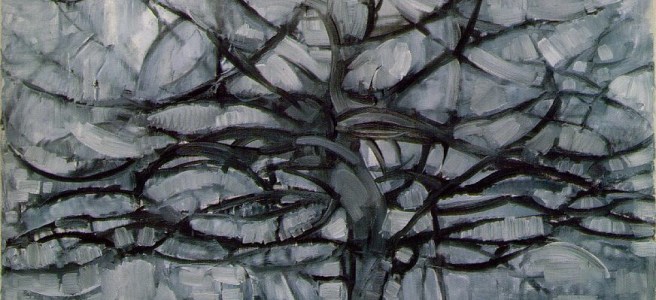
Lastly, let me share a few of my favorite images, ones that have conjured ideas for writing. The header image is “The Grey Tree” by Piet Mondrian. I stared at that image on and off while writing a winter scene. It’s so stark and cold. And I love that you can see the brush strokes. It speaks of darkness, of cold, of death….

Or how about a masterpiece? Van Gogh’s Sunflowers? Monet’s Garden at Giverny? Picasso’s Guernica?


And I’m just dying to write something based on the sculptures by Matteo Pugliese. I won’t hijack an image here but I urge you to check out his work at MatteoPugliese.com. His bronze figures emerge from the walls like human forms escaping imprisonment from life in the second dimension. I’m telling you…

While you’re at it, explore the art and photography blogs here on WordPress. Some of the images are amazing. I follow a couple of bloggers who regularly post some fabulous images for the daily and weekly photo challenges they participate in. Stop and stare at them for a while. Based on what you see, imagine what happens next. Or ask yourself, what just happened here? After all the root word for imagine is image! I hope these suggestions help you find some inspiration. Happy writing my friends!

Places, everyone! Writing Action!

Working out the issues in novel writing.

“And… Action!” the director orders.

The actors, already in position and waiting, begin to play out they parts in the scene. Perhaps they are fleeing for their lives, preparing to engage in hand-to-hand combat or in a steamy, passionate, heart-stopping kiss. A good director will shoot a scene over and over, coaching the actors until it plays just the want he or she wants it. The movements, the facial expressions, the gestures all have to be absolutely perfect for the scene to ring true, to be authentic. The very same principles can be applied to creating the action scenes in the written form. An author must visualize –watch the scene unfold in the imagination– then write. What works? What reads awkwardly?

In writing, we talk about SHOW versus TELL. In other words, don’t just say “Mary made a cup of tea.” Show Mary filling the kettle, lighting the stove, spooning tea leaves into the pot… and so forth. It makes for much more interesting reading because all these little actions help the reader “see” what the characters are doing. The best way to illustrate is by example, so let’s practice, shall we?

The fight:

Instead of saying: Brad punched Kerry in the nose….

Brad stood staring Kerry down, his fists clenched at his side. Kerry just didn’t know when to shut up. Insinuating that Brad’s intentions toward Maya were less than honorable was the last straw. And now he was laughing about it. Brad pivoted, putting most of his weight on his right foot. When his arm shot out, Kerry didn’t have time to react. As the clenched fist connected, Kerry felt as well as heard the crunch of bone, tasted blood in his mouth. His head spun as his neck whipped around from the impact and he stumbled. He grabbed the back of the chair to keep from falling when the next blow landed. All the air was sucked out of his lungs with the punch to the gut. The blood was pouring from his nose now. He was choking on it. He raised a hand in surrender. “Please,” he managed in a hoarse whisper.

Ok, that’s enough. You get the idea. Not my best writing, but good enough for our purposes. The point is that action sequences have to have, well, action! There has to be movement. Describe smells, tastes, textures and sounds: the taste of blood, the crunch of bone, for example. The reader can visualize the scene because of the detail the writer has provided. I know that some writers actually make up story boards for action scenes. It helps because it breaks a scene into its component parts. A caution — don’t get all listy.  By that I mean, don’t list the components of a scene like: First, Brad put all his weight on his right foot, then he pivoted, then he threw the first punch and then…  Get it? Listy – not good.

You might even want to watch a fight scene from film or TV to find some inspiration. The same would be true of a car chase, an attack by aliens or giant radioactive monsters… (All of which I may address in future posts.  I know — you can’t wait.) Nevertheless, the principles apply.

Now let’s go to the complete other end of the spectrum to an example of a smaller, more subtle kind of action.

The kiss:

Instead of saying:  Brad kissed Maya tenderly…

Tears streamed down Maya’s cheeks and it broke his heart. Brad crossed the room in three strides and took her in his arms. “Maya,” he whispered, framing her face with his hands. With his thumbs, he gently swept away the last of her tears. Her blue eyes were bottomless pools and he found himself sinking into them. With his heart thudding in his chest, he lowered his lips to hers, softly at first. Tentatively, he deepened the kiss as she responded. She sighed against him, parting her lips slightly, letting him in. She tasted like the salt of her tears but he didn’t mind.  He teased with his tongue, slowly, languidly as if he could make this kiss last forever…

Ok, romantic drivel, I know. Sorry, dudes. There are things to consider when writing the perfect kiss. What are the kissers doing with their hands? Is it a chaste, first-time kiss or a passionate kiss between long time lovers? Do they angle their heads one way or another? (The nose gets in the way, after all!) How long does it go on? They may be out of breath when they finally break apart.

Speaking of breath, I know we don’t like to talk about it, but is it minty fresh, taste like cigarette smoke, coffee or the shot of whiskey he or she just tossed back? Think about textures again: his soft flannel shirt, her silky blouse, his rough and calloused hands, her glossy, swollen lips, his strong arms, her lustrous hair, blah, blah, blah.

You see what I’m saying, though, right? You, the reader, have the movie of the scene playing in your head while your eyes scan those words. Every time you write action, think about how the five senses are impacted. That is how you SHOW action, instead of just TELLing us that it happened.

I hope you found this to be useful! Happy writing, my dears!