I had a ridiculous week and don’t have Small Cuts – Genevieve’s part ready yet, so in the meantime…. A repost of a short story from last year. I’ve been asked to contribute some of my fiction to a Pennsylvania authors’ anthology (exciting!) and this is one that I selected:
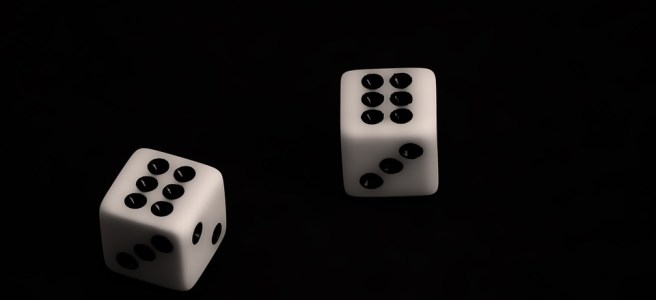
Roll the Bones
Gina wasn’t a gambler. She was a meticulous planner. Thus she was nearly sick with anxiety as she emerged from the airport shuttle in front of the Luxor Hotel and Casino in Las Vegas. This was the last place on earth she would have chosen for this meeting. Actually, that she’d agreed to this meeting at all was unthinkable. Nevertheless, here she was. She told herself that it only made sense, since Las Vegas was halfway for both of them and the airfare and hotel room were more than reasonable.
Taking a deep calming breath, she lifted her rolling suitcase from the shuttle to the sidewalk. She had overpacked for a mere weekend getaway, but she wanted to be prepared for every possible scenario. Her heart skipped a beat when she imagined the inevitable outcome of any of those scenarios —it gave her such a thrill.
After collecting her key card at the reception desk, Gina took the elevator to the forty-second floor. Her hands were shaking as she swiped the key. He said he would leave word. She wasn’t sure what that meant. As nervous as she was, she was also excited. She wanted this badly. Very badly. It had been way too long…
The room faced east, away from the setting sun. It was cool and quiet —the only noise coming from the air conditioning unit beneath the window. She took a moment to marvel at the view, with the lights coming on all over the City of Sin —how appropriate. She turned and for the first time noticed the bouquet of red roses on the dresser. A small white envelope was attached. She opened the note and read, “Meet me in the casino at nine. I’ll be rolling the bones.”
Rolling the bones. A dice game. Gina knew she should’ve done more research on gambling. That would have been the logical thing to do. But nothing about this trip, this rendevouz, was logical. When she got to the casino she would have to ask about the dice games or else she’d be wandering aimlessly all night.
After showering and dressing in the simple but elegant dress she had bought especially for their first meeting, she applied perfume in strategic places, wound her glorious hair into a twist, added her diamond drop earrings and a swipe of burgundy lipstick. Then, with just a little liquid courage enabled by raiding the mini bar, she returned to the ground floor in the elevator.
When the doors opened, it was onto a carnival scene —the lights and sounds of slot machines and roulette wheels. Statuesque cocktail waitresses in impossibly high heels circulated with drinks for the gamblers. Gina spotted one with an empty tray and stopped her to ask about games played with dice. The waitress smiled benignly, amused at her apparent naivety, but directed her to the craps tables on the far side of the vast expanse.
As Gina wound her way through the throng of tipsy revelers, her eyes scanned the faces for one familiar. Familiar to her at least from viewing it in cyberspace. Eventually, she spotted her goal. The craps tables were equally populated with men and women taking their turns at throwing the bones. She knew this much about dice —that they were originally made of bone and possibly were used in some religious or mystical capacity in predicting the future. Seven or eleven. Seven or eleven. A winner, here. A loser, there. Roll again.
She felt him before she heard him. “Gina,” he murmured against her ear. Her spine tingled and she turned slowly to face him. She had to look up. Grey-blue eyes stared back at her. She knew him right away. Just what she’d been hoping for, dreaming of, all these months. He was dressed all in black —black suit, black shirt — no tie, black shoes. Black hair curling over his collar. She smiled and he relaxed. “You look beautiful. Just like your picture.” He lifted her hand to his lips and kissed it. Charming.
“The roses were beautiful,” she said. “Thank you for them.”
“Shall we go see them?” he asked, still nuzzling her fingers.
“I thought you were playing,” she said, gesturing to the tables.
“I’m not that kind of gambler,” he said with a grin. He ran his thumb over her full lower lip. “Besides, the tables aren’t the only place to roll the bones.”
She swallowed hard. This was going faster than she had anticipated. But no matter. She was ready. She gave him a confident smile. “All right. Follow me.”
He took her hand and let her lead him to the elevators. When the doors closed on them and they were alone, he took her in his arms and said, “You are just as I imagined.”
She braced her hands on his chest and replied, “As are you.”
When the doors opened onto the forty-second floor, he released her and gestured for her to lead the way. She opened her small black clutch and removed the key card from it. Then swiping the lock open, she allowed him to enter before her. Keeping her eyes on his back, she followed him into the darkened room. The door swung shut behind her as she drew a second item from her bag. When he whirled around to face her, the hand holding the gun wavered just a little. The blade of the knife he held glinted in the moonlight shining through the uncovered window. His laugh was low and genuinely mirthful. She gave small chuckle herself.
“What are the odds?” he asked, lowering the knife. “Of two killers finding each other online?”
She kept the gun trained on him as he took one step back. “Apparently they are higher than you would think.”



 Meg Sorick, Author/Artist