
Novel Writing Mistakes

In proof reading your work, I always recommend reading out loud. This exposes awkward sounding sentences and the overuse of the same or similar words. Well, in my last novel excerpt I was in such a hurry to finish and post it, I neglected to follow my own advice. Nevertheless, it gives me an opportunity to demonstrate what NOT to do.

Here is the section in question:

“All right. Stay back and we’ll take a look,” the officer said.

He waved over one of the other officers and together they approached the shattered shop window. The other officer swept his Maglite around the darkened interior and focused it on something toward the front of the room. He spoke to the first officer who nodded and came back to where Brad and I were standing. “It looks like a large rock, or maybe a piece of concrete block, it’s hard to tell from here. Do you mind opening the place up so we can take a closer look?”

Officer, officer, officer… I only discovered just how bad that sounded after reading it out loud. Here is the edited version of that same section:

“All right. Stay back and we’ll take a look,” he said.

He waved to his partner and together they approached the shattered front window. The second officer swept his Maglite around the darkened interior and focused it on something toward the front of the room. He spoke to the first officer who nodded and came back to where Brad and I were standing. “It looks like a large rock, or maybe a piece of concrete block, it’s hard to tell from here. Do you mind opening the place up so we can take a closer look?”

Better, but not perfect. However, technically this whole thing is a first draft so some extensive editing will be done before it ever goes to print. I hope this shows you how helpful it is to read your work out loud. I have learned my lesson!
Paint Me a Word Picture

“Any fool can pick a rose and pluck its petals, but the man of genius breathes its scent and paints its forms: that is the kind of author we will read.” – Essay on Novels; The Marquis de Sade

That is such a lovely quote, I had trouble figuring out how to follow it up!

Unless you are a technical writer, compiling how-to manuals for ‘some assembly required’ projects or writing textbooks for engineers… writing and composing involves much more than just listing facts on a page. Writing is an art form.

Storytellers don’t just recount events in the order in which they happened. No. We attempt to paint pictures with words. To set the scene, we hope to make the reader feel the cold wind blowing off the North Sea or the scorching heat of the desert sun. We use beautiful language to describe the tastes of the food or the taste of a lover’s kiss. Can you smell the smoke from the burning village or of sound of screaming and the clash of swords? Feel the textures of skin against skin in a gentle caress or in a bare knuckle brawl?

Anthropologically, storytelling in the form of song or saga has been used to help the balladeer or the skald keep the oral history of a people alive. It is some of the earliest writing ever discovered. The Epic of Gilgamesh, for example, dates back to 2000 BCE. Another Sumerian text, The Tale of the Shipwrecked Sailor, may be even older than that. Can you imagine the story surviving if the tale was dull and lacking life? Or if it were just a chronological list of situations and incidents?

Fiction writing is not a roll call.

As writers, we have stories within us just begging to be told. Perhaps they are based on an interesting life full of adventures  or one filled with anguish and tragedy. The Marquis de Sade, for example, was imprisoned for most of his life. (See Citizen Sade by Mr. Cake of cakeordeathsite) His uncontrollable nature led him to behave in a most outrageous way. However, despite the unavoidable outcome, he believed that his desires should not be suppressed, for to do so would go against that very nature. Inevitably, it got him in a lot of trouble. Yet, there is more to the man than his bad reputation. (See Yet Another Effort also by Mr. Cake -he is writing a series of posts on the Marquis)

Alternatively, maybe we are keen observers, listeners -able to conjure a story by watching a couple argue at a restaurant or seeing a child apart from all the other children playing on the playground. We ask why or what happens next? All the joy and pain, the desperate hopes, the unbreakable spirit, the crushed dreams and lost loves pour onto the page. Those strong emotions, however, produce the most powerful writing. Writing that has life…

That is the reward of writing – touching the heart and mind of the reader- to entertain at a minimum, but even better, to stimulate the mind, to stir the emotions, captivate the spirit, shake it to the core. It’s a heady thing– moving a soul. Choose carefully, the words you’re about to commit to paper. Craft them with skill, arrange them just so. Speak them aloud to see how they roll off the tongue. Inhale the scent of the rose and paint its forms.

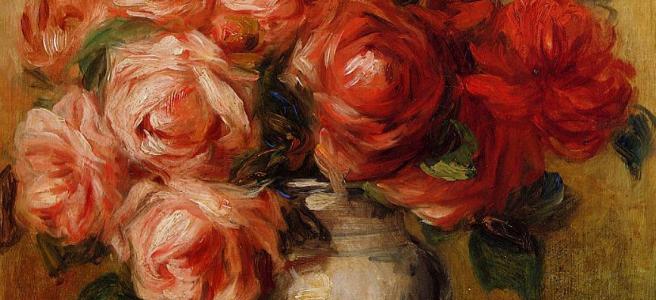
Header Image: Still Life With Roses – Pierre-Auguste Renoir 

Repeating Yourself

Do repetitive phrases waste the reader’s time? Here are some common phrases that are  redundant.

  • advance planning: planning must always be done in advance
  • ask the question: is there ever anything else that can be asked but a question?
  • assemble together: a group cannot assemble any other way but together
  • cash money: cash is money
  • combined together: just like assemble together, there is no way to combine apart
  • each and every: as adjectives, these words mean the same thing
  • end result: results only happen at the end
  • fewer in number: fewer only refers to numbers
  • large in size: large denotes size, you don’t need to say “size”
  • mix together: like combine and assemble, things can only be mixed together
  • month of November: everyone knows November is a month
  • red in color: can red be anything other than a color?
  • square in shape: square is its shape
  • sum total: if you have a sum, you have a total

Many of these phrases, however, are used in every day speech. I don’t think I’ve ever watched a cooking show where the host hasn’t used the expression “mix together” or “combine together.” What does that mean for a writer?  Expressions like these are grammatically repetitive, yet common in usage. So for example, if you are writing dialogue between two average people, it might be perfectly acceptable to use phrases like these. Why? Because that’s how people talk. On the other hand, if you are writing narrative, you probably want to avoid them. Reading your work out loud will expose some of the clumsy phrases and awkward grammar that might have crept into your writing. Happy editing my friends!