I had the opportunity to practice some basic drawing skills last weekend. Going back to the ‘drawing’ board once in a while is a good idea; it keeps you from getting lazy!
Shading gives an object a three dimensional quality. Additionally, that object casts a shadow onto whatever background it rests upon. Being able to correctly add these to your drawing will make it realistic. The object I practiced this weekend was a sphere. I’ll show you the progression. There is specific terminology for the lines and shadows, but I skipped those for simplicity’s sake.
First, and obviously, you have to draw a circle. Using a jar lid as a template, I traced. Next you have to decide where the light source is coming from. In my drawing it is coming from the right. Further into the drawing I will make adjustments to the direction slightly, but this works for getting started. The ‘light’ lines will give you the basic dimension of the cast shadow, as well. The cast shadow of the sphere will be roughly perpendicular to the light lines.
Next, I shaded the circle as if the light was coming slightly above and in front of the light. On a sphere, there will be no straight lines, all the shadows will be curved. And the shadow will fade gradually with the curvature. The second photo shows a 1 to 5 scale of tones from light to dark. Notice that the darkest part of the sphere doesn’t extend all the way to the surface it’s resting on. That’s because there will be a little reflected light from the surface. The cast shadow will also consist of a gradation of shades with the darkest being directly under the sphere.

Now it’s time for subtle adjustments. Notice in the first photo, the the darkest part of the shadow on the sphere is higher than in the second. This shadow should meet up with the shadow cast on the the surface. I corrected it by the second photo. Next, in above photo, there are still distinct lines from when I drew my original circle. Find them on the lower left and upper right of the sphere. Those kind of lines don’t exist in nature. Finally, the cast shadow is too far forward based on where I’ve placed the light source. This angle needs to be adjusted. Here is the final result:
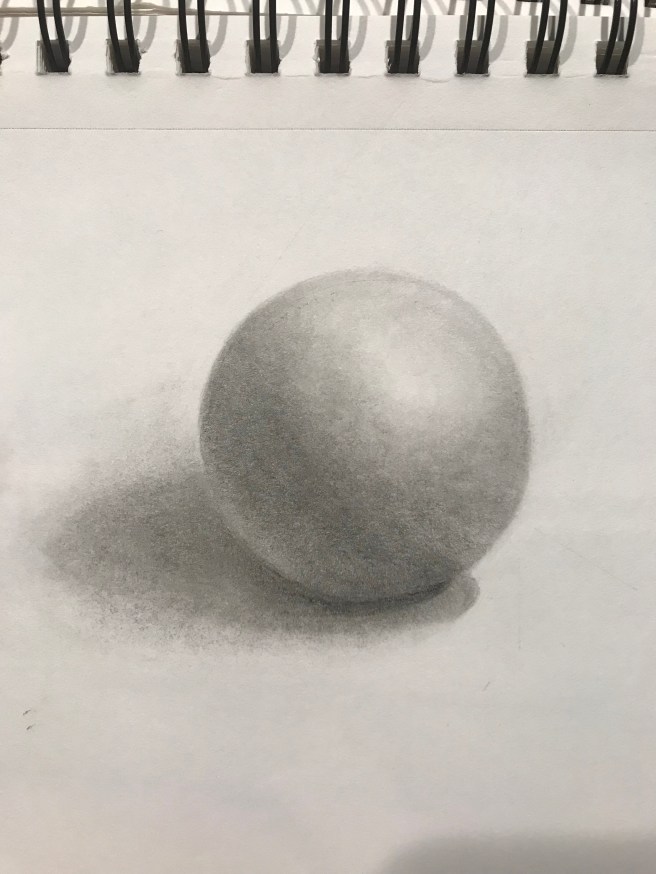
I don’t pretend to be an expert; in fact I’m still learning a lot of the basics, still. However, I thought this might encourage others to pick up the pencil or pen and give it a try. Have a great Friday!




 Meg Sorick, Author/Artist