Edvard Munch and The Spanish Flu

fcdca4dd8d734ea10e5592a83fbf1ce8
Self Portrait, Spanish Influenza
Mr. Cake (cakeordeathsite) has graciously agreed to share another of his wonderful art posts with me. In reading about the flu epidemic, I learned that the artist, Edvard Munch, was a victim. This was once again a nugget of information perfectly suited to his expertise. 

At beginning of 1919, the Norwegian artist Edvard Munch (see Madonna) who painted one of the most famous paintings of all time, 1893’s The Scream, became seriously ill with the Spanish Influenza that had already claimed the lives of millions across the world.

Munch painted hundreds of self-portraits throughout his career, most notable are Self-Portrait with Burning Cigarette from 1895

ng-m-00470_pressebilde
Self Portrait With a Burning Cigarette
and 1903’s startling Self-Portrait in Hell.

self-portrait-in-hell-1903
Self Portrait In Hell
Munch’s art which encompassed Symbolism and paved the way for Expressionism, brought a new and unprecedented focus on subjectivity and psychological states, naturally found raw material in the unflinching and dramatic presentation of the diseased and tormented self.

Self-Portrait, Spanish Influenza, featured at the top, though of a later period, is no exception in its neurotic intensity. The jarring colours are suggestive of sickness and trauma and Munch’s sallow mask-like face seems to be staring straight at death.

Munch would survive the Spanish Influenza, dying in 1944 at the age of 80. His paintings and prints retain an evocative urgency in their depiction of the universal states of anguish, illness, sexual anxiety and dissolution of the body.


The Origins of War

We all know the story. In Sarajevo, on June 28, 1914, Gavrilo Princip -a Bosnian-Yugoslav Nationalist- shot and killed Archduke Franz Ferdinand, heir to the throne of Austria-Hungary- the event that escalated the world into war. This was however, merely the match thrown onto the gasoline-soaked woodpile that was Europe in the years leading up to The Great War.

The geopolitical wrangling that went on in the decades leading up to outbreak of hostilities is complicated. Germany felt they were being economically oppressed and excluded politically by the other European powers, namely France and Britain. They were a relatively new nation, having coalesced from the unification of the separate states of Bavaria, Prussia and so forth. And because they weren’t a colonial power like Britain and France they didn’t have the depth of resources to draw on or the room for expansion as did those two. Here is a brief background on how things got to this point. Bear in mind that massive and numerous books have been written on the subject, so this really is just the basics.

Germany as we know it did not exist in the early 1800’s. Following the Napoleonic Wars, the independent German territories were bound together into The German Confederation. The confederation that would eventually become The German Empire in 1871, was made up of constituent territories, including four kingdoms, six grand duchies, five duchies, seven principalities, three cities and one imperial territory.

With the Industrial Revolution of the 19th century, the states of Germany had shifted from a rural agrarian economy to an industrial one, with strengths in coal, iron/steel and chemical production, and railroads. With this change came urbanization and the movement of its population from the countryside to the cities. During this time, Germany became an industrial, technological and scientific giant.

images
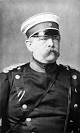
Otto Von Bismarck
With economic changes came political changes too. Economic wealth led to German nationalism which then resulted in a shift from a liberal democratic coalition among the states to imperialism and a united German Empire. During his tenure, Prussian Prime Minister, Otto Von Bismarck, engineered three successful wars, including the Franco-Prussian War of 1870, which resulted in France’s loss of the region of Alsace-Lorraine and the final unification of all the German states  under an Emperor (Kaiser Wilhelm I). Bismarck’s influence was instrumental in establishing the House of Hohenzollern (a Prussian dynasty) as the reigning monarchy over the newly formed empire.

Nevertheless, economic power failed to give the German Empire the political status to which it felt it entitled within the European community. Additionally, since the Empire had failed to establish alliances with the other European powers, it found itself with only Austria-Hungary as its ally. And while the rest of Europe had embraced the concept of democracy and self-determination, Germany’s Wilhelmine Westpolitik was a powerful conservative force opposing revolution, supporting old dynastic tradition, second only to Tsarist Russia.

de03b24f9973706b3534fea5ea296724
Alfred Von Schleiffen
The Germans felt that the British Empire had dominated the scene for too long and it was time for the rise of Mittel Europe -namely The German Empire to take its rightful place at the table alongside the other powers of Europe. It was with this idea that German growth and expansion were being strategically and maliciously restrained, that led the German military commander Count Alfred Von Schleiffen to formulate a plan for the invasion and defeat of France by way of Belgium. The Schleiffen Plan was completed in 1906, eight years before the outbreak of hostilities.

Meanwhile, the French, anxious about this new shift of military and economic power within Europe, and having been humiliated in 1870 by the German conquest of their territories, were developing their own plans to retake the regions of Alsace-Lorraine. So when the shot was fired in June 28, 1914, it was the match that set the woodpile of Europe ablaze.


In the Zone

In reading about the Spanish Influenza, I came across a bit of information that is perfectly suited for the expertise of Mr. Cake. I pressed him into service for a guest post and he kindly agreed.  

Avant-garde catalyst, the quintessential modernist and fashionable man about town, Guillaume Apollinaire saw himself as a spiritual heir of Charles Baudelaire, an urban poet who doubled up as an art critic. He coined the term Cubism and was the most impassioned and ardent of its early defenders. He also coined the term Orphism (a tendency in abstract art) and more famously, Surrealism, to describe Erik Satie music for Jean Cocteau’s ballet Parade.

His list of contacts within Parisian artistic and literary scenes reads as a veritable who’s who of the pre-war avant-garde and include Picasso (a particularly close friend), Andre Breton, Marc Chagall, Gertrude Stein, Marcel Duchamp, Blaise Cendrars, Jean Cocteau, Henri Rousseau, Andre Derain and Giorgio de Chirico, who painted a Premonitory Portrait of Apollinaire in 1914 that eerily predicts the wounds that he was to suffer during WW1.

His 1913 collection Alcools is a landmark in literary modernism and features the important poem Zone that while grounded in Symbolism, points towards the future in its emphasis on the energy and vitality of the modern city and engagement with (then) new, evolving technologies.

Apollinaire also wrote several erotic novels including Les Onze Mille Verges, (The Eleven Thousands Rods), and he also led to the critical re-evaluation of Marquis De Sade of whom he remarked was ‘the freest spirit to ever live’.

Apollinaire volunteered during the first WWI and was stationed, appropriately for someone who was known for his fondness of a drink, in the Champagne Region. He suffered a head-wound in 1916 that required Apollinaire to undergo trepanning; he never really recovered although he published in 1917 another landmark collection of poetry Calligrammes that uses typography to startling effect, poems are shaped like a mirror, heart, a watch etc.

In 1918, still weakened by his war wound Apollinaire succumbed, like 19 million others to the Spanish Flu. He was 38 years old.

After his death Andre Breton, who admired Apollinaire and was very much in the tradition of poet/critic and cultural instigator, would take his coined phrase Surrealism and make it into one of the major intellectual and artistic movements of the 20th century.

I would have liked to include his seminal poem Zone, however it is a very lengthy poem, so I have chosen instead one of his poems from his 1913 collection Alcools, Hotels.

Hotels

The boss is doubtful
Whether you’ll pay
Like a top
I spin on the way

The traffic noise
My neighbour gross
Who puffs an acrid
English smoke

O La Vallière
Who limps and smiles
In my prayers
The bedside table

And all the company
in this hotel
know the languages
of Babel

Let’s shut our doors
With a double lock
And each adore
his lonely love

Translation A.S Kline

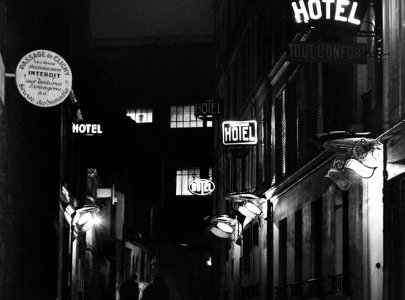
Image: Brassai-Bouvelard De Clichy 1932