
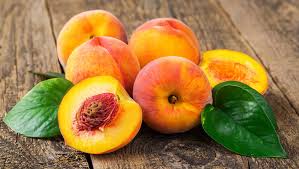
Le Boulangerie (6) Peach Cobbler

To accompany my novel in progress: Breaking Bread, welcome to Le Boulangerie.

I planned this post to align with this past weekend’s Super Bowl game. It would either be a celebration or a consolation to the parts of the country hoping for an Atlanta Falcons victory. Well, consolation it is… they lost and in a most heartbreaking fashion. Giving up a commanding lead and ultimately losing in the Super Bowl’s first ever overtime. Here’s to you Atlanta, Georgia. Have some cobbler.

For those of you outside the United States, cobbler is essentially a deep dish fruit pie. Instead of a traditional pie crust, fruit is baked with a sweet batter in a baking dish instead of a pie plate. The dessert originated in the American Colonies while still under British rule. The early settlers, with lack of ingredients and improper tools for cooking and baking, had to improvise. Thus the ‘cobbler,’ possibly derived from the old term: cobeler, which means wooden bowl, was created by stewing fruit, topping it with batter and baking in cook pots rather than pans.

Here is a recipe adapted from one of my Nana’s recipes for apple cobbler. I wanted to make peach, for Georgia after all. (Even though fresh peaches aren’t in season and really that would be the ideal time to make this…)

Ingredients:

  • 1/2 cup butter
  • 2 cups sugar, divided
  • 4 cups peaches, fresh or thawed frozen (I used frozen)
  • 1-2 tablespoon lemon juice
  • 1 cup all purpose flour
  • 1 tablespoon baking powder
  • 1/4 tsp salt
  • 1 cup milk
  • ground cinnamon

Method:

  • Preheat oven to 375 degrees. Melt butter in a 11X13 baking dish in oven. Remove from oven when melted.
  • Mix flour, 1 cup of sugar, baking powder and salt in a small bowl. Add milk and mix until just combined. Pour batter into baking dish on top of butter. Do NOT stir.
  • Bring peaches, remaining 1 cup of sugar and lemon juice to a boil in a medium sauce pan. Pour peaches over batter (they’ll sink in). Do NOT stir. Sprinkle with cinnamon.
  • Bake for 40 – 45 minutes until the top of the cobbler is golden brown.
  • Serve with vanilla ice cream.

My condolences, Atlanta. I hope this helps.


Le Boulangerie (3) Pierogi

To accompany my novel in progress: Breaking Bread, welcome to Le Boulangerie!

Week three and I’m already sort of going off script. Pierogi are not baked but they are made of dough so…. And I have a good reason for featuring them this week: Pittsburgh. (And don’t be confused, I am from Philadelphia, not Pittsburgh.) For those of you outside the United States and those who pay zero attention to sports, here’s the connection: I am a Pittsburgh Steelers football fan. (Steelers fan in Eagles territory…) The Steelers are in the playoffs. This Sunday they played and won their game against the Kansas City Chiefs in what can only be described as an ugly win. Nevertheless, the playoffs demand a party and a party demands food and drink.

Any city like Pittsburgh with a vibrant Polish and Eastern European community, will certainly be known for the foods of that ethnic origin–pierogi, for example. Pierogi are pockets of dough filled with a variety of ingredients. A traditional pierogi is most often filled with a combination of potatoes and cheese, potatoes and onions or cabbage. In honor of the Steelers, my friend Alexandra, armed with her Ukrainian grandma’s recipe, agreed to show us how to make pierogi from scratch on Sunday afternoon. I feel an annual tradition starting…

Now, right at the beginning I have to warn you, this was neither quick nor easy but it was so totally worth it. The key to this entire process as you might imagine is the dough:

Ingredients:

  • 1 cup of whole milk, scalded
  • 1/2 stick of butter
  • 1 cup warm water
  • 1 teaspoon of active dry yeast
  • 1 teaspoon salt
  • 1 egg
  • 6 – 7 cups of flour

Method:

Scald milk in saucepan. Put butter in hot milk to melt. Allow to cool for a few minutes. Mix water and yeast in a separate bowl. Let rest 5 minutes. Add salt and egg to milk mixture. Combine thoroughly. Gradually add flour in with mixer. As dough thickens, knead by hand instead (or switch to dough hook if using a stand mixer). Cover bowl with cloth and allow dough to rise about an hour.

Then the dough gets rolled out to about an eighth inch thickness and cut into rounds:

img_1509
When the rounds are ready, it’s time to fill them. Ours were stuffed with mashed Yukon gold potatoes, cheddar cheese, green onion and bacon. Fold the round over the stuffing mixture, seal with egg wash and use the tines of a fork to crimp the edges.

The filled pierogi go into a pot of boiling, salted water for a few minutes and then into a pan for frying in butter to a light golden brown.

And no Ukrainian or Polish meal would be complete without kielbasa, img_5004purchased at a butcher shop in northeastern Pennsylvania (coal mining country) another area with a large Eastern European community. We’re calling Pierogi fest 2017 a huge success!

And did I mention the Steelers won? Yeah, that too!

img_5017


Le Boulangerie (1) Baguette

To accompany my novel in progress: Breaking Bread, welcome to Le Boulangerie!

There is no more appropriate bread to open this series with than the baguette. The most basic of breads, the simplest of ingredients and yet the most wonderful results. The composition of a traditional baguette is nothing more than flour, salt, yeast and water. You need no complicated tools, this can all be done by hand. Though it takes time to get from start to finish, most of that time is spent waiting for the rise. The actual working time is quite short. Here’s what you do:

We begin with a “starter” – a water/flour/yeast mixture that gives the yeast a head start in the consumption of the carbohydrates in the flour. The byproduct of ‘yeast eating sugar’ is CO2 and that is what makes bread rise.

Starter:
1 cup  flour
1/2 tsp yeast
1 1/4 cup lukewarm water (comfortable enough to dip a finger in)

Combine in a large bowl, cover and let rise 2-3 hours, until it gets bubbly.

When the starter has done its thing…

Add in:
1 tsp yeast
2 additional cups of flour
1 1/2 tsp salt
Enough water to make a smooth dough (usually not more than another 1/4 cup)

Hand form dough into a smooth ball. (Or you can use a stand mixer with a dough hook) Place dough ball in a bowl dusted with flour, dust top with flour. Cover bowl with a kitchen towel. Let rise 40 minutes or until doubled in size. 

When doubled, cut dough in half, keeping as much air in the dough as possible. Fold and roll dough pieces into 2 baguettes. Place on floured baking sheet*, cover and let rise an hour. 

Heat oven to 425. Just before placing baguettes into the oven, slash the tops of the loaves diagonally several times. Spritz with water to make the loaves nice and crusty. Bake 20-25 minutes, until golden brown.

*I actually use a baguette pan. I have a similar one for Italian loaves. These aren’t necessary but they do help make more uniform loaves. I hope these turn out for you if you try them. They are the perfect accompaniment to a hearty soup or stew. Bon appetit!