
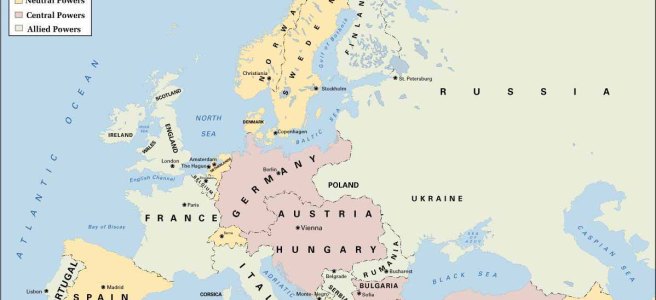
The royal houses of Europe have always been a bit of an incestuous bunch —at least until recently when standards have been relaxed. For those of royal blood, their selection of future mates was largely arranged so as to form or strengthen political alliances. As a result, the pool of choices was very limited and the families of Europe (including Russia up through the 19th century) became a confusingly intermarried bunch.
Three of the principal combatants during the First World War –Britain, Germany and Russia– were ruled by men whose close family ties were unable to prevent that dreadful conflict. King George V of Great Britain, Tsar Nicholas II of Russia and Kaiser Wilhelm II of Germany were first cousins. Here’s how they were related:
King George V was the son of King Edward VII and his wife Alexandra of Denmark.
Tsar Nicholas II was the son of Tsar Alexander III and his wife Dagmar of Denmark (Alexandra’s sister).
Kaiser Wilhelm II was the son of Kaiser Friedrich III and his wife Victoria of Great Britain (Edward’s sister).
Additionally, Tsar Nicholas II and Kaiser Wilhelm II were related further back in the family tree through the marriages of the tsar’s distant cousin (the granddaughter of Nicholas’ great grandfather —I’m not sure what that relationship works out to be…) to Wilhelm I, King of Prussia (Wilhelm II’s grandfather).
AND, Tsar Nicholas II married Alexandra of Hess-Darmstadt —daughter of Alice of Great Britain, sister of Edward VII, making him cousin by marriage as well.
Despite these close familial relationships, in 1914 the monarchs found themselves at war in the worst conflict the world had ever seen up to that time. By the end of The Great War, two of those monarchies had been brought to their end —the Russian through revolution and the German through defeat. Tsar Nicholas II and his family were executed on July 17, 1918 by the revolutionary Bolsheviks who had been holding the Romanovs captive after Nicholas’ abdication of the throne. The kaiser was forced to abdicate the Imperial German Crown and the Prussian Kingship on November 9, 1918 as the German army was near collapse and revolution loomed on the home front. Wilhelm fled by train to the neutral Netherlands where he lived out his life in exile.


 Rudolf Franz Karl Josef was born on August 21, 1858 and with his early education, began his grooming to lead the empire. Unlike his conservative father, Rudolf developed more liberal views and was intensely interested in the natural sciences, especially mineralogy. His marriage to Princess Stéphanie of Belgium was initially a happy match, but the royal couple grew distant after the birth of their only child, Elisabeth. Rudolf, a passionate man, began drinking and embarking on a number of love affairs. At one point, he considered trying to have his marriage to Stéphanie annulled, but was prevented by his father, the emperor.
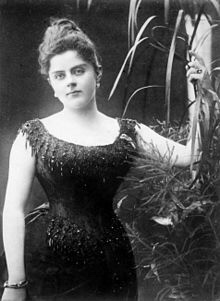 and began a doomed affair. Although, by all accounts, Marie was devoted to her married lover, Rudolf carried on liaisons with other women during the 3 months he and Marie were involved. At Rudolf’s hunting lodge in Mayerling, on January 30, 1889, the lovers committed murder suicide –the act confirmed by letters of Marie’s which recorded that she was preparing to take her own life for the sake of ‘love’. Prior to the events at Mayerling, however, the ‘unbalanced’ Crown Prince had proposed a similar suicide pact to another of his mistresses, the actress, Mizzi Kaspar, who regarded the suggestion as a joke. Alas, in Vetsera he found a gullible and willing partner.

 Meg Sorick, Author/Artist