

As the war drags on, dreams of glory are replaced with bitterness and cynicism as revealed in this short poem by Siegfried Sassoon from 1918.

If I were fierce, and bald, and short of breath,
I’d live with scarlet Majors at the Base
And speed glum heroes up the line to death.
You’d see me with my puffy petulant face,
Guzzling and gulping in the best hotel
Reading the Roll of Honor, ‘Poor young chap,’
I’d say– ‘I used to know his father well;
Yes, we’ve lost heavily in this last scrap.’
And when the war is done and youth stone dead,
I’ll toddle safely home and die– in bed.
According to historian Barbara Tuchman:
“After the Marne, the war grew and spread until it drew in the nations of both hemispheres and entangled them in a pattern of world conflict no peace treaty could dissolve. The Battle of the Marne was one of the decisive battles of the world not because it determined that Germany would ultimately lose or the Allies would ultimately win the war but because it determined that the war would go on. There was no looking back …”
“General staffs, goaded by their relentless timetables [for troop mobilization], were pounding the tables for the signal to move lest their opponent gain an hour’s head start. Appalled upon the brink, the chiefs of state who would be ultimately responsible for their country’s fate attempted to back away, but the pull of military schedules dragged them forward.” — The Guns of August
(Header image thanks to 1914-1918.net)
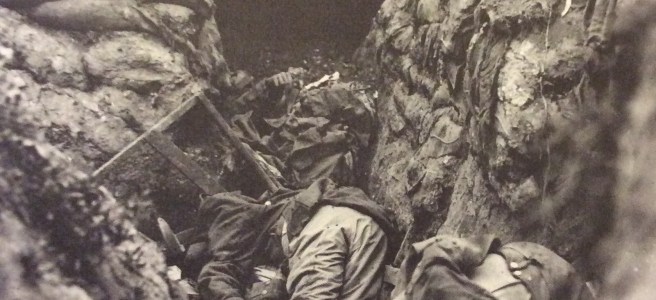

 cousins whose great grandfathers perished in the Great War. I must admit to having a morbid fascination with this most horrific period of human history. In the course of my research, I stumbled upon a collection of poetry, written about the war and the experiences of the men who fought those bloody and futile battles. I just have to share one or two of these with you. I’ll begin with this one by Wilfred Owen. The soldiers faced not only the enemy in battle but also the terrible conditions of trench warfare. The mud, the water, the lice and rats, and the cold:
 Meg Sorick, Author/Artist