
The Joy of Research

One of the most important things a writer must do besides actually write a story is to do research. Nothing can ruin a book, short story or non-fiction/opinion piece more than messing up on the details. A lazy researcher makes for a mediocre writer.

66085901

As I research my current project, a story that crosses time to the era during and around The Great War and its aftermath, I’ve been burying myself in books and articles about the battles, troop movements, the commanders, the subsequent Spanish Flu pandemic. I’m perusing books of photography, reading collections of wartime poetry and even collections of letters sent home from the different theaters of war. All of this material will give me a better grip on what the people of that era were enduring as they lived through those monumental times.

Granted, writing a story out of time and in such complex conditions requires a great deal of research and quite frankly, I might be going overboard with it. But here’s the thing… I am profoundly interested in The Great War, and therefore, the research is a joy, not a burden. When the book is finished, the characters that I create will accurately portray the attitudes and experiences of the people of that period.

It follows then that good writing, dependent on good research, naturally emanates from an author who writes about a subject, in a genre, during a time period that he or she is extremely interested in. Writers set themselves up for failure when they choose to write something they wouldn’t read themselves.

Before I go on, I must say that I’m not advocating limiting yourself to just one style of writing. For example, nothing says a romance writer can’t write science fiction. Or a science fiction writer can’t author a noir thriller. It’s important to test and stretch your writing skills, get out of your comfort zone. But, you have to love it! You can get into trouble if you choose to write something with which you don’t relate or in which you have no interest. Why would a writer do that?

Trends in fiction or pop culture can have an impact on what you choose to write about. If you feel compelled to follow those trends, maybe even for perceived financial reasons, the result will be a body of work that is not backed by your enthusiasm, your fascination and your love for the words you have penned. The research will be a drudgery, and likely will lack the scope and depth necessary to give the bones of the book flesh and blood. Without your passion fueling it, the project may bog down and never be completed. That, my friends, is a waste of your precious time.  The question is how much and what type of research should you do?

As an overview, here are some items that may need to be researched for your story and/or book.

Time and space/place – if writing in a period of history, a geographical location you are not familiar with, or both, extensive research will be needed to create the landscape, set the scene and the mood for the story.

Weather/climate – get your seasons straight! Related to place/space, weather for the locale should be appropriate for the seasons. It will determine what clothing your characters will wear, have an impact on their activities, driving conditions and so forth.

And speaking of driving conditions… what sort of transportation is common in the place where your story is set? Make sure buses, trains and subways actually provide service to that city. Is there an airport? Do flights really connect to the places where your characters travel? Does everyone depend on automobiles for transportation? If so, on what side of the road do they drive? Where does the driver sit?

Regarding characters:

What is their race/ethnicity? Is it the same as yours? If not, don’t make assumptions, or worse, write cliches and stereotypes. There are resources for writing a character of a different ethnic background online. Even better, interview a friend or coworker and get first-hand knowledge.

Even within a country there may be great regional differences. Language or dialects, religion, socioeconomic conditions can vary widely within a large nation.

Employment – don’t give your characters a job you know nothing about. Alternatively, make sure you have access to someone in their particular field that you can ask questions and from whom you can get detailed feedback.

Age – an older writer may have trouble relating to the experiences of a modern day child/teen/young adult, unless of course, they have children that age. Additionally, a young writer will not know what it feels like to be an old person. Ask parents, grandparents, older neighbors and friends.

Even habits like smoking, drinking, gambling… or exercise regimens like running, weight lifting, or sports like golf or tennis might need to be researched to get the terminology correct.

That is by no means an exhaustive list but it may give you an idea of the details that, even if they are not directly included in the narrative of your story, will give it the sound and feel it needs to be authentic and entertaining. I hope this demonstrates how being fascinated by your subject matter will make research a joy and not a burden!
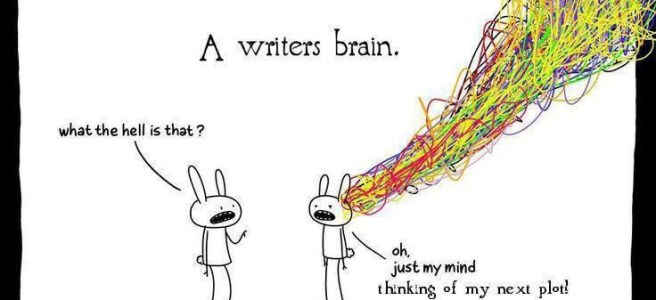

Exploding Brain Syndrome

The other kind of writer’s block…

Ah, writer’s block — that scary situation in which you sit staring at the blank page or screen and can’t conjure a single thing to write. It’s a common occurrence, happens to nearly all of us at some point. Once in a while it can be so debilitating that a writer may throw in the towel and give up for good. That is the writer’s block we are all familiar with.

Sometimes, though, the opposite situation challenges us — that is, having too many ideas clogging up our brains. There are several ways exploding brain syndrome presents itself.

When we first manifest a desire to write, it may not be clear what type of writing we want to do or what we might actually be good at. Let’s suppose that ultimately your desire is to write a novel. That is a daunting task to tackle without any writing experience. You decide to start a blog, follow other writers to see what they’re doing. Suddenly you are exposed to multiple writing styles, genres, and subject matter. Micro-fiction, short stories, serial fiction, personal journals, poetry in all its varieties… It’s all good! You want to try everything. And you can and should.

But… just try one or two things at a time. Don’t attempt everything all at once. I love the idea of micro-fiction as a starting point for story-telling. It forces a writer to be concise, to choose words carefully so as to convey the entire story in a small package. Six words stories, thirteen words stories, one hundred words stories — all of these types of challenges are floating around Bloglandia. Try doing one of those every week. Or try a poetry challenge, perhaps a haiku or a limerick.  Notice I said or not and?  The point is if you try to do it all at once, you will be very unfocused. You won’t excel at anything.

If you are an avid reader, the material you read might spark an idea. Or several hundred. (Exaggeration for emphasis!) That happens to me all the time. Some little side plot or one of the secondary characters sticks in my head and I wonder what kind of story they have to tell me. That’s what your notebooks, index cards or files on your computer are good for. Save all those good ideas for further exploration at a later date. For now, pick one and concentrate on it.

Even experienced writers can have exploding brains. You would think that after a while, you’d start to run out of new stories to tell but sometimes the opposite happens. A story can take on a life of its own, turning into a complicated mess that becomes unmanageable. Why? It can be difficult to bring a story to a conclusion. Even a well-plotted and outlined story might take an unexpected detour. You introduce a twist you hadn’t originally anticipated, but it’s so good you can’t ignore it! It must be written! That’s fine. Actually, that’s great! Keep going with it. But go back and review your outline, rework it so that the story doesn’t end up becoming “War and Peace” (300,000+ words)!

Alternatively, maybe the whole story works. With a novel, there’s nothing that says you can’t finish up the main story arc, leave a cliffhanger for the sequel, and publish what you have. Or alternatively, finish the whole thing and edit the hell out of it. You may find, upon review, that you have a lot of unnecessary filler. That is inevitable. My first book was over 110k words – way too long for the genre. I edited it down to 91k. That’s a lot to lose. So take a good look at what you’ve got and see where you can trim. If you don’t find that much to cull, outline what you have and look for natural breaks in the action. See if one of those breaks would make a good spot to pause the story for the sequel.

In the end, it seems that having too many ideas can be as debilitating as not having any ideas at all. The key to successfully overcoming exploding brain syndrome is to approach your ideas in an organized manner. Be meticulous about recording your ideas in a file — either paper or electronic. While experimenting with other types of writing, approach each one at a time.  Don’t lose sight of your ultimate goal.  And more importantly, don’t let your brain explode.

Worth It

Don’t get discouraged…

Writing can be a blessing and a curse. If you’ve been at this a while, you know what I mean. Sometimes things go very well. Creativity is sparkling, words are flowing, the keys of the keyboard tap out a furious staccato. The finished work is brilliant – some of the best stuff you’ve ever written. You edit carefully, then send it out into the world, on your blog, into a self-published book on Amazon, or in a query to an agent. You wait for the response.

And nothing….

You get a few likes on your blog, maybe a couple lukewarm comments. Your book languishes, sales are weak, nonexistent even. The agents are silent, or worse, dismissive… “Thank you but your work isn’t a good fit for me. Good luck in your journey…”

If you are expecting the usual litany of “think positive”clichés, sorry! You know how I hate that crap! Nevertheless, how do you keep from going under in the floodwaters of writing and publishing?

Remember why you started writing in the first place.  Even if your goal is to make a living at this endeavor, your most basic reason for writing has to be because you love it.  You have a song to sing, a story to tell, a cause to champion, and so forth.  We all want to be appreciated, have readers enjoy what we write.   But it is a rare thing to achieve overnight success.

Our world has trained us to expect instant gratification.  If we can’t have “it” right now, something is wrong.  Writers need to have vision – a long view.  Ok, here’s a cliche but an appropriate one:  it’s a marathon, not a sprint.  A marathon requires setting a pace, having time goals for the splits of the race, refueling at appropriate opportunities… You know what I’m saying?  Yes, some faster runners will blow by you. But here’s the cool thing about marathon running:  most runners race to achieve a personal best.  That’s why thousands of slow runners sign up to participate in marathons.  The goal is completion, not winning.  So to carry the metaphor back to writing, success can’t be tied to sales, reviews, likes and comments.  Success is tied to your personal best.  And like a runner who keeps training, you only get better the more you run.

Don’t let your desire for validation derail your dreams.  Whatever you write, for whomever you write, on whatever medium you write, remember that you love to write.  And that alone makes it worth it.