From March 2015, a fairy tale I wrote as an accompaniment to my third novel: Run For It. The main character, Graham is a storyteller and a musician. These words are ‘his’ …
Along time ago, before Fergus the giant lived on the West Coast of Ireland, and before there were men in that land, a race of fair and noble folk populated the island. These tiny folk, about half the size of a man were called The Aosi. They had pale eyes, either blue or green, and hair the color of spun gold. They had learned to be quick and clever for at that time, wolves and bears still roamed the island.
The Aosi were good at living off the land. They knew which berries were good for food and which ones were poisonous. The same was true with the mushrooms and tubers that grew in the forest. In fact, the Aosi were so good at it, they didn’t need to plant crops. They trapped wild fowl and hare and fished in the sea and foraged in the woods and the meadows for the vegetation that grew in abundance. They were masters at weaving and spun the most beautiful cloth from the wool they sheared every spring from the sheep that roamed the land.
One lovely summer day, one of the fair folk by the name of Alwyn was gathering mollusks from the mouth of Galway Bay, when he saw a dark shape on the horizon. He watched for a while, long enough to realize the dark shape was a ship and it was approaching their shores. He ran to tell his kinsmen and when they had heard the news, the entire community ran to the edge of the water to see what was coming to their land.
As I’ve said before, Galway Bay is a long deep bay, so this ship was able to sail far inland before coming to anchor at the mouth of the Corrib River. The people ran alongside the shoreline to keep watch on this ship that had sailed from another land. Tall men could be seen walking along the deck of this ship. They heaved their anchor into the waters of the bay and soon a smaller boat was lowered into the water from the deck of the ship. Several of the men swung themselves down into it. They lowered oars into the water and paddled for shore.
The people looked at each other in wonder and apprehension. These men were big and fearsome and looked warlike with their dark hair and long beards. They were clad in furs and skins and from what they could see, they carried swords on their belts and knives in their tall boots. So the dark haired men rowed to the shore where the Aosi waited. The leader of the men stepped first from the boat and drew his sword. All the people gasped and stepped back. This impressive soldier turned his fearsome gaze upon the wee beings who stood before him and threw his head back and laughed. “Lads!” he shouted, “looks like a bunch of little nippers come to greet us.”
Alwyn swallowed hard and bravely stepped forward. “My name is Alwyn,” he said. “We are the inhabitants of this island. Welcome to Galway. Who might you be?”
“I am Iorwerth the Black come from the Eastern Isles,” he answered, haughtily. “Have you not heard the tales of my might in this land?”
Alwyn cleared his throat and said, “Begging your pardon my Lord, but how come you to the West Coast of Ireland if you sail from the Eastern Isles?”
“We are worthy seamen,” he told him. “We sailed round the southern shores and followed the coastline north. Now tell me, are there no men in this land?”
“No my lord,” Alwyn said humbly. “This land belongs to us. We call ourselves the Aosi.”
“A oh she, is it?” Iorwerth sneered. “And this land belongs to you?”
“Yes it does, and it has for many a moon gone by.”
“Well, we’ll see about that!” Iorwerth laughed and signaled to his comrades to come ashore from the boat.
At this outburst, Alwyn realized there would be no reasoning with the dark haired men and they’d need to use their wits and agility to outwit the invaders. He signaled to his kinsmen and they withdrew to the forest.
At first, his kinsmen were afraid, but Alwyn rallied them to face this challenge. “My brothers,” he said, “if we do not outwit this foe, more invaders will come to this land and take it’s riches from us, to whom it rightly belongs. Let us come up with a plan to trick these large clumsy men. For though they be mighty and fierce, they are slow, much slower than we, and this can be used to our advantage.”
One by one, his kinsmen offered suggestions to Alwyn. With much discussion, they arrived at a solution and quite a good one it was, for the Aosi simply wished to be left alone to live on the shores of Galway Bay and raise their children in peace.
The kinsmen of Alwyn withdrew to the deepest part of the forest to put their plan into operation. Each one had an assignment to carry out before the light returned to the land in the morning. Alwyn alone, stayed behind and hid by the mouth of the Corrib River to keep watch, as the dark haired men unloaded supplies from their ship by means of the small boats that could be paddled to shore. He counted thirty dark haired men as they came ashore. It seemed that but a few had stayed behind on the ship. He watched as they set up camp and lit fires and roasted meat. They drank ale until they were drunk with it, just as Alwyn had anticipated.
At first light, the dark haired men were all snoring in their tents when Alwyn went off to see his kinsmen. He found them tired and dirty but happy that they had everything in place to outwit the men. Three of his brothers had set their traps during the night and had caught two fine rabbits and one fat pheasant for their trouble. The sisters of Alwyn built a fire in the pit for roasting meat and cooked the two rabbits and the pheasant over the flames. It gave off a wonderful smell. The aroma of roasting meat wafted all the way to the shore where the hungover men lay in their tents, snoring. Soon, the first of them stirred and woke his comrades.
“Are you hungry, my lords?” called Alwyn from the edge of the forest. He sat on a log, eating a hunk of roasted meat, and licking his chops.
The men grunted that they were indeed hungry, to which Alwyn answered, “Well, my lords then we have a fine breakfast waiting for you at our homes.” He turned to go into the forest and signaled that they follow him. And they did follow Alwyn. Sometimes they lost sight of him for he was fleet of foot and they were large and clumsy from the effects of all the ale they had drunk the night before. But even when they couldn’t see Alwyn, they could follow the aroma of the roasting meats coming from the interior of the dark woods.
Eventually, they came to a dappled clearing where the fair ladies sat near the roasting spit, turning the rabbits and the fowl over the fire. Without a thought, the hungry men ran into the clearing and pitched into the pit the Aosi had spent all night excavating and covering with long grasses. So focused on the food were the men, that even as their comrades began to fall, they kept pushing forward until all thirty of the men were trapped in the pit. They hollered and they threatened but there was nothing they could do.
Alwyn and his kinsmen left a few folk behind to guard the pit while the rest of them returned to the shores where the men had camped for the night. There they found five small boats tied to the logs that lined the mouth of the Corrib River. They pulled one of the boats out of the water and set it on fire and because the wood was sodden from being in the water, the fire sent up great clouds of smoke. This got the attention of the sailors left on the ship. They began to shout and run back and forth on the deck. Finally the last of the small boats was launched from the ship and all but one man came ashore.
Just as the sailors got to the shore and were about to set foot in the shallow water, Alwyn and his brothers gave a mighty heave and dropped their fishing nets down onto the small boat, trapping the men in their craft. They grounded the boat, tied the sailors hand and foot, and left them sitting on the bank of the Corrib River. These men too, hollered and threatened but there was nothing they could do.
The sun rose high in the sky for it was mid summer and soon the air grew hot on the banks of the Corrib River. Even in the forest, the sun shone brightly in the clearing were the pit was located and the men trapped therein grew hot and irritable. The fair ladies called down to the angry men and asked if they wanted a drink. And of course they did. The ladies lowered down large water jars filled with a drink they had made from the local berries. All the men drank the sweet liquid greedily. They emptied the jars and demanded more. A second round of the drink was lowered to the men and then a third. After this, the men began to get sleepy and they all collapsed in a heap, for the drink had been drugged. When the Aosi were sure they it was safe they pulled the men out of the pit one by one and bound them hand and foot and carried them back to the mouth of the Corrib River where their comrades were tied up.
Well, when their comrades saw this, they thought the sleeping men were dead and they cried out for mercy to the fair folk, begging them to spare their lives. Alwyn stepped forward and struck a bargain with the sailors of the ship. He said, “We are magical folk, you see, with the power of life and death in our hands. Take these men and return to your ship and never set foot on our shores any more and we will spare your lives and the lives of these men. What do you say?”
They all nodded vigorously and agreed to leave the land and never return. Alwyn and his kinsmen loaded the sleeping men into the remaining boats and had one of the sailors row them back to the ship. When all of them were returned to their vessel, the let the last sailor go back to the ship. Alwyn and his kinsmen watched and cheered as the sailors weighed anchor and took the ship west out of Galway Bay. But that was not the end of the matter.
The very next day, a dark shape appeared on the horizon and the Aosi feared the worst. Had the men figured out their ruse and returned to take vengeance? When the ship drew closer however, the people could see it wasn’t the same ship. This one was bigger and more lavishly outfitted with gold paint and blue sails and the men who walked the deck were dressed in cloth garments and had neatly trimmed beards. Alwyn and his brothers rushed to the banks of the Corrib River to see what these new strangers wanted. A tall man with a red cloak and a shining gold crown stepped from the boat that had been launched from the ship and bowed low before Alwyn.
“I am Emrys the Great, your faithful servant.” he said, averting his eyes.
Alwyn and his kinsmen looked at themselves in wonder. “Excuse me Lord Emrys, how is it that you call yourself my servant?” he asked.
Emrys looked up at him and said, “You have done me a great favor by defeating my enemy, Iorwerth the Black, a criminal and would-be usurper of my throne. We had been chasing the rogue and his band from the Eastern Isles, when we lost him in a great fog. By the time we had caught up, he and his men were fleeing in the direction from which they had come. They surrendered to us and told us the tale of the fair folk who had the power of life and death in their hands. These traitors will face their punishment when we return to the Eastern Isles. But before we sailed for home, I wished to pay tribute to the mighty people who had done our kingdom so great a service. I am forever in your debt.”
So it was that the men made a treaty with the Aosi of Galway and became fast friends and allies for many generations.
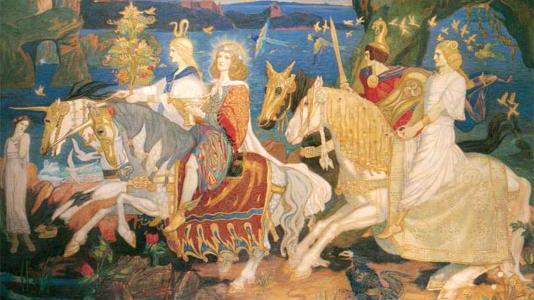
(Header Image: Riders Of the Sidhe – John Duncan. 1911)

 Meg Sorick, Author/Artist