In Flanders’ Fields

In Flanders fields the poppies blow
Between the crosses, row on row,
That mark our place; and in the sky
The larks, still bravely singing, fly
Scarce heard amid the guns below.

We are the Dead. Short days ago
We lived, felt dawn, saw sunset glow,
Loved and were loved, and now we lie
In Flanders fields.

Take up our quarrel with the foe:
To you from failing hands we throw
The torch; be yours to hold it high.
If ye break faith with us who die
We shall not sleep, though poppies grow
In Flanders fields.

~John McCrae

“In Flanders Fields” is one of the most popular and most quoted poems from World War One. It was composed by Lieutenant-Colonel John McCrae, a Canadian physician. He enrolled with the Canadian Expeditionary Force at the age of 41. Because of his age and his medical background, he could have enrolled in the medical corps but instead he chose to join a fighting unit.  He was inspired to write the poem after presiding over the funeral of his friend and fellow soldier, Lieutenant Alexis Helmer. Both men fought in the Second Battle of Ypres. Only one of them would live to tell…

The Second battle of Ypres was fought between April 22 and May 25 in 1915, in the Flanders region of Belgium. It is noteworthy since this is where the German army launched one of the first chemical attacks in the history of war. Despite this horrific onslaught, the Canadian lines held for over two weeks, and the Germans were unable to break through.

Describing the scene as a “nightmare,’ McCrae wrote to his mother: “For seventeen days and seventeen nights none of us have had our clothes off, nor our boots even, except occasionally. In all that time while I was awake, gunfire and rifle fire never ceased for sixty seconds…. And behind it all was the constant background of the sights of the dead, the wounded, the maimed, and a terrible anxiety lest the line should give way.”

McCrae’s close friend, Alexis Helmer, was killed during the battle on May 2. The next day, as he presided over the funeral, McCrae noted how quickly the poppies grew around the graves of the fallen at Ypres. He composed the poem that day, May 3, 1915, while sitting in the back of an ambulance at an Advanced Dressing Station outside Ypres. This location is today known as the John McCrae Memorial Site.

Brothels of Pompeii

Header image: Mount Vesuvius, as seen from the streets of Naples – photo my own.

Yes, the world’s oldest profession… I was going to make this a Wordless Wednesday post, but I really think it deserves a little description. So in the name of history, let me explain what you are looking at. The images painted on the walls of a typical brothel of the time –Pompeii was destroyed by the eruption of Mount Vesuvius in AD 79– weren’t merely to arouse the patrons visiting the establishment. You see, at the height of Pompeii’s splendor, an average citizen would have been illiterate. Only the upper classes would have been able to read or write. Thus, the images provided a sort of menu from which the customer could make some choices. Also, notice that the one being ‘serviced’ in the images all had the darker skin of someone who worked out of doors, perhaps depicting a shepherd or field laborer, whereas the prostitutes all had the fairest of skin. Here are some photos from my trip to Italy in 2009:

rome-465rome-466rome-468rome-469rome-472

Paul Nash: War Artist, Seaside Surrealist

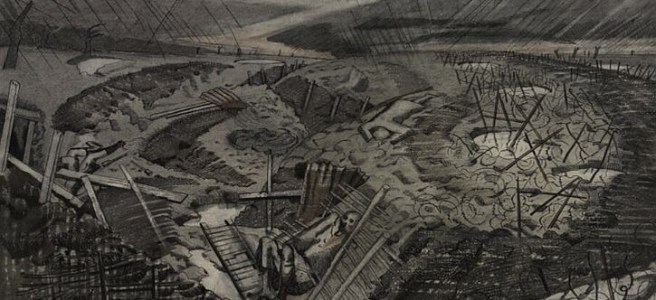
Header Image: After the Battle, 1918 – Paul Nash

With another connection to World War One, I’ve asked Mr. Cake (and he kindly agreed) to share a piece on the wonderful artist Paul Nash.

Paul Nash is one of the foremost of British artists of the 20th Century as well as a major landscape painter. He was an official war artist in both World Wars, a leading exponent of Modernism in England , a founding member of the avant-garde group Unit One, whose members included Henry Moore, Barbara Hepworth, Ben Nicholson and the art critic, poet and writer Herbert Read, with whom he organised the International Surrealist Exhibition at the New Burlington Galleries, London in 1936.

Nash’s paintings and lithographs that he produced as official war artist during WWI are some of the most potent and visceral images of the devastated landscapes wrought by the infernal mechanised weapons of war. Justly famous are The Ypres Salient At Night and We Are Making A New World both of which are part of the Imperial War Museums permanent collection.

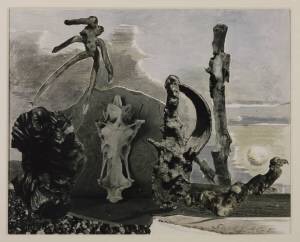
The war had left Paul Nash emotionally and artistically drained. In 1933 he formed the short-lived but important avant-garde group Unit One. He formed links across the Channel with the Surrealists, later commenting that he hadn’t found Surrealism, Surrealism had found him. Around this time he was based in the seaside town of Swanage on the Dorset coast, which led him to formulate his theory of ‘Seaside Surrealism’. He also began an affair with another exceptional Surrealist, Eileen Agar ( see Surrealist Women: Eileen Agar). Notable works of this period as the found objects collage Swanage and the painting Landscape In A Dream from 1936-1938.

Swanage circa, 1936 – Paul Nash 

At the start of WWII, Nash was again commissioned as a official war artist, this time with the Royal Air Force and the Air Ministry, which led to one of his most haunting paintings, Totes Meer (Dead Sea), (see below) based on Caspar David Friedrich’s The Sea of Ice, which was inspired by a field of crashed German aircraft in Cowley, Oxfordshire.

Paul Nash died in 1946 from heart failure resulting from his long term asthma. He is currently the subject of a major retrospective at the Tate until March 2017. Recently there has been a critical re-evaluation of his work, especially the important paintings from WWI and WWII, and he is generally considered the most important British painter between J.M.W Turner and Francis Bacon.

Totes Meer (Dead Sea) 1940-1 Paul Nash 1889-1946 Presented by the War Artists Advisory Committee 1946