
What gives you the ‘write’?

Finding the inspiration to write.

New writers, experienced writers, amateur or professional —meaning you actually get paid for this stuff, at some point, will struggle to find something to write about. Even non-fiction writers may wrestle with finding new ways to express themselves so that their writing doesn’t become stale or monotonous. And yet, we do write on. Writers have unique ways of working through the times we get stuck and can’t move forward.

Sometimes it’s just a lack of focus.  This is where I find myself currently –dreaming about vacation, searching travel websites…  You’ve probably picked up on that from some of my latest posts!  Nevertheless, I have goals set, schedules to meet, and must find a way to press on.  So with that in mind, here’s something that inspires me when my muse has wandered off to somewhere warm and sunny.

Music:

If you know me, you know I love music. I’m am a rock star in my mind.  Or a groupie, at a minimum.  Alice Cooper’s caddy, maybe.  (The godfather of shock rock is a huge golfer!)  But I digress…  Music can be very inspiring. Think about the music you love, your favorite song. Think about how that song makes you feel when you hear it. There are songs that make me want to dance with joy, weep in misery and every variety of emotion in between. That emotion can be translated into your writing. Here’s one way.

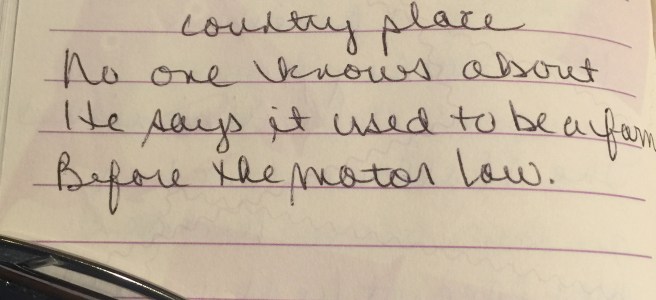
One of the things that I love to do is use a song lyric as a writing prompt. A line, phrase or verse can have such deep meaning and can be personal to each listener.  A story can arise from pondering what that lyric says to you. Don’t even worry about what the songwriter was thinking. What memory or feelings does it conjure in you? Where were you and who were you with when you first heard that song?

This doesn’t only work for short stories or poetry.  There have been times where I’ve been staring at my computer screen, halfway through a novel manuscript –even with a thoroughly plotted outline– when I’ve drawn a complete blank.  What happens next?  I can’t summon the words.  So finding the music that matches the mood of the scene I’m writing, taking a break and just listening, can prod my imagination.  A word, a phrase, or just a feeling can propel the scene forward.  And boom you’re off and running again!

Want to try? Here are a few lines from some of my favorite songs. Try writing a paragraph (or longer, if you’re really inspired) that tells a story based on the line.

1) “My uncle has a country place, no one knows about…” – Red Barchetta, by Rush.
2) “He’s gonna break her heart to pieces, she don’t wanna see…” A Woman In Love, by Tom Petty and the Heartbreakers.

-Don’t like male vocalists? How about these ladies?

3) “When it’s you I find like ghost in my mind…” – Emmylou, by First Aid Kit and speaking of Emmylou.…
4) “It was a teenage wedding and the old folks wished them well…” –C’est La Vie, by Emmylou Harris.

Don’t like any of these?  Use a line from your favorite song.  Go ahead, give it a shot. If you like what you wrote, put a link in the comments.  If not, no worries.  I’m not starting a challenge or anything.  But see if music doesn’t fire your imagination, poke an elbow your muse’s side and give you the ‘write’!

Here’s all of Red Barchetta by Rush.  I love these guys!   Neil Peart writes most of the lyrics for the songs and he’s an absolute god on the drums.  Alex Lifeson on guitar and Geddy Lee, bassist extraordinaire, complete the trio.

Places, everyone! Writing Action!

Working out the issues in novel writing.

“And… Action!” the director orders.

The actors, already in position and waiting, begin to play out they parts in the scene. Perhaps they are fleeing for their lives, preparing to engage in hand-to-hand combat or in a steamy, passionate, heart-stopping kiss. A good director will shoot a scene over and over, coaching the actors until it plays just the want he or she wants it. The movements, the facial expressions, the gestures all have to be absolutely perfect for the scene to ring true, to be authentic. The very same principles can be applied to creating the action scenes in the written form. An author must visualize –watch the scene unfold in the imagination– then write. What works? What reads awkwardly?

In writing, we talk about SHOW versus TELL. In other words, don’t just say “Mary made a cup of tea.” Show Mary filling the kettle, lighting the stove, spooning tea leaves into the pot… and so forth. It makes for much more interesting reading because all these little actions help the reader “see” what the characters are doing. The best way to illustrate is by example, so let’s practice, shall we?

The fight:

Instead of saying: Brad punched Kerry in the nose….

Brad stood staring Kerry down, his fists clenched at his side. Kerry just didn’t know when to shut up. Insinuating that Brad’s intentions toward Maya were less than honorable was the last straw. And now he was laughing about it. Brad pivoted, putting most of his weight on his right foot. When his arm shot out, Kerry didn’t have time to react. As the clenched fist connected, Kerry felt as well as heard the crunch of bone, tasted blood in his mouth. His head spun as his neck whipped around from the impact and he stumbled. He grabbed the back of the chair to keep from falling when the next blow landed. All the air was sucked out of his lungs with the punch to the gut. The blood was pouring from his nose now. He was choking on it. He raised a hand in surrender. “Please,” he managed in a hoarse whisper.

Ok, that’s enough. You get the idea. Not my best writing, but good enough for our purposes. The point is that action sequences have to have, well, action! There has to be movement. Describe smells, tastes, textures and sounds: the taste of blood, the crunch of bone, for example. The reader can visualize the scene because of the detail the writer has provided. I know that some writers actually make up story boards for action scenes. It helps because it breaks a scene into its component parts. A caution — don’t get all listy.  By that I mean, don’t list the components of a scene like: First, Brad put all his weight on his right foot, then he pivoted, then he threw the first punch and then…  Get it? Listy – not good.

You might even want to watch a fight scene from film or TV to find some inspiration. The same would be true of a car chase, an attack by aliens or giant radioactive monsters… (All of which I may address in future posts.  I know — you can’t wait.) Nevertheless, the principles apply.

Now let’s go to the complete other end of the spectrum to an example of a smaller, more subtle kind of action.

The kiss:

Instead of saying:  Brad kissed Maya tenderly…

Tears streamed down Maya’s cheeks and it broke his heart. Brad crossed the room in three strides and took her in his arms. “Maya,” he whispered, framing her face with his hands. With his thumbs, he gently swept away the last of her tears. Her blue eyes were bottomless pools and he found himself sinking into them. With his heart thudding in his chest, he lowered his lips to hers, softly at first. Tentatively, he deepened the kiss as she responded. She sighed against him, parting her lips slightly, letting him in. She tasted like the salt of her tears but he didn’t mind.  He teased with his tongue, slowly, languidly as if he could make this kiss last forever…

Ok, romantic drivel, I know. Sorry, dudes. There are things to consider when writing the perfect kiss. What are the kissers doing with their hands? Is it a chaste, first-time kiss or a passionate kiss between long time lovers? Do they angle their heads one way or another? (The nose gets in the way, after all!) How long does it go on? They may be out of breath when they finally break apart.

Speaking of breath, I know we don’t like to talk about it, but is it minty fresh, taste like cigarette smoke, coffee or the shot of whiskey he or she just tossed back? Think about textures again: his soft flannel shirt, her silky blouse, his rough and calloused hands, her glossy, swollen lips, his strong arms, her lustrous hair, blah, blah, blah.

You see what I’m saying, though, right? You, the reader, have the movie of the scene playing in your head while your eyes scan those words. Every time you write action, think about how the five senses are impacted. That is how you SHOW action, instead of just TELLing us that it happened.

I hope you found this to be useful! Happy writing, my dears!

How would you write it?

I’m pondering a situation in which someone has died.  This person is popular amongst her peers.  The main character of this story is only one of a few who knows the deceased for what she really is:  a cruel, passive-aggressive manipulator.  This has been kept secret in order to maintain appearances for years.  The dilemma is  this:  Everyone expects grief, mourning, an elaborate funeral and/or memorial service from our main character.  She wants none of it.  She is actually relieved at the removal of this person from her life.  Yet, will everyone else think she is a monster for feeling this way?  What does she do?

Imagine the effort it would take to stand in a line, accept everyone’s sympathy, thank them for their support…  While secretly leaping for joy.  While privately and happily contemplating a future free of this negative influence.  But also perpetuating the lie.

On the other hand, would it be courageous of our main character to decide not to fake it?  To just arrange for a burial and forgo the formalities?  To let everyone know their sympathy is wasted on her?  Or would that be horrible?

The direction I take going forward from this plot point is dependent on it’s outcome.  I really would like your feedback.  Bear in mind this is less about right versus wrong than it is about what would make a more interesting read.  Issues abound no matter which decison is made!

Any thoughts?