You can find part one of the story here.
(2)
Amanda paled. “What do you mean, it’s like he’s not alive?”
Ignoring her question, the doctor hurried to the door and called for one of the nurses to come quickly.
Brian sat in stunned silence. He shook his head to clear it. “There must be something wrong with his equipment,” he murmured.
Amanda smiled nervously. “Yes, yes. Of course you’re right. It’s got to be some sort of malfunction.”
The doctor returned, a second stethoscope and sphygmomanometer in his hands and performed the tests a second time. Without a word, he shook his head in dismay. A moment later a nurse entered the room with yet another set of tools and a tray with syringes and vials. When the third examination yielded the same results, the doctor readied the syringe. “Bloodwork,” he said. “We’ll get to the bottom of this.” But as he probed for a vein, his look of concern turned to fear. “I can’t even find a vein. I’m sorry… let me just try…” he said as he found a spot and gently pressed the needle into flesh. “What the…?” he said, stumbling back. The needle had barely penetrated Brian’s skin. He tried another spot and another. Then the other arm but it was no use.
“What is it? What’s going on?” Amanda demanded, the doctor’s alarm apparent.
“There’s something under the skin. Some kind of barrier.” He sat heavily on his rolling chair and looked at Brian with awe. “Artificial limbs? Some kind of advanced technology? Experimental surgery? Something? Anything? Any way you can explain this?”
Brian shook his head. “Never even had my tonsils out.”
The doctor rubbed his hands over his face. “We need to run more tests. I’m sending you to the hospital.” He turned to the nurse. “Call ahead. Tell them the situation so they’re ready and waiting for him.” Then taking a deep breath, he continued, “There has to be a logical reason for these findings. We’ll get x-rays, a CT scan, maybe an MRI. The hospital is one of the finest in the country. You’ll be in the best possible hands.”
They sat, not speaking while the doctor typed furiously into his laptop. A moment later, the nurse returned to let them know a team of doctors would be expecting them and gave them directions as to where to go.
As Brian slipped his shirt back on, there was a commotion in the waiting room. “Excuse me a moment, will you?” the doctor said and hurried from the room. Amanda and Brian exchanged a look as the sound of raised voices, then shouting and doors slamming reached their ears.
“We’d better go see what’s happening,” Brian said. But just as they reached the door, it flew open and two imposing figures blocked the way. The men, at least they assumed they were men based on their size, were dressed in hazmat suits, masks and boots.
“You both need to come with us,” one of them ordered.
“But what…?” Brian began, before the other one cut him off.
“Everything will be explained. We need to go now. This is not optional.” And to emphasize his point, he raised his gloved hand to show them a gun.
Each man took Brian and Amanda by the arm and escorted them through the now deserted office. A third man stood guarding the door. After exiting the building, they were herded into a waiting van. Just as the door was sliding closed, Amanda turned back to see the man guarding the office pull of his mask and unzip the suit.
“What’s going on? Are we in some kind of danger?” Brian demanded as the van began to move.
The two men who had rushed them from the office now removed their protective clothing as well. The one holding the gun spoke. “No. We just needed a plausible cover to remove you from the office. The staff and the other waiting patients were told there was a noxious spill, and we were clearing the area as a precaution.”
“But why? Where are you taking us?” Amanda asked, her voice shaking.
“I’m not authorized to answer your questions. Please be patient,” he said.
“We were supposed to be going to the hospital… my husband…” Amanda began.
“We are aware of that ma’am. That’s how we found you. We been monitoring medical facilities on the chance something like this would happen. That’s all I can tell you. Please remain calm.”
“Remain calm?!? Remain calm?!?” Amanda cried. Brian tried to put an arm around her but she shook it off. “You need to tell us what’s going on and where you’re taking us, right now! Right this very minute!”
The two men exchanged a look and the one not holding the gun opened a small case sitting on the floor beside him. “We hoped it wouldn’t come to this.” He extracted a syringe and before Amanda could react, stuck it into the side of her neck.
“No….” she sighed as she felt unconsciousness overwhelming her. The last thing she remembered was staring up at the dome light of the van.
To be continued…

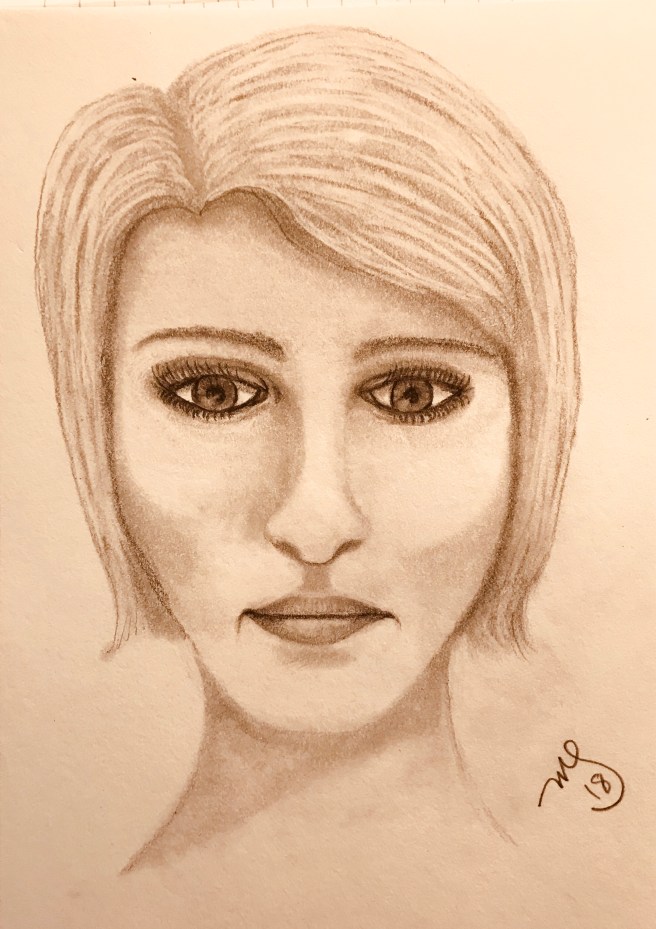 You said I had an interesting face

 Meg Sorick, Author/Artist