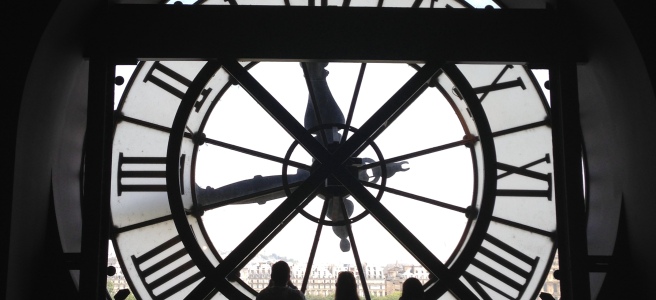
I’ve written about this before, but it’s been a while and I thought it was worth revisiting. The photo is my own of the clock face at Musee d’Orsay in Paris.
I write. A lot. Four books in two years, a fifth near completion, several completely unrelated projects, including all the poetry, non-fiction and short stories I’ve posted here. Recently, a friend of mine asked how I had time to write like that. The short answer is: I have no life. Ok, that’s a joke, sort of. Many of us who are trying to live the writing life are fitting it into an already busy schedule. How does someone with a day job manage to carve out time in the day to write? Schedules vary, but there are some principle to apply.
In the days when I was in practice at another doctor’s office, I had a long commute –nearly an hour. In the morning, I regularly tuned in to NPR’s Morning Edition. On one of those long drives, I heard an interview with author, Nora Roberts. For those of you who don’t know her, she is a ‘rock star’ of romance writers. She has written over 209 novels in her illustrious career. Now, love it or hate it, the romance genre has been underrated by literary snobs for no good reason. Jane Austen was a romance writer. So were the Bronte sisters, Margaret Mitchell, Gustave Flaubert, F. Scott Fitzgerald, Edith Wharton – need I say more? Anyway the style of writing has nothing to do with the point I’m trying to make.
Back to Nora’s interview, and the big impression it made on me. She said she approaches her writing like any other person would approach their work day. She gets up early, exercises, puts the coffee pot on and by 8:00, she is at her desk to write for an 8 hour day! That’s right, a full work day. Writing is work, albeit very enjoyable work, but work nonetheless.
Though I still have a day job, I have tried to impose that kind of discipline upon my writing. Every weekday, I get up early and write for an hour or so, exercise and go to the office (now it’s in my home) to see my patients. Tuesday and Thursday, the days I don’t have office hours, I keep on writing. (So that’s how she does it!) I set deadlines to keep from getting off track. I have writing goals for my novel series, for my blog and for the unrelated projects like Here Lies a Soldier and The Mysterious Arboretum.
Anyway, the trick is to be analytical and slightly selfish when it comes to your writing.  Take a look at your weekly schedule. How much time do you spend in front of the TV? Playing video games? Fooling around on Facebook and Twitter? I know, I know, I do it, too. This is time you could be spending on your writing. On the other hand, don’t let your writing become so burdensome that you lose your joy. After a big project is complete, or sometimes in the middle when you’re hitting the wall, take a break, step back and recharge your batteries.
Here are some things you should NOT sacrifice for time to write:
-your spouse/partner and children (unless you secretly can’t stand them)
-your health and wellness: take time to exercise, drink plenty of water and eat healthy food – it powers your brain (also booze, but that’s a subject for it’s own post)
-your spiritual life: whatever that means to you, be it meditation, prayer, or just quiet time to think (also gives you a legitimate excuse to ignore your family)
-reading for pleasure: writers need to read, period
-spending time with friends (if you still have any)
 Why that last one? Because frankly, writers spend a lot of time in our own heads and can invent our own friends by writing them. I am totally guilty of that. While that internal chatter is essential for good writing, you have to turn it off once in a while. Don’t give up the chance to have real life human connections in order to create your fantasy world.
Writers, the bottom line is if you are going to do this, your writing can’t get shuffled so far to the bottom of the pile that you never finish anything. If you find that happening to you ALL THE TIME, then reevaluate your plan to be a writer. Maybe the writing life is not for you. That’s ok, too. Be a reader. After all, someone’s got to read all this stuff we write!
How about the rest of you? Writers, how do you find time to write?
(As always, some of that was meant to be humorous. I assume you’re all savvy enough to pick out the useful stuff from the nonsense.)


 I was unable to find cremant d’Alsace in my local liquor stores. By now, you are not surprised, I know. So my substitute for this week is a nice (real) champagne… Moët And Chandon Nectar Imperial.
 Meg Sorick, Author/Artist