
The Great War – Research Notes (16) The Art Of War

When war broke out in August 1914, no one on either side of the conflict believed that it would rage on for over four bloody, devastating years. Many in fact, welcomed the war, believing it to be an opportunity for adventure —glorious and brief. The famous declaration that the whole thing would be finished ‘before the leaves fell from the trees’ or at the latest ‘by Christmas’ contributed to the romantic notion of going off to war. These fantasies were soon shattered by the gruesome reality of modern warfare.

The responses to the war evolved as time passed; from initial enthusiasm, nationalistic fervor and patriotism to shock, horror, anguish and remorse. These various and sometimes contradictory emotions are reflected in the art of the time. Photography and film news reels brought the carnage to life, so that even those at home got a taste of the true nature of war. Many artists and writers saw the war from the front lines and composed poetry, authored literature and created works of visual art reflective of those dreadful experiences. The following are samples of some of the works of art produced during and following The Great War:

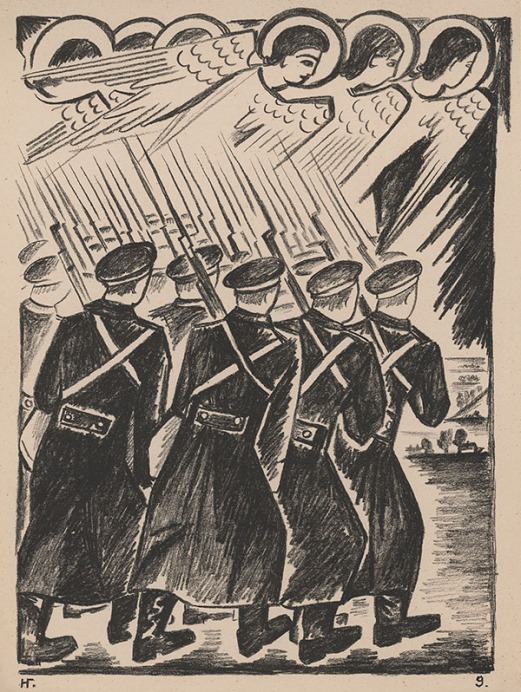
I.  At the outset, many believed that the war would bring an end to the old social and political systems and usher in a new order of equality and progress. This optimism can be seen in the following lithograph from a collection called, Mystical Images of War. The artist, Natalia Goncharova, a Russian living in Paris at the outbreak of war, depicts the angelic host watching over the soldiers as they march away.

The Christian Host ~ Natalia Goncharova, 1914
goncharova.jpg

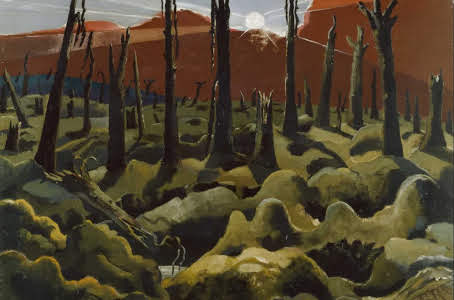
II.  Paul Nash is one of my favorite artists and he’s been featured here previously. The painting Ypres Salient At Night heads my poem: Tales Of War. Despite the optimistic title, Paul Nash’s painting depicts a scarred landscape with shell-holes, mounds of earth, and leafless trees –the resulting devastation of World War One.

We Are Making a New World ~ Paul Nash; 1918
Unknown

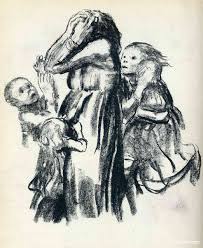
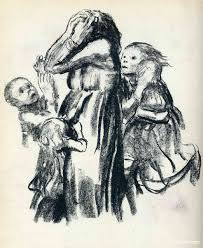
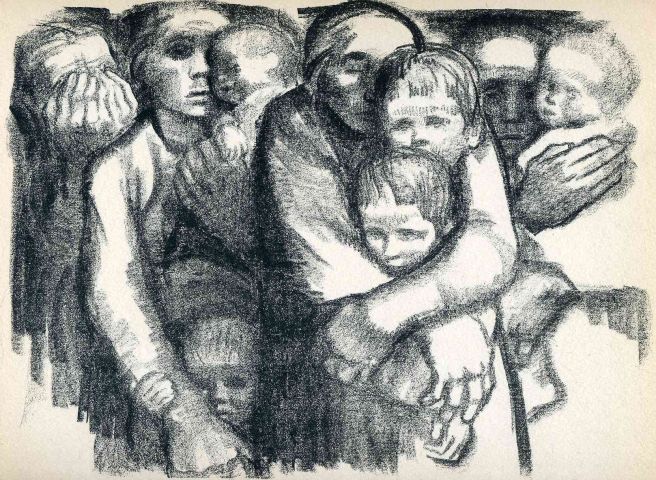
III.  Kathe Kollwitz used her art to portray the grief of loss from war. The following two pieces show the heartbreaking agony and hardship experienced by those left behind.

Killed In Action (Gefallen) ~ Kathe Kollwitz, 1920
Unknown-1

Mothers in different stages of life, held together by one common bond: the need to protect their children.

Mothers (Mütter) ~ Kathe Kollwitz, 1919
81cfd894f50c6a43b91ab3e4ffa5efc6.jpg

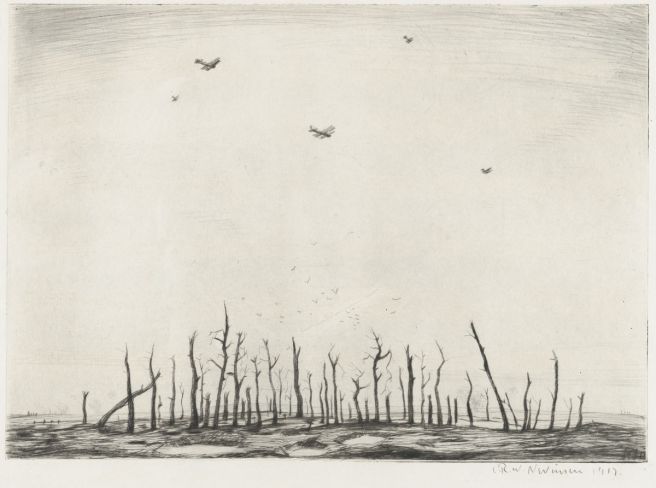
IV.  Christopher Richard Wynn Nevinson revisits the desolation of No Man’s Land with insect-like planes buzzing overhead in That Cursed Wood, a title taken from a line in Siegfried Sassoon’s poem, At Carnoy: “Tomorrow we must go / To take some cursed wood… Oh world God made!”

That Cursed Wood ~ Christopher Richard Wynn Nevinson, 1917
main-image.jpeg

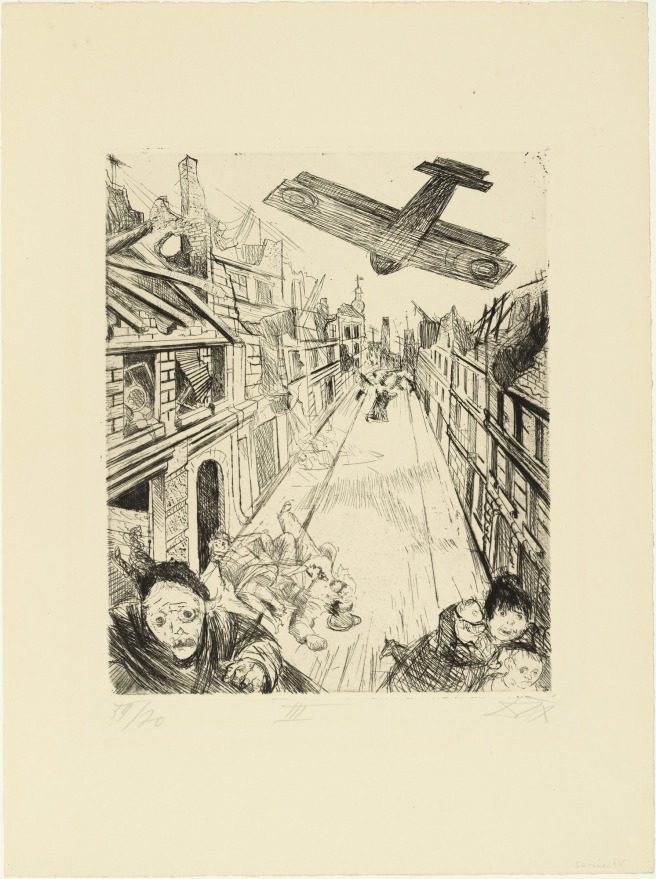
V.  I’ve featured Otto Dix twice before in my Great War posts. Shock Troops Advance Under Gas was the image for a post on chemical weapons and I used The Wounded Man to head my post about the disfiguring injuries to soldiers. You can click on the links to view those pieces. Otto Dix served for four years as a machine gun operator in the German army on the front lines in Belgium and France. He was grievously injured and suffered terrible nightmares about his experience. After the Armistice, during the height of these nightmares, he produced a series of drawings and etchings called The War (Der Krieg). Here is one more from that collection. In sharp contrast to the nationalist propaganda featuring war heroes like Baron Manfred von Richthofen (The Red Baron), Lens Being Bombed shows the terror and desperation of the citizens of the town in Northern France as they run for their lives.

Lens Being Bombed (Lens wird mit Bomben Belegt) ~Otto Dix, 1923-1924
cri_000000116429.jpg

There are many, many more significant artists and artwork to consider, so this will be one of several posts on the subject.

Fiction Writing Is Not a Roll Call

A common mistake many new writers make is to inundate the reader with unnecessary information or too much information all at once. In writing circles it’s called infodump. It might manifest as a roll call of characters, lengthy biographical history as each one is introduced, overly detailed scene setting or world building. It happens because writers want their readers to understand the context of unfolding events. While the writer’s intentions are good, it bogs down the pace of the story and it doesn’t leave the reader with questions that need to be answered by reading on.

Imagine reading this paragraph:

Jennifer Dunne was a 28 year old woman whose mother had just died, but since they never had a very close relationship, Jennifer was not able to cry at her funeral. Her elderly father was her only source of comfort growing up and she followed in his footsteps by becoming an engineer and going to work in his company. Jennifer has two best friends, Des and Joni, who she has known since grade school and they are as close as sisters would be. They all live in Doylestown, the county seat of Bucks County, Pennsylvania, which is an hour north of Philadelphia. (Are you bored yet?)

My first draft of Three Empty Frames wasn’t quite that bad, but I did an awful lot of infodumping on my first try at novel writing. The thing is… all that information eventually got included in the story but in small doses as the information became relevant to the plot.

One of my chief methods of incorporating detail into the story, especially the biographical history of the characters, is through dialogue. In the fictional world as in the real world, when people talk, they tell one another about themselves. When boy meets girl or girl meets girl or whatever, it is only natural for the pair to begin to share personal information. Even then, it wouldn’t be natural for the character to tell his entire life story, but just a few memories can reveal a great deal about the person and what makes them tick. The same is true with their conversational style and delivery. The way they talk will give the reader clues as to their personality without having to describe it intimate detail:

Jen was smart and loyal but guarded, keeping all but her close friends at arms’ length. Her sense of humor was sarcastic and as a result, she often offended people unintentionally. (Readers will figure this out on their own as they see how Jen relates to others; they don’t need it spelled out for them.)

The same is true of your setting. The location doesn’t need to be described in meticulous detail as the story opens. However, in just a few words, the scene can be set:

“It was a bright cold day in April and the clocks were striking thirteen.” ~ 1984; George Orwell.

Just from that opening line, we know the weather and time of year but we also know something’s up because our clocks don’t strike thirteen. It’s only later on that we discover the full extent of Orwell’s dystopian vision, yet, the season and time of day are described clearly. And establishing place and time is an important feature to include within the first few paragraphs of a story. It orients the reader, connecting them to the fictional world. Nevertheless, the details can be saved for later. This includes the size of the town or its population, its proximity to another metropolitan area, the main industry of the region (if that even matters) and its infrastructure: busy highways, high-rise apartments, public transportation versus narrow streets, quaint houses and mountain views. Just an aside —the bit about ‘clocks striking thirteen’ is one of those mysterious details that compels the reader to continue. We should all aspire to create such a hook at the start of the story!

Things can get tricky when your story has a big cast of characters. In order to distinguish one from another, you might feel obilgated to write a lengthy biography to fix each one in the reader’s mind. But really, if the character is not central to the plot, this is irrelevant filler material. For minor characters, a unique and memorable name might be enough to set them apart from the main players. Some minor characters don’t even need to be named. For example, Jen might just refer to ‘her boss’ rather than ‘Harry, a fifty year old chief engineer in her department who isn’t afraid to get his hands dirty and is well liked by all his employees’. Seriously, who cares? Unless Harry is going to have a larger role later on, there is no need to expound on his qualities as a boss. Additionally, if you do have a big cast of characters, don’t introduce all of them in Chapter One. Bring each one onto the stage as their appearances become integral to the plot. For example, your mystery story might have a detective investigate the crime, but if the story is built around the victims of the crime then the detective doesn’t need to show up until several chapters in. A late introduction doesn’t automatically diminish the minor character’s importance to the story. While the main characters should be introduced early, so that the reader can establish a relationship with them, the rest of the cast can enter as they become relevant.

The tendency to infodump is a difficult one to overcome. Nevertheless, with awareness and practice it can be managed and mastered.

Wishing you happy writing and productive editing.

Header image via Vector Images

Pennsylvania’s Emerging Writers

A few months ago I was approached by an editor at Z Publishing House asking me to submit some of my work to be included in a forthcoming anthology of writers from my home state. I am delighted to say my short story Dissolved was selected for inclusion in the collection along with some other very talented and creative writers from Pennsylvania. If you are interested in checking out the book, it is available for purchase on Amazon. Find it here.