
I’m not one for making resolutions. However, I don’t avoid them if they seem like worthy goals. In that spirit, I have been taking on the Goodreads reading challenge each year. Personally, I think writers ought to be avid readers, as well. Reading is what inspired me to try writing so why on earth would I give it up?
Nevertheless, the more involved I’ve become in writing and blogging, the less time I’ve devoted to my books. Last year, I set the goal of reading 25 books for the Goodreads challenge: 2 per month (plus one). I am sorry to say, I fell short by 5 books. But with researching for my writing, I still did a lot of reading. At any rate, this year, I’ve lowered the bar to 20 books and I thought I’d share the ones I’ve chosen to read:
- A Line In the Sand – The Anglo-French Struggle For the Middle East, 1914-1918; James Barr
- Living – Henry Green
- Loving – Henry Green
- Party Going – Henry Green
- Madame Bovary – Gustave Flaubert
- Down and Out In Paris and London – George Orwell
- Storm Of Steel – Ernst Junger
- Devil’s Brood – Sharon Kay Penman
- The Man In the High Castle – Philip K. Dick
- The Mother Tongue – Bill Bryson
- The Gods of Guilt – Michael Connelly
- Princess Margaret: A Biography – Theo Aronson
- The Collected Poems of Ivor Gurney
- Blue Mars – Kim Stanley Robinson
- A Farewell To Arms – Ernest Hemingway
- Garden Of Lies – Eileen Goudge
- On Writing; A Memoir of the Craft – Stephen King
- W. B. Yeats and the Muses – Joseph Hassett (started, but not finished)
- The Crimes of Love – The Marquis de Sade (started but not finished)
- The Bell Jar – Sylvia Plath (started but not finished)
If I manage that, I will clear the precariously stacked pile on my bedside table! Yes, I still read paper books. I consume books in three formats, actually: paper, e-book and audio-book. I also usually have several going at the same time. For example, I listen to an audiobook while exercising, read one non-fiction/biography and one fiction book all at once. As long as I keep the genres distinct, I can keep from getting them confused.
So, my writer friends, what are you reading this year?
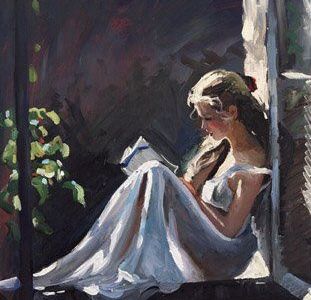
Artwork: ‘Serenity’ – Sheree Valentine Daines

 Meg Sorick, Author/Artist
