Color – A Limerick 

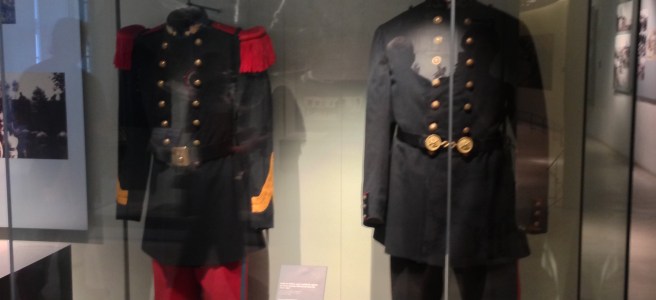
In ‘pantelon rouge’ marched the army of France
But the uniform gave them little chance
To dodge the enemy bullet
In fact made them a target
All because of the color of their pants

In response to Mind and Life Matters limerick poetry challenge.

World War I: The very heavy French losses during the Battle of the Frontiers can be attributed in part to the high visibility of the French uniforms, combined with peacetime training which placed emphasis on attacking in massed formations. The shortcomings of the uniforms were quickly realized and during the first quarter of 1915 general distribution of horizon-blue clothing in simplified patterns had been undertaken.

Source -Wikipedia; photo my own

The Spanish Flu of 1918- Research Discoveries

I’ve been researching for my story Here Lies a Soldier by reading as much as I reasonably can about the time period. Honestly, too much and I’d be ready to jump off a bridge… One part of the story involves The Spanish Flu Epidemic –albeit ever so peripherally– and I wanted to educate myself on the plague that killed some 50 million people worldwide in 1918, more than 10 times the number killed by The Great War.

Rather than ‘reinvent the wheel,’ pulling tidbits and random facts from all over the place, I am in the process of reading a book about the flu:  Living With Enza -The Forgotten Story Of Britain and the Great Flu Pandemic Of 1918.  IMG_3464

Thusly, the information I am going to share with you has been taken from this work. The author —Mark Honigsbaum— has compiled and sifted through a huge amount of data to write this book. Here are some of the things I found interesting and frankly, horrifying.

Some facts about influenza:

The term influenza most likely derives from the Italian phrase ‘influenzi coeli’ meaning ‘influence of the heavens.’ By the mid 18th century it was more common to hear the term, ‘influenzi di freddo’ or influence of the cold. It was in this sense that the term entered the English language in 1743.

Influenza viruses spread aerially, usually in small droplets expelled when someone coughs or sneezes, and tend to be more stable in cool dry conditions. Researchers have also discovered that at around 5 degrees C (41 degrees Fahrenheit) the virus transmits for about 2 days longer than at 20 degrees. A popular (and morbid) children’s rhyme of the time may actually be spot on. It goes like this:

I had a little bird
Its name was Enza
I opened the window
And in-flu-enza

The Spanish Flu in particular:

The Spanish Flu was so virulent because of its genetic makeup. There are 3 types of influenza viruses: A, B, and C. The B type produces classic winter flu while the C type rarely causes disease in humans. The A type, however, is the one responsible for the great pandemics of history. Because viruses are not cells, they do not have DNA to organize their replication. Rather, they use 8 delicate strands of RNA which codes for proteins and enzymes on the surface of the virus. Trouble arises during replication because the RNA cannot copy perfectly. Errors called ‘antigenic drift’ occur when the avian or swine strain of the virus is exchanging genes with the human host.  The result is a new subtype of the virus. Then once inside the new host, the 8 strands of RNA randomly shuffle, generating an entirely new virus for which the human immune system has no antibodies. With no defense, the virus can spread like a wild-fire.

The rate of mortality fell disproportionally on young adults, usually the least vulnerable of a population. The 1918 flu struck suddenly and without warning. One moment a person was up and about, the next day they would be lying incapacitated, coughing up greenish-yellow sputum. The final stage came when their lungs filled with fluid, prompting the heart to leach oxygen from the head and feet, resulting in a dark purple staining across the lips and cheeks of the victim.

Possible contributing factors:

The effects of gas attacks during the war.  Gasses like phosgene and chlorine were not only capable of disabling and killing on contact, they also acted as soil contaminants denying valuable ground to the enemy. In all, it is estimated that some 150,000 tons of poison gasses – the equivalent of a modern day supertanker – were dumped on the killing fields of Flanders and Northern France during the last 2 years of the war, saturating the soil to the point where it became impossible for attacking troops to hold territory without large numbers of men having to retreat to field hospitals with suppurating blisters, damaged lungs, and eyes.

The most mutagenic of all gasses – mustard gas – 12,000 tons of which was dumped on the Western Front in 1917, accounted for 400,000 casualties. According to John Oxford, Professor of virology at Queen Mary’s Medical School of London and military historian Douglas Gill: these agents may have prompted ‘stepwise mutational changes’ in the influenza virus. And in combination with the bitterly cold conditions that prevailed at the Western Front in the winter of 1917, and the stresses and strains of war, it is possible such contaminants would have lowered men’s resistance to the flu.

That is a lot of information and I’m only part way into this fascinating book. If this subject interests you at all, I recommend reading it. As I continue my research, I’ll share some more of what I learn along the way. Or if you think this is terribly boring, let me know in the comments!



Here Lies a Soldier – the story thus far…

Last year I began writing a serial fiction piece with The Great War as the backdrop for this story that crosses the generations. Set primarily in the modern day, two cousins research their family history and discover a discrepancy in the records. With an incomplete picture, the pair tries to piece together what really happened 100 years in the past.

After setting the story aside to collaborate with Kevin on Double Seduction, I am ready to pick up the tale where I left off. If you’d like to catch up, the first seven installments may be found here. However, if you just want a quick refresher, here’s a synopsis of the story so far.

Chapter one: Meredith Miles visits Bedford House Cemetery every year to lay flowers at the gravesite of her great-grandfather, Frederick Jennings.  For many years, she brought her grandmother Anne, to the site to “visit” the father she never knew. Freddie had been killed in the First Battle of Ypres in April 1914, leaving his young wife at home, widowed and pregnant.

While laying flowers on the grave, Meredith is joined by a man about her age with a sheet of paper in his hands. David Jennings is there to visit, too. In his search to compile his family’s ancestry, he discovers that his great-grandfather, William, had a younger brother. William was also killed in The Great War and his body never recovered. Realizing she has a cousin she never knew about, Meredith offers to spend the afternoon with David, filling in the gaps where she can and showing him the Flanders region where both their ancestors lost their lives.

Chapter two: Meredith receives long delayed mail from David. He had written to attempt a visit and to pass on a family heirloom – a locket with the photographs of their great grandfathers inside. The mail misses her because she has moved from her London apartment to take a teaching position at St. Eanswith College in a small town on England’s Southeast coast. She has left the stress of the city and the university to get a fresh start after a painful breakup. Rob Powell has kept Meredith’s heart on a string. He won’t commit to her, yet he expects her to be there for him. She has finally decided to end it rather than to be constantly disappointed.

Chapter three: David makes plans to spend the Christmas holiday with Meredith in England.

Chapter four: David arrives in England.  Meredith picks him up at the airport. She takes him for lunch and a drive along the coast. Then, after an enjoyable day in each other’s company, David and Meredith are surprised when Rob shows up at the house unexpectedly.

Chapter five:  Rob is Meredith’s weakness. She allows him into her home and into her bed only to find him gone again before she rises. She tries to hide her sadness and shame from David but eventually she breaks down and he comforts her. David begins to feel very protective of his cousin.

Chapter six: The research begins.  David has brought along a binder full of memorabilia passed down to him from his father and grandfather.  Meredith has her gran’s scrapbook and photo albums. While poring over all the material, Meredith tells David the whole story about Rob and their breakup. We learn that David has been divorced for seven years. At the end of the chapter, Meredith finds a bit of information that changes everything and starts them on their journey of discovery.

Chapter seven: Meredith has discovered Ada Henry Jennings’ obituary. Ada was William’s wife, David’s great-grandmother, who died in 1918 – a victim of the Spanish flu epidemic. The obituary lists Ada as survived by a daughter, Gladys, as well as a son, Hayden. David has a great aunt – Gladys – and possibly second cousins he never knew about. Meredith and David decide to do further research. We find out that Hayden Jennings was a difficult man and didn’t get along well with his son Thomas, David’s father. We also learn that David’s parents –Thomas and Ellen– were killed in a car accident a few years ago.

So there you have it – the story so far.  The new installment will be posted next Friday, May 20. I hope you all enjoy the story as it unfolds. And so you know, Jennings is my family name and Frederick  Jennings is the name of my grandfather. The rest of the tale, however, is fiction. Thanks for reading!