Alan Seeger was born in New York City on June 22, 1888. After joining the French Foreign Legion in 1914, Seeger was killed in action in northern France on July 4, 1916.
I have a rendezvous with Death
At some disputed barricade,
When Spring comes back with rustling shade
And apple-blossoms fill the air—
I have a rendezvous with Death
When Spring brings back blue days and fair.
It may be he shall take my hand
And lead me into his dark land
And close my eyes and quench my breath—
It may be I shall pass him still.
I have a rendezvous with Death
On some scarred slope of battered hill,
When Spring comes round again this year
And the first meadow-flowers appear.
God knows ‘twere better to be deep
Pillowed in silk and scented down,
Where love throbs out in blissful sleep,
Pulse nigh to pulse, and breath to breath,
Where hushed awakenings are dear…
But I’ve a rendezvous with Death
At midnight in some flaming town,
When Spring trips north again this year,
And I to my pledged word am true,
I shall not fail that rendezvous.
I heard this song performed in a pub the other night. Perhaps I’ve been living under a rock, but I’d never heard it before. I am not ashamed to say it made me cry. The song was written by Scottish songwriter Eric Bogle after he sat beside the graveside of Private William McBride of the Iniskilling Fusilliers (Ireland). On the day that the real Willie McBride died –April 22, 1916 at The Battle Of the Somme– the fighting was particularly fierce. The men were waist deep in water in the trenches as the German bombardment rained down on them. The green fields of France ran red with blood that day. I’ve included a video version of the song by The Furies, the Irish group who made the song famous.
Well how do you do young Willie McBride?
do you mind if I sit down here by your graveside
and rest for a while ‘neath the warm summer sun
I’ve been walkin’ all day and I’m nearly done
I see by your gravestone you were only nineteen
when you joined the great fallen of 1916
Well I hope you died quick and I hope you died clean
Willie McBride was it slow and obscene
CHORUS
Did they beat the drum slowly did they play the fife lowly,
did they sound the death march as they lowered you down
did the band play the last post and chorus,
did the pipes play the “Flowers of the Forest”
And the beautiful wife or the sweetheart for life
in some faithful heart are you forever enshrined
and although you died back in 1916
in that faithful heart are you forever nineteen?
or are you a stranger without even a name
enshrined forever behind a glass pane
in an ould photograph torn tattered and stained,
fading to yellow in a brown leather frame?
CHORUS
Now the sun shines down on the green fields of France
a warm summer wind makes the red poppys dance
The trenches have vanished under the plows,
there’s no gas no barbed wire, there’s no guns firing now
but here in this graveyard it’s still No Man’s land,
the countless white crosses stand mute in the sand
for man’s blind indifference to his fellow man,
to a whole generation that was butchered and damned
CHORUS
Now Willie McBride I can’t help wonder why
Do those who lie here do they know why they died
Did they really beleive when they answered the call
did they really believe that this war would end wars
Forever this song of suffereing and shame
the killing the dying was all done in vain
for young Willie McBride it’s all happened again,
and again, and again, and again and again
With another connection to World War One, I’ve asked Mr. Cake (and he kindly agreed) to share a piece on the wonderful artist Paul Nash.
Paul Nash is one of the foremost of British artists of the 20th Century as well as a major landscape painter. He was an official war artist in both World Wars, a leading exponent of Modernism in England , a founding member of the avant-garde group Unit One, whose members included Henry Moore, Barbara Hepworth, Ben Nicholson and the art critic, poet and writer Herbert Read, with whom he organised the International Surrealist Exhibition at the New Burlington Galleries, London in 1936.
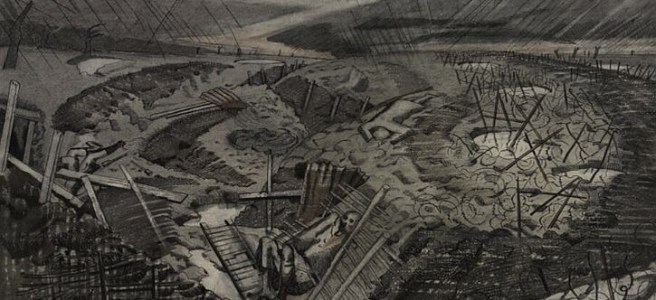
Nash’s paintings and lithographs that he produced as official war artist during WWI are some of the most potent and visceral images of the devastated landscapes wrought by the infernal mechanised weapons of war. Justly famous are The Ypres Salient At Night and We Are Making A New World both of which are part of the Imperial War Museums permanent collection.
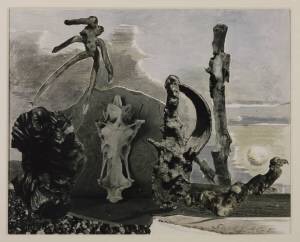
The war had left Paul Nash emotionally and artistically drained. In 1933 he formed the short-lived but important avant-garde group Unit One. He formed links across the Channel with the Surrealists, later commenting that he hadn’t found Surrealism, Surrealism had found him. Around this time he was based in the seaside town of Swanage on the Dorset coast, which led him to formulate his theory of ‘Seaside Surrealism’. He also began an affair with another exceptional Surrealist, Eileen Agar ( see Surrealist Women: Eileen Agar). Notable works of this period as the found objects collage Swanage and the painting Landscape In A Dream from 1936-1938.
At the start of WWII, Nash was again commissioned as a official war artist, this time with the Royal Air Force and the Air Ministry, which led to one of his most haunting paintings, Totes Meer (Dead Sea), (see below) based on Caspar David Friedrich’s The Sea of Ice, which was inspired by a field of crashed German aircraft in Cowley, Oxfordshire.
Paul Nash died in 1946 from heart failure resulting from his long term asthma. He is currently the subject of a major retrospective at the Tate until March 2017. Recently there has been a critical re-evaluation of his work, especially the important paintings from WWI and WWII, and he is generally considered the most important British painter between J.M.W Turner and Francis Bacon.
Totes Meer (Dead Sea) 1940-1 Paul Nash 1889-1946 Presented by the War Artists Advisory Committee 1946



 Meg Sorick, Author/Artist
