The Lurking Dread

At the heart of every story lies a universal theme: good versus evil. The way it manifests may vary greatly, but it will be present in its many forms across all genres of fiction. To achieve the happy ending, our heroes must conquer the evil. In the tragedy, it is the evil that does the conquering. Even in humorous writing, there will be some sort of obstacle to overcome (evil) despite the comedy playing out on the pages. And because it is even present in such ‘happy’ stories, we call it conflict instead of good versus evil.

This ability to conceive the idea of evil –of suffering– is unique to human beings. Cattle, for example, don’t think ahead of time about what they will encounter upon entering the slaughterhouse. Everyone, every single one of us that has ever lived has experienced suffering and evil.  Why then, are we drawn to it in our books, music and art? Because let’s be honest, we are drawn to it. Even when there isn’t a positive outcome vis-a-vis the hero vanquishing the villain, the happily-ever-after romance, the underdog team winning the game at the buzzer. Think Greek tragedy, Shakespeare, Sylvia Plath.

In music, an entire genre –The Blues– arose from the experience of African American slaves in the Deep South.

Barrelhouse1.gif
History of the Blues: rubber city review

Some of the greatest individual works of art as well as whole artistic movements are heavy with dread: Hieronymus Bosch, for example; Georgio de Chirico, Edward Munch, and Kay Sage are others.

For the writer, composer or artist, their art itself can be a coping mechanism. The especially gifted will tell you they are compelled to create. Without this release of creativity, they would go mad. Some ‘go mad’ anyway –the inability to manage the melancholy, the internal (or external/physical suffering) then leads to self destruction– while others are able to harness the dread and put it back in its cage when they’ve made use of it.

When we the observer, are drawn to this outlet for pain, on some level we recognize the dread lurking within. “That,” we say, “is how I feel.” “This happened to me.” “I am hurting, confused, scared, angry, desperate, lonely too.” Whatever the medium, we see in it, a mirror of our own experience. So because conflict and suffering IS the common experience of all mankind, artistic expression of that experience resonates strongly with every one of us. Art isn’t always pretty, but it is successful if it makes you feel something.

Warring Muses

Adventures in novel writing. Internal chatter and trying not to sound like a crazy person.

Is it ever a bad thing to have too many ideas? To have more than one story whirling around in your mind? I guess that depends on how your brain filters and manages the internal chatter.

I was really excited to begin this year with work on my World War One story, Here Lies a Soldier. I’ve continued my research and note taking for points to include in the story but all the while other voices have been ‘whispering’ in my ear. (Not literally. I promise I’m not crazy. I think…) Small Cuts is a piece that was inspired by a dinner out with friends. A dinner in which I was left largely out of the conversation and free to observe the diners at the tables around me. (This is not a complaint about my experience at dinner, mind you. I am always a ready and willing observer of people.)

After initially writing the opening scene from one perspective, I expected to be done with it. But then another figurative finger tapped on my shoulder and indicated that she wanted to talk. Who am I to pick and choose when there is another side to the story? The same thing happened with the other members of this quartet until finally I’d ‘spoken’ to all of them, gained insight into what each of them was experiencing, feeling and remembering. Now I was done. Or was I?

I had no plans to pick up the thread of this story, but one by one, each of these characters began to continue their report of the events that evening. I had no choice but to listen and record. Yep, sounds crazy.

Such is the life of a writer. In your world, characters talk to you and to each other. It often keeps you awake at night. It makes your mind wander in the middle of a family gathering, a business meeting or during a class. Your family, friends, coworkers and teachers are not amused. Sometimes those internal conversations are so real to you that you continue them out loud, to the confusion of those around you.

The thing is, that internal chatter is essential to good writing.  “Hearing” the voices talking, listening to an invisible narrator spin a tale, visualizing the scene, debating the sides of an issue during conflict;  that is writing, writing without committing the words to paper.

But what if there’s a bunch of different ‘voices’ talking and shouting over the others? My dilemma is whether I should write both stories simultaneously or focus on one over the other. I have already delayed the writing of the war story to finish a novel in my series and I’m not inclined to push it off again. Can I successfully write both stories together? Perhaps. They are different enough from each other not to overlap in plot or dialogue. Each story would only be a first draft, but… how does the saying go? The only bad first draft is the one you haven’t written. So are two first drafts better than one? Do you see how I keep asking questions in this post instead of providing answers? This is me thinking out loud. I really haven’t figured out how to negotiate peace between the warring muses and let all the sides have their say.

Thanks for listening to the ramblings of a crazy writer!

Paperback Writer…

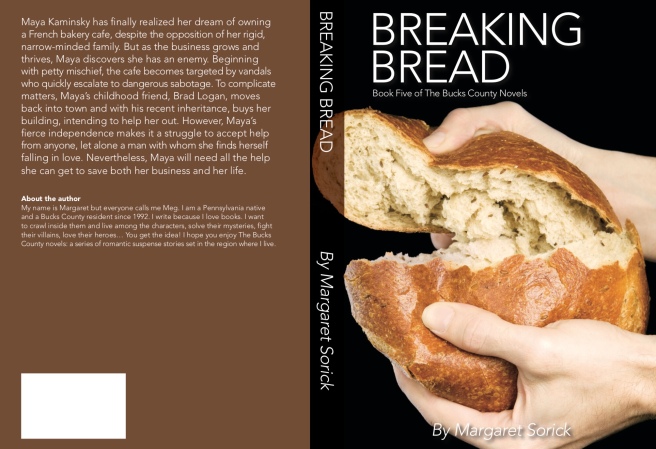
This won’t be news to the indie authors who’ve published their books in print version within the last year or so. But for those of you following along with me as I went through the process with my latest novel: Breaking Break, here’s an update.

Recently (I’m not exactly sure when) Kindle Direct Publishing began offering its authors a means to create a paperback version of their e-books directly from the Kindle publishing site. Prior to this, authors who wanted to create a print version of their books, needed to use the Amazon subsidiary, CreateSpace. For Breaking Bread I decided to try using the new Kindle tool. Mind you, it is still in ‘beta’ version so obviously they haven’t worked out all the glitches with it just yet.

I probably wouldn’t have even taken note of any problems had I not used a custom book cover. I have a friend with a graphic design business who creates my covers for me (per my direction) and sends me the print ready pdf file to upload to the site. When I uploaded the cover file to the Kindle publisher it gave me the error message that the file was not the right size (as in the actual dimensions of the book) BUT nowhere could I determine what size the cover needed to be! Without that information, I was dead in the water.

And so I reverted to CreateSpace and started the process all over again. CreateSpace adjusted the pdf file to the correct size without any fuss and the paper version is now ready for publishing. Find it here!

img_1750