
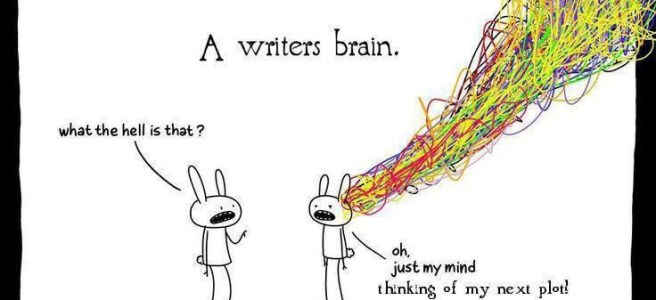
Exploding Brain Syndrome

The other kind of writer’s block…

Ah, writer’s block — that scary situation in which you sit staring at the blank page or screen and can’t conjure a single thing to write. It’s a common occurrence, happens to nearly all of us at some point. Once in a while it can be so debilitating that a writer may throw in the towel and give up for good. That is the writer’s block we are all familiar with.

Sometimes, though, the opposite situation challenges us — that is, having too many ideas clogging up our brains. There are several ways exploding brain syndrome presents itself.

When we first manifest a desire to write, it may not be clear what type of writing we want to do or what we might actually be good at. Let’s suppose that ultimately your desire is to write a novel. That is a daunting task to tackle without any writing experience. You decide to start a blog, follow other writers to see what they’re doing. Suddenly you are exposed to multiple writing styles, genres, and subject matter. Micro-fiction, short stories, serial fiction, personal journals, poetry in all its varieties… It’s all good! You want to try everything. And you can and should.

But… just try one or two things at a time. Don’t attempt everything all at once. I love the idea of micro-fiction as a starting point for story-telling. It forces a writer to be concise, to choose words carefully so as to convey the entire story in a small package. Six words stories, thirteen words stories, one hundred words stories — all of these types of challenges are floating around Bloglandia. Try doing one of those every week. Or try a poetry challenge, perhaps a haiku or a limerick.  Notice I said or not and?  The point is if you try to do it all at once, you will be very unfocused. You won’t excel at anything.

If you are an avid reader, the material you read might spark an idea. Or several hundred. (Exaggeration for emphasis!) That happens to me all the time. Some little side plot or one of the secondary characters sticks in my head and I wonder what kind of story they have to tell me. That’s what your notebooks, index cards or files on your computer are good for. Save all those good ideas for further exploration at a later date. For now, pick one and concentrate on it.

Even experienced writers can have exploding brains. You would think that after a while, you’d start to run out of new stories to tell but sometimes the opposite happens. A story can take on a life of its own, turning into a complicated mess that becomes unmanageable. Why? It can be difficult to bring a story to a conclusion. Even a well-plotted and outlined story might take an unexpected detour. You introduce a twist you hadn’t originally anticipated, but it’s so good you can’t ignore it! It must be written! That’s fine. Actually, that’s great! Keep going with it. But go back and review your outline, rework it so that the story doesn’t end up becoming “War and Peace” (300,000+ words)!

Alternatively, maybe the whole story works. With a novel, there’s nothing that says you can’t finish up the main story arc, leave a cliffhanger for the sequel, and publish what you have. Or alternatively, finish the whole thing and edit the hell out of it. You may find, upon review, that you have a lot of unnecessary filler. That is inevitable. My first book was over 110k words – way too long for the genre. I edited it down to 91k. That’s a lot to lose. So take a good look at what you’ve got and see where you can trim. If you don’t find that much to cull, outline what you have and look for natural breaks in the action. See if one of those breaks would make a good spot to pause the story for the sequel.

In the end, it seems that having too many ideas can be as debilitating as not having any ideas at all. The key to successfully overcoming exploding brain syndrome is to approach your ideas in an organized manner. Be meticulous about recording your ideas in a file — either paper or electronic. While experimenting with other types of writing, approach each one at a time.  Don’t lose sight of your ultimate goal.  And more importantly, don’t let your brain explode.

Worth It

Don’t get discouraged…

Writing can be a blessing and a curse. If you’ve been at this a while, you know what I mean. Sometimes things go very well. Creativity is sparkling, words are flowing, the keys of the keyboard tap out a furious staccato. The finished work is brilliant – some of the best stuff you’ve ever written. You edit carefully, then send it out into the world, on your blog, into a self-published book on Amazon, or in a query to an agent. You wait for the response.

And nothing….

You get a few likes on your blog, maybe a couple lukewarm comments. Your book languishes, sales are weak, nonexistent even. The agents are silent, or worse, dismissive… “Thank you but your work isn’t a good fit for me. Good luck in your journey…”

If you are expecting the usual litany of “think positive”clichés, sorry! You know how I hate that crap! Nevertheless, how do you keep from going under in the floodwaters of writing and publishing?

Remember why you started writing in the first place.  Even if your goal is to make a living at this endeavor, your most basic reason for writing has to be because you love it.  You have a song to sing, a story to tell, a cause to champion, and so forth.  We all want to be appreciated, have readers enjoy what we write.   But it is a rare thing to achieve overnight success.

Our world has trained us to expect instant gratification.  If we can’t have “it” right now, something is wrong.  Writers need to have vision – a long view.  Ok, here’s a cliche but an appropriate one:  it’s a marathon, not a sprint.  A marathon requires setting a pace, having time goals for the splits of the race, refueling at appropriate opportunities… You know what I’m saying?  Yes, some faster runners will blow by you. But here’s the cool thing about marathon running:  most runners race to achieve a personal best.  That’s why thousands of slow runners sign up to participate in marathons.  The goal is completion, not winning.  So to carry the metaphor back to writing, success can’t be tied to sales, reviews, likes and comments.  Success is tied to your personal best.  And like a runner who keeps training, you only get better the more you run.

Don’t let your desire for validation derail your dreams.  Whatever you write, for whomever you write, on whatever medium you write, remember that you love to write.  And that alone makes it worth it.

Write on, my friends.

I had a conversation with a friend the other night. Someone who also wants to write. Well, does write, she just hasn’t finished anything. I sympathize. There are times when, no matter how hard you try, the action in your story just comes to a screeching halt. I’m actually at that point in my current project. Seriously, if I’ve managed a paragraph in the last month, it’s probably an exaggeration. It’s true I’ve been stretching myself thin here in Bloglandia, with the collaborative work I’m writing with Fictional Kevin and my other weekly features. Nevertheless, I need to move forward with the next book in my novel series. But I’m stuck… Sound familiar?

When I’ve struggled like this in the past, I’ve found a way to get through it. Ready for some brilliant advice? Write nonsense. Yep. Even if it totally sucks, doesn’t move your plot along, bogs your characters down… you get the idea, you’re still writing. And sometimes that’s all we can do – keep going. So for example, describe your character’s grocery list, have them watch TV, make tea and read their own books. Maybe have them engage in mundane household activities or meet one of the other characters for lunch. Sound like a waste of time? Trust me it’s not. It’ll get you to the next ‘thing’ and you can go back and delete all the filler. And delete, you must!

Unless this unexpected foray into tea making, housekeeping or lunch having has become somehow integral to the plot, you have to cut it out of there. Even if it’s some of the most beautiful writing (you think) you’ve ever done. The exception here might be the lunch with another character, where possibly their conversation over soup and salad may reveal important plot points or details. Otherwise, you are just wasting the reader’s time.

But not your time, you see. You’ve moved forward. You have kept writing. And that is what writers do!