Research Notes – The Great War (12) Passchendaele 1917

My current work in progress is a historical novel partly set during the Great War. In order to write the time period accurately, I’ve been spending many hours reading and researching. One of my characters will be in the mud of Passchendaele in 1917. I visited the area in 2013. It is still chilling to think of the horrors that the soldiers endured.

The stalemate along the Western Front in 1917 looked like it might finally be breaking, with successes by British and Canadian forces in taking Messines and Vimy Ridges, respectively. The German salient had been pushed back and the plans to break the line were being formulated. The forthcoming battle would officially be known as the Third Battle of Ypres, but would be more famously known as The Battle of Passhendaele, after the little village a few miles to the east of the site.

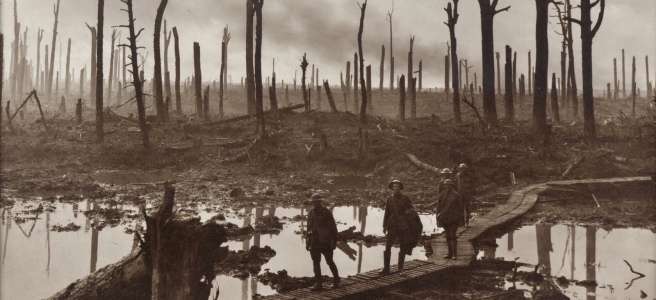
The area from Ypres to Passchendaele slopes continuously uphill—not an ideal way for the British to forge into battle. Even the soil around the area was about to become an obstacle. It had the consistency of clay—dense and heavy and prone to holding water. Before the war, the farmers who worked this land had needed to build up an elaborate drainage system to draw off the water during the rainy season. The battles fought in the area over the course of the war had demolished this fragile system, with the result that rain-soaked fields would become mires of thick, clinging mud. The success of the British advance in the Third Battle of Ypres was dependent on the weather cooperating.

June 1917 proved to be a good month for getting ready. In July the weather was for the most part agreeable, and the gun batteries came forward and took up their positions. The standard means of attack was to use heavy artillery to bombard the enemy in their trenches and then to send infantry ‘over the top’ to fight man to man. The initial bombardment could go on for weeks at a time, rendering the field into which the soldiers would follow a nightmare landscape of craters, rubble and ash. Though this approach had so far not proven to be an effective method, the generals were still enthralled by the idea of ‘more’ —more artillery cannons, more guns, more men, and not to mention, more casualties.

Airplanes had become a means of reconnaissance and the reports brought back by the pilots stated that the German morale was low and conditions looked good for an attack. However, British intelligence-gathering during the war was neither very objective nor accurate. The spies were told what the commanders hoped was true, and the spies basically confirmed that it was.

The artillery began raining death on July 18th, with the infantry attack scheduled to begin on July 31st. But as the shriek and blast of the heavy mortars went on for those two weeks, the weather began to turn. At first, occasional heavy rains filled the myriad shell holes littering the fields and due to the poor drainage, they remained that way. Still, on that last day of July 1917, the men crawled from the trenches at day break, carrying 60-80 pounds of gear on their backs and began to advance. They made two miles by nightfall and considered it a good start.

The next day, the first of August, it began to rain in earnest. This was no summer shower; it was a steady, soaking, continuous downpour. It rained for two weeks straight. The already saturated soil began to dissolve. The shell holes filled and the engineers tried to build up wooden walkways around them. The soldiers were slipping in the mud, falling in, and with their heavy packs weighing them down, drowning. The boards laid down to create footing were little better. In the rain, they became slick so that the soldiers had to tread carefully. The Germans shot the slow moving infantrymen off the boards, they fell in the mud and drowned.

August gave way to September and still the rain fell. Despite all this misery, the attack went on and finally Canadian troops took and held the village of Passchendaele. The advance on the Ypres Salient had gained the British four miles at the cost of a quarter million men.

British military historian Basil Liddell Hart relates the story of a staff officer who visited the battlefield after the fact. As he gazed out at the sea of mud, he said, “My God, did we send men to advance in that?” He then broke down and wept as his escort led him away.

There would never be another battle like Passchendaele. F. Scott Fitzgerald wrote in Tender Is the Night that battles like those fought on the Western Front could never be fought again:

“See that little stream we could walk to it in two minutes. It took the British a month to walk to it a whole empire walking very slowly, dying in front and pushing forward behind. And another empire walked very slowly backward a few inches a day, leaving the dead like a million bloody rugs. No Europeans will ever do that again in this generation. …This took religion and years of plenty and tremendous sureties and the exact relation that existed between the classes.”

He meant the only people that could fight that sort of battle were those who possessed a sure faith in their countries, their institutions, and their own unquestioned value systems. Only that kind of faith and confidence could prepare men sufficiently to endure the hell of such battles. Men like that were now gone: rotting in the fields of Belgium and France or if they lived, no longer in possession of such faith.

Nevertheless, the war itself had another year to run. New methods and new weapons were about to change the practice of war forever.

Images courtesy: Canadian War Museum, The Times of London, The Spectator, and Wikipedia

Research Notes – The Great War (11) Keeping House In 1914

My current work in progress is a historical novel partially set during World War One. To write the story accurately, I’ve been reading about all things war related. This is not really about The Great War, but it is about the time period. As with the details of the conflict, the Spanish Flu epidemic and other events that would impact the lives of my historical characters, I want to make sure I write everything authentically. That includes the way they would have worked, eaten, dressed and housed themselves.

My central character in the 1910’s timeline, Gladys Henry, is a young woman who, although would have been considered fairly middle class –her father is a clerk at the bank in their town in the west of England– has had to take on a job when the family falls on hard times. Her father becomes too ill to work and of course, without work there is no pay. In those days, the options for women to work were limited. Without some sort of training in a profession like teaching or nursing, women would likely have to find work as domestic help. This is the case with Gladys. She spends her days as a maid in the services of a wealthy family in the town, cleaning the manor house in which they live.

Now, this all probably sounds very Downton Abby, but I absolutely refuse to rely on another work of fiction as a source for information. (Besides, I really wasn’t a fan after they killed off Matthew. Ugh.) Anyway, in my internet search, I came across an article titled “Home Duties” from a periodical of the time which describes the tasks involved in keeping house in those days.

In cleaning the bedrooms for example, windows would be opened wide, no matter the season. Curtains or draperies would be taken from their rods and shaken out, carpets would be rolled up and removed to the outdoors to have the dust beaten out. The now bare windows would be washed as would all the mirrors. Upholstered furniture would be brushed and leather furniture wiped down with damp, flannel cloths.

Sheets would be stripped from the beds and taken to the laundry where they would be washed and scrubbed by hand and then hung on lines to dry, after-which they would be ironed by a fire-heated iron. The rest of the bedding: blankets, quilts, coverlets, etc. would also be shaken out and left to air on the outside clotheslines. As you can imagine, the weather would have a huge impact on the housekeepers’ ability to perform these duties!

When furniture needed to be polished, a home made polishing agent was concocted. I found this recipe for one in the article:

  • Half pint of cold water
  • One ounce of Castille soap cut into slices and dissolved in the water
  • Half pint of turpentine
  • One ounce white wax, one ounce bee’s wax, dissolved in the turpentine
  • Mix the water solution and the turpentine solution together
  • Add one to two tablespoons menthylated spirits and shake vigorously.

When all was cleaned, dried and removed of wrinkles, everything would be put back in place, and if the rooms would not be in use till guests once again visited, everything would be covered with dust sheets.

Whew…. makes me grateful for my Shark vacuum and my Maytag washing machine. This might seem like research ovrkill, and in truth not all of that will make it into the story. However, just knowing how they performed their duties helps keep mistakes from creeping in. For example, erroneously describing the use of a commercial product which may not have existed in those days. It’s the small things that can make or break a story sometimes. I just wish I had a couple of Victorian ladies to beta read this book for me!

Research Notes – The Great War (10) Plague Ship Leviathan

I’m researching The Great War for my current work in progress: a historical novel set partially during that time. To write the period accurately, I’ve been reading and studying the war and the surrounding events. Some of the older material I’m reposting in order to better organize it. I wrote this post in 2016 during my Spanish Flu research. The epidemic will play a central role in the historical timeline. I hope you find it interesting and don’t mind me recycling! ~ Meg

The early 1900’s and 1910’s saw the launch of many famous super liners –ships designed to carry thousands of passengers across the Atlantic Ocean from Europe to the Americas in  luxury and comfort. These were famous liners like White Star Lines’ Titanic and her sister ships Olympic and Britannic, Cunard’s Lusitania and Mauritania, and even larger –Hamburg-America’s Imperator, Vaterland and Bismarck. The Bismarck* would hold the title of largest ship in the world until 1935.

The three German ships had the ill fortune of being launched just prior to the outbreak of World War I and thus spent little time in the service of Hamburg-America before being laid up in port thanks to British domination of the seas.

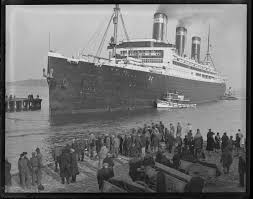
It was late July 1914, when the SS Vaterland made her crossing to New York City, USA. When the guns of August began to fire, the return trip was determined to be unsafe, she was laid up at her Hoboken, New Jersey terminal and remained there for nearly three years.

In 1917, when the United States entered the Great War, the Vaterland was seized and rechristened as the SS Leviathan by President Woodrow Wilson. She would now be put into service transporting fresh American troops to the port of Brest in France to bolster the exhausted French and British forces.

By late September 1918, the second wave of the epidemic flu was beginning to spread through the troops destined for the front. The giant transport ships, with their confined decks and crowded bunks provided the ideal conditions for incubation of the virus. Circumstances aboard the massive troop ship Leviathan proved to be the worst of all.

On September 29, 1918, SS Leviathan left New York harbor for Brest, carrying 9,000 troops and 2,000 crew on board. By the following morning, the sick bay was overwhelmed with men suffering from the symptoms of flu. It took just three days for 700 more men to sicken and for one of them to die. Bunks were turned into makeshift sick beds. Healthy men were confined to less well ventilated quarters and the disease roared through the ship like a wildfire.

On the fourth day, October 1st, 2000 men had fallen victim to the dreadful disease. The official Navy report states that ‘pools of blood from severe nasal hemorrhages were scattered throughout the compartments, and the attendants were powerless to escape tracking through the mess, because of the narrow passages between the bunks.’

The ship docked in Brest on October 8, 1918 with 2000 men sick with flu and pneumonia, 80 had died and been buried at sea and those left healthy were desperate to get off the plague ship. Nevertheless, 280 of the ill men were too weak to get off the ship and 14 more died before the end of the day. Some 1000 of the remaining patients had to be carried via stretcher to the base camp from the wharf in a convoy that stretched four miles. The American influenza casualties eventually reached into the hundreds.

One interesting side note regarding Leviathan: her crew included Chief Quartermaster, Humphrey Bogart, future American film star. As the senior enlisted man in the Navigation Division, Bogart would have been on the helm whenever the ship sailed in or out of harbor.

Image via flickr

*This ship is not to be confused with the battleship Bismarck, commissioned by the Nazis in World War Two. This Bismarck was a passenger ship, was never actually launched before the outbreak of the war and later was handed over to the Allies as war reparations and rechristened as the HMS Majestic of the White Star Line.