Not so very… Sherry

Week 25 in The Year of Drinking Adventurously. Sherry.

Dry Sack, it sounds like a dental issue doesn’t it? The bottle came in a drawstring jute bag – a dry sack. And it was all downhill from there…

It’s been years since I tried sherry. My mother drank it occasionally and I’m sure I sneaked a sip. Because that’s how I was as a kid… Into everything. Mom tended to choose her food and beverages based on the type of book she was reading. A novel set in Victorian times meant tea, tarts, cucumber sandwiches and sherry. I am not kidding.

Nevertheless, since my sherry sampling is so far in my hazy past, I entered this week with no preconceived notions.

Remember how awful whiskey tasted the first time you tried it? Or beer? Drinking doesn’t come to most of us automatically.  We sample, our palates acclimate, our tastes broaden and so do our horizons. And so Monday evening, with a light supper planned for dining outside, I opened my bottle of medium (not dry not sweet) blended sherry.

I bought a Spanish sherry rather than a domestic product, hoping to have a more authentic experience. Although the blending of Amontillado and Oloroso sherries may have diminished my experience somewhat.  And there weren’t a whole lot of options at my local liquor store to choose from.  So it’s entirely possible that like my initial reaction to saki, my impression of sherry might be somewhat skewed…  Because I hated it! And I’m the girl that didn’t mind grappa! I took one sip, grimaced, tried again – yes, still bad. I’m afraid this bottle is going to languish in the refrigerator until I foist it on one of my unsuspecting friends.

Now, I’m really curious to hear Lula’s impression…. And hopefully she delved into the history, etc. because I am totally skipping it. I am not hopeful for next week either. It’s port – sherry’s Portuguese cousin.
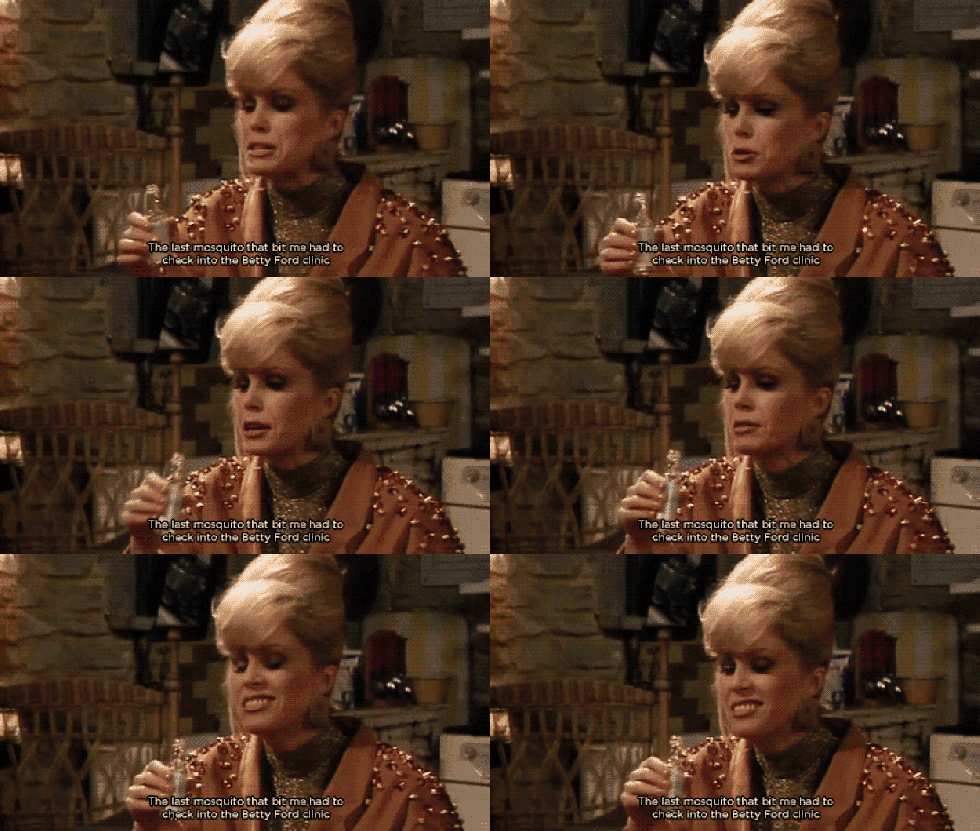


It’s for medicinal purposes, Sweetie.

Week 24 in The Year of Drinking Adventurously! It’s gin!

Oh, joy of joys, we’re back to a booze I adore – gin.  With hazy origins in the Middle Ages, gin evolved from the Dutch beverage, genever, whose name is derived from the Dutch word for juniper, gin’s primary component.

Co-opted by the English, gin’s original uses were medicinal, with the juniper berries being combined with other botanicals so that the flavor of the juniper could be either prominent or subtle depending on the mixture. During British Colonialism, the good old Gin and Tonic was responsible for saving countless lives, thanks to the “tonic” component.  Quinine, an effective antimalarial agent, could be added to water to create tonic and mixed with gin to improve the flavor. Among other things…

anigif_enhanced-buzz-1855-1420405350-4

As with many alcohols we’ve considered so far, there are rules governing the production and labeling of gin. There is basic gin, distilled gin and London gin which is regarded as the premium style. But then… enter the craft distilling movement and a whole new crop of styles has emerged.

Bluecoat American Dry Gin – Philadelphia Distilling Company

From Jeff’s book: “Bluecoat American Dry Gin, the flagship brand of Philadelphia Distilling Company, has, since 2005, become a rather prominent example of this new style. The name Bluecoat, naturally, is the colonial answer to the Redcoats’ centuries-long gin dominance. The brand’s key botanicals include natural coriander seed, American citrus peel, natural angelica root, and, of course, juniper berry (organic berries, to boot). A major distinction for the product produced in the City of Brotherly Love is that it’s not quite as juniper-forward as its British brethren. Bluecoat’s blend creates more of a citrus experience on the palate.”

I toured the distillery a couple years ago and had a tasting of all their products, including (if you remember) Vieux Carre Absinthe and the Blue Coat Gin. I compared it with my Bombay London Gin and indeed the juniper flavor is far more subtle in the Blue Coat.

How do I drink gin? Classic martini, obviously, gin and tonic on a hot summer afternoon, but one of my favorite gin cocktails is the gimlet. I drank my first gimlet in audacious surroundings – The Blue Bar in the famous Algonquin Hotel in New York City.

The Algonquin opened in 1902 and its Oak Room was long one of New York City’s premiere cabaret nightclubs.  After the end of World War I, the hotel became the site of the daily meetings of the Algonquin Round Table, a group of journalists, authors, publicists and actors who gathered to exchange ‘bon mots’ (well-chosen words) over lunch in the main dining room. This daily gathering lasted for the better part of ten years.

With its oak panels and other decor recalling an earlier time, the heyday of cabaret, the Oak Room was small, intimate, and expensive (at least $100 per person, more if one had dinner, except for matinees). When finally it was closed in 2012, part of the space occupied by the former Oak Room was used to enlarge the Blue Bar…img_3818

So the gimlet:    In a shaker with ice:
1 ounce fresh lime juice
1 ½ ounces gin
1 teaspoon powdered sugar
Shake and serve with ice and a wedge of lime in a rocks glass. Enjoy!

Now, run, sweeties and see how Lula drank her gin!

(She’s Eddie to my Patsy! And we are absolutely fabulous!)


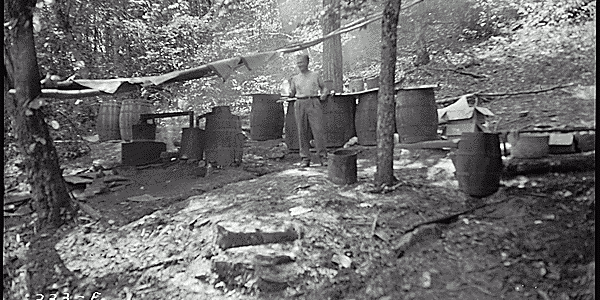
Moonshine, y’all!

Week 23 in the Year of Drinking Adventurously! Moonshine!

Sunday, June 5th was National Moonshine Day here in America. A day to celebrate the spirit of Prohibition. When America went dry in 1920, the movement gave rise to an illegal industry that –now legal– has become romanticized in the hearts of Americans.

Moonshine wasn’t invented during Prohibition, but distillers that were just making the stuff for their families and for local sale saw an opportunity to cash in on the demand for illegal booze. Unfortunately, because of the huge and sudden spike in that demand, the moonshiners often added inferior and sometimes dangerous ingredients to stretch their batches. Things like paint thinner and antifreeze made drinking moonshine a real gamble. Ever hear the term “blind drunk?” It was a real possibility!

Now if I’d been on my game a couple of weeks ago, I’d have realized that my visit to Eastern Tennesee, Gatlinburg in particular, left me plunked right in the heart of moonshining country. Gatlinburg is home to Ole Smoky Original Moonshine Whiskey. By the way, Kevin, you could have shared that with me. Thanks for nothing!

Fortunately, that’s not the only place I’ve visited that has a moonshine connection!

I spent a week in the Blueridge Mountains of Southern Virginia last year with an incredible view and a lousy internet connection.  (Not complaining, just explaining.)  The summer had been ridiculously busy and a do-nothing vacation was just the ticket.  Coffee on the deck to watch the sunrise, a daily walk along the mountain roads with the valley falling away to one side, a nightly soak in the hot tub in the moonlight with a beer and nothing but stars overhead, thanks to no light pollution. Idyllic!

Part of the joy of traveling is taking in local culture and cuisine.  And well, in that part of the country, the local cuisine is barbecue and the local heritage is moonshining.  The house we rented was only about 20 minutes from Mt. Airy, North Carolina — home to Mayberry Spirits.  At the time, the distillery was in its “soft opening” stage and only open Friday and Saturday afternoons.  Nevertheless, we had a nice tour from the very knowledgeable and enthusiastic owner and distiller himself. It’s a small operation, making just enough booze to supply the local liquor stores with product.

We were able to sample their main products: Mayberry Moonshine, toasted oak whiskey and toasted vanilla whiskey. IMG_2810 While most moonshine is 80% corn based, Mayberry’s products are sorghum based.  Weird, right?  Maybe, but it makes a unique and deliciously smooth whiskey.  (Even the straight moonshine went down easy, almost like a high-quality white rum.)  Needless to say, I brought home a supply!  So if y’all end up in that neck of the woods, stop on into Mayberry Spirits and have a sip of Carolina moonshine! Careful though!  It’s 100 proof!

Now, how should you drink your moonshine? You can substitute it for whiskey in whiskey-based cocktails or for rum in rum-based cocktails, so instead of a Long Island Iced Tea, here’s an idea:

Appalachian Iced Tea!

In a mason jar, over ice, combine:
3/4 oz tequila
3/4 oz vodka
3/4 oz tripel sec
3/4 oz gin
3/4 oz moonshine
1 oz sour mix
Splash of cola to top it off and stir
Garnish with a lemon slice and drink on your front porch in your rocking chair!

Since Lula is also plunked smack dab in the middle of moonshine country, I expect she had no trouble with this week’s adventure!