End Of Summer, End Of An Era

In two days time, I will close the doors on my chiropractic practice for good. The week leading up to the finale has been busy. On Friday, one of my first patients will be my last and she and I are going for lunch to celebrate. On September first, when people ask me what I do for work, I will tell them I am a writer.

Being a chiropractor for 23 years has helped me become a good writer of fiction. How is that possible? There are several ways:

  • I hear about people’s lives, their jobs, their families and what they like to do for fun. This gives me a deep reservoir to draw from in creating characters’ basic details.
  • Truth is really stranger than fiction. My patients all have stories to tell. Some of them give me ideas!
  • As a doctor working with people who are in pain, you learn to develop empathy, to stand in their shoes. This also helps develop characters. Especially, the villain of the story who a writer may not fully explore. But I have found that even the scoundrels have a reason for why they do what they do.
  • I have had to learn to be a good communicator. People in pain are emotional, scared and sometimes even angry. Being able to explain, console and reassure is absolutely vital on the patient’s first visit. Good communication means being concise, not muddying the waters with overly complex and/or technical terminology. This is also the goal of the writer. Unless of course you are writing a technical manual!
  • Last but not least, I have had to actually do some writing. I’ve written countless reports for insurance companies, attorneys and claims adjusters. You learn a certain writing style in composing letters and compiling examination findings. While this doesn’t translate directly to fiction writing, it does give you practice in consistency and flow.

I cannot say whether or not I will miss being a chiropractor. I can say that I am excited to begin the next chapter of life. After a little vacation planned for next week, I will return to my war story with renewed dedication this September. And I will work at it as my full time job.

Happy writing and productive editing!
Research Notes – The Great War (14) The Injured

My current work in progress is a historical novel set partly during the years of World War One. In order to write the time accurately, I’ve been reading and researching the subject extensively.

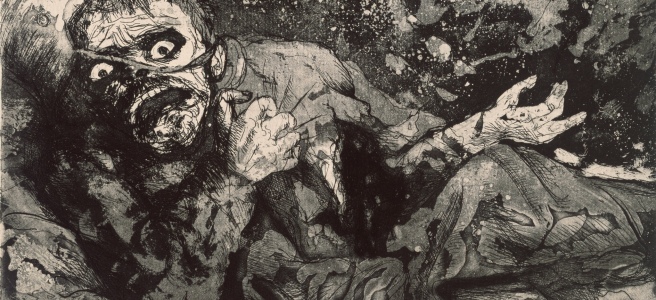
The casualty figures for this four year-long conflict are staggering. Forty million casualties, 15-19 million of which were deaths, 23 million wounded. But numbers, when they get too large tend to lose their meaning. When you put a face (literally) to the fallen, the injured, the mutilated, it has far more impact. These disfigurements to the face were especially cruel, changing the single most important way humans physically identify themselves; the way we recognize ourselves in the mirror and the way we present ourselves to the outside world.

The surgeons did their best to patch up these horrible wounds, but techniques were primitive and faces and bodies could never be returned to normal. The following short video tells the story of one woman who gave these men hope.

Header Image: The Wounded Soldier; Otto Dix 1916

Writing Ritually and Habitually

Some writers can write anywhere, anytime, under any conditions. Some of us need routine. And some of us have obsessive compulsive rituals we need to follow for any writing to happen. I am pretty adaptable in my habits but I do have preferences. This is my favorite way to write:

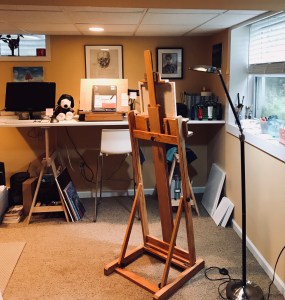
Place: I recently converted part of my finished basement into a writing space and art studio. Prior to that, I was sharing a desk with my husband in an alcove of our bedroom and using the kitchen counter for art projects. I’m sure you can imagine the mess I was making. In the basement studio —I call it my subterranean lair, because in my head I am a superhero— I have sliding glass doors and a large double window for natural light and lots of plants just outside for a view of nature as well. I have a long countertop area to use for drawing and an area for my computer and monitor at the other end. My easel stands in front of the window for my canvases. This setup keeps my on my feet for not just for art but for writing, too. Standing is my preferred posture; it’s better than sitting on your kiester all day. Trust me, I‘m a doctor— at least until August 31st! Besides that, it makes it easier to move around. If I’m working out a scene in my head, I might pace or dance around if I have music playing. And that is definitely a healthy habit to have!

Time: I seem to have all my best ideas in the wee hours of the night, and alas, so many of them are gone by morning. However, when something truly inspired wakes me up, I have a notebook and pen nearby so I can tiptoe to the bathroom and scribble it down. As for my lengthy writing sessions, I prefer to start first thing in the morning, write for at least an hour or two and break off for my exercise; I usually don’t write in the middle of the day. I also may write in the evenings, just before bed, but often that leaves me unable to turn my brain off for sleep. Not cool; I love sleep.

Music: I like to write with music on in the background, but it isn’t absolutely essential. Complete quiet is fine, too. When I do have music on, it is usually classical, jazz, or soft electronic music. The only time that changes is if I’m writing something ‘energetic’ like an argument, a comedic scene or a big revelation. In that case, I might put on dance music or loud rock. Under normal circumstances, though, I get too distracted with the lyrics. For drawing and painting, I choose my music based on the mood of the piece I want to create. Sometimes, it’s not even music but nature sounds that make the backdrop to my artwork.

Beverages: Early morning writing requires coffee, at least two cups. And by cups, I mean giant mugs. If I find myself writing in the afternoon, then I have tea. And after 5:00, well it’s happy hour, right? Seriously, though I don’t over-imbibe while I write. Occasionally, a whisky or a pint is a little lubrication for the creative mind, but too much of that and you end up with a mess on your hands and a whole lot of rewriting to do! (See this episode of Drinking Adventurously for more on that subject).

Goals: In paying attention to the habits of other successful writers like Stephen King, Lisa Scottoline, John Grisham, and Nora Roberts, the single habit they all share is setting writing goals. Perhaps it is as vague as ‘a page a day’ —if you are writing a page that is filled with dialogue, that might not be very many words, whereas a scene-setting narration with lots of description might have a high word count. Other goals may be specific to word count, chapter completion, character development or plot resolution. My goals are usually tied to plot resolutions. In other words, I write until I finish up a scene at an appropriate spot. It isn’t always the end of a chapter, but that is most often the way it ends up.

If there is one thing I’ve learned in writing these past four years, there is not a right way or a wrong way to write, as long as you keep writing! Tell me, fellow writers, what are your rituals?