
Filling the Creative Reservoir

Life with all its stresses can be a drag on your creativity. And yes, we all know about the writers and artists who use their anger, pain, and frustration as source material for their work. But what if your crappy, exhausting job, bills, debt and student loans, managing your kids’ school activities and issues, and if you’re a part of the sandwich generation, taking care of aging parents, isn’t proving to be terribly inspiring? When you do find a spare minute to yourself and finally sit in front of the screen or the canvas, then nothing comes. All those daily anxieties push out the great ideas that used to wake you up in the middle of the night. Can you force yourself to be creative? Or is it hopeless?

Take a look at it this way: some of those ‘daily grind’ things we do involve being creative. Things like parenting, successfully carrying out the tasks of your employment, cultivating your relationships and cooking meals for your family. When we appreciate that we are being creative in our daily routine, we must then figure out how to cultivate creativity for our artistry. Sometimes it’s as simple as asking, ‘what if…?’ and letting your mind answer the question with all the possibilities.

Remember that your talents have already manifested themselves. If you’ve been creative in the past, you can be again. Reflect on those past achievements. While it’s true that creativity may come naturally to some, many successful artists and writers have simply nurtured their creativity over time. You see what I’m saying? They worked at it. The writer or artist who sits staring at the blank screen or canvas waiting for inspiration to strike is going to be waiting a long time. Inspiration comes not just from within but also from without. We must take the initiative to find it.

Read other authors in your genre. Read other authors outside of your genre, including non-fiction. Watch films, television programs, go to the theater. Go outside and move your body. And for Pete’s sake, turn off the podcasts and the news and refresh your mind with some quiet time. Listen to music. Go to the art museum, or even a small gallery and take time to study the paintings, photographs or sculptures. Spend time with your friends, especially those who also have creative pursuits. Join a book club – you might be able to find one through your local library or independent book store. Take an evening art class, even if it’s way below your skill level. You’ll always learn at least one new thing. Spend time with people who inspire you, rather than drain you. Granted, we can’t all hang out with our heroes but this is the time to read interviews, listen to lectures or read their biographies.

And since we began this discussion by acknowledging the scarcity of free time, I’m by no means advocating ALL of those suggestions. Just pick one that fits into your schedule. Above all, don’t get discouraged. If the creative reservoir seems dry, it might take a little time to fill it back up again. Start adding just one bucket full at a time.
Research Notes – The Great War (15) The War Poets

In the course of researching my historical novel: Here Lies a Soldier, I’ve read books on the battles, the origins of the conflict, the Spanish Flu epidemic which came close on its heels, and of the life and struggle of the average citizen striving to weather that horrible storm. Among some of the most compelling subjects I’ve researched are the works of art, the literature and especially the poetry composed at the time.

During the First World War, unlike previous wars, a significant number of important British poets served as soldiers. As one might expect, they composed poetry that reflected their experiences in battle, the conditions in the trenches and the spirit of the men they fought beside. Some of them died in battle: Edward Thomas, Isaac Rosenberg, Charles Sorley and Wilfred Owen. The ones that survived, like Siegfried Sassoon, Ivor Gurney and Robert Graves, were deeply affected by the horrors of war and their work demonstrates their traumatization.

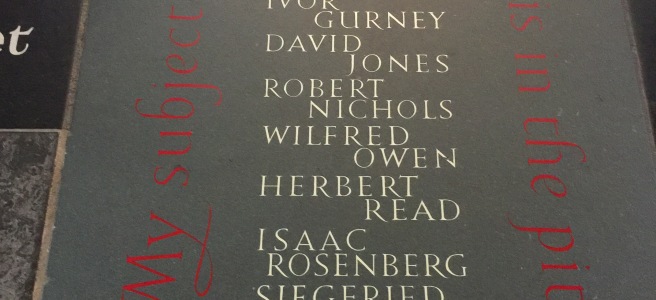
In Westminster Abbey, Poet’s Corner is a section of the South Transept. Among the graves and other memorials of Britain’s famous poets, lies a stone slab with the names of the War Poets inscribed on it. It’s also inscribed with words from Wilfred Owen’s “Preface”

“My subject is war, and the pity of war. The Poetry is in the pity.”

Anthologies of these poems were very popular during the war. In my collection of War Poems: Men Who March Away, the editor has grouped the collection by date, giving the reader a glimpse of how attitudes toward the war changed over time. Here is one of Wilfred Owen’s poems – Exposure. The soldiers faced not only the enemy in battle but also the terrible conditions in the trenches – the mud, the filthy water, the lice, the rats and the cold. Sometimes the waiting was as dreadful as the action.

Exposure – Wilfred Owen

Our brains ache, in the merciless iced east winds that knive us . . . 

Wearied we keep awake because the night is silent . . .

Low drooping flares confuse our memory of the salient . . .

Worried by silence, sentries whisper, curious, nervous,

       But nothing happens. 

Watching, we hear the mad gusts tugging on the wire,

Like twitching agonies of men among its brambles.

Northward, incessantly, the flickering gunnery rumbles,

Far off, like a dull rumour of some other war.

       What are we doing here?

The poignant misery of dawn begins to grow . . .

We only know war lasts, rain soaks, and clouds sag stormy.

Dawn massing in the east her melancholy army

Attacks once more in ranks on shivering ranks of grey,

       But nothing happens.

Sudden successive flights of bullets streak the silence.

Less deadly than the air that shudders black with snow,

With sidelong flowing flakes that flock, pause, and renew,

We watch them wandering up and down the wind’s nonchalance,

       But nothing happens.

Pale flakes with fingering stealth come feeling for our faces—

We cringe in holes, back on forgotten dreams, and stare, snow-dazed,

Deep into grassier ditches. So we drowse, sun-dozed,

Littered with blossoms trickling where the blackbird fusses.

       —Is it that we are dying?

Slowly our ghosts drag home: glimpsing the sunk fires, glozed

With crusted dark-red jewels; crickets jingle there;

For hours the innocent mice rejoice: the house is theirs;

Shutters and doors, all closed: on us the doors are closed,—

       We turn back to our dying.

Since we believe not otherwise can kind fires burn;

Now ever suns smile true on child, or field, or fruit.

For God’s invincible spring our love is made afraid;

Therefore, not loath, we lie out here; therefore were born,

       For love of God seems dying.

Tonight, this frost will fasten on this mud and us,

Shrivelling many hands, and puckering foreheads crisp.

The burying-party, picks and shovels in shaking grasp,

Pause over half-known faces. All their eyes are ice,

       But nothing happens.

Bully, bully

The days are gone
When one withering look
Could silence a room
The time has passed
From when your opinion counted
Your license has been revoked
All authority is rescinded
So whatever is was
You were about to say?
Just keep it to yourself.

~A poem by Meg Sorick.

Thinking about the kids as they return to school… I wish they all could realize that these days will pass and with them, the bully’s power to terrorize.