The Origins of War

We all know the story. In Sarajevo, on June 28, 1914, Gavrilo Princip -a Bosnian-Yugoslav Nationalist- shot and killed Archduke Franz Ferdinand, heir to the throne of Austria-Hungary- the event that escalated the world into war. This was however, merely the match thrown onto the gasoline-soaked woodpile that was Europe in the years leading up to The Great War.

The geopolitical wrangling that went on in the decades leading up to outbreak of hostilities is complicated. Germany felt they were being economically oppressed and excluded politically by the other European powers, namely France and Britain. They were a relatively new nation, having coalesced from the unification of the separate states of Bavaria, Prussia and so forth. And because they weren’t a colonial power like Britain and France they didn’t have the depth of resources to draw on or the room for expansion as did those two. Here is a brief background on how things got to this point. Bear in mind that massive and numerous books have been written on the subject, so this really is just the basics.

Germany as we know it did not exist in the early 1800’s. Following the Napoleonic Wars, the independent German territories were bound together into The German Confederation. The confederation that would eventually become The German Empire in 1871, was made up of constituent territories, including four kingdoms, six grand duchies, five duchies, seven principalities, three cities and one imperial territory.

With the Industrial Revolution of the 19th century, the states of Germany had shifted from a rural agrarian economy to an industrial one, with strengths in coal, iron/steel and chemical production, and railroads. With this change came urbanization and the movement of its population from the countryside to the cities. During this time, Germany became an industrial, technological and scientific giant.
images
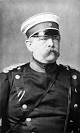
Otto Von Bismarck
With economic changes came political changes too. Economic wealth led to German nationalism which then resulted in a shift from a liberal democratic coalition among the states to imperialism and a united German Empire. During his tenure, Prussian Prime Minister, Otto Von Bismarck, engineered three successful wars, including the Franco-Prussian War of 1870, which resulted in France’s loss of the region of Alsace-Lorraine and the final unification of all the German states  under an Emperor (Kaiser Wilhelm I). Bismarck’s influence was instrumental in establishing the House of Hohenzollern (a Prussian dynasty) as the reigning monarchy over the newly formed empire.

Nevertheless, economic power failed to give the German Empire the political status to which it felt it entitled within the European community. Additionally, since the Empire had failed to establish alliances with the other European powers, it found itself with only Austria-Hungary as its ally. And while the rest of Europe had embraced the concept of democracy and self-determination, Germany’s Wilhelmine Westpolitik was a powerful conservative force opposing revolution, supporting old dynastic tradition, second only to Tsarist Russia.

de03b24f9973706b3534fea5ea296724
Alfred Von Schleiffen
The Germans felt that the British Empire had dominated the scene for too long and it was time for the rise of Mittel Europe -namely The German Empire to take its rightful place at the table alongside the other powers of Europe. It was with this idea that German growth and expansion were being strategically and maliciously restrained, that led the German military commander Count Alfred Von Schleiffen to formulate a plan for the invasion and defeat of France by way of Belgium. The Schleiffen Plan was completed in 1906, eight years before the outbreak of hostilities.

Meanwhile, the French, anxious about this new shift of military and economic power within Europe, and having been humiliated in 1870 by the German conquest of their territories, were developing their own plans to retake the regions of Alsace-Lorraine. So when the shot was fired in June 28, 1914, it was the match that set the woodpile of Europe ablaze.


Books, how I love thee.

Writers, if you are not a lover of books, you need to have your heads examined. Seriously, you cannot, CANNOT be a good writer if you do not read. I have always loved books. As an only child, I grew up reading – making fictional friends to take the place of siblings. The first books I clearly remember reading were Richard Scarry’s picture books. Then it was Ramona Quimby and her big sister Beezus. Nancy Drew, Little House on the Prairie, Little Women….

I was a book nerd in high school, too. When other kids goofed off in free periods, I’d go bother the librarian. My high school librarian Mrs. Long, was a big, intimidating lady, but oh, she had great taste in books. She introduced me to Tolkien, Frank Herbert, Jules Verne, Douglas Adams…

And honestly, how can one pick a favorite? I’ve read the complete Sherlock Holmes collection and not just because of the TV series, either. (Although, I could listen to Benedict Cumberbatch reading a deli menu. That voice…) Other favorites include: Robinson Crusoe, The Count of Monte Cristo, Twenty Thousand Leagues Under the Sea. More contemporary favorites are Tom Clancy’s: The Hunt For Red October, John Grisham’s: A Time To Kill, Khaled Hosseini’s: The Kite Runner and Sara Gruen’s: Water For Elephants.

Anthony Trollope asked, “What on earth could be more luxurious than a sofa, a book and a cup of coffee?” I couldn’t agree more. Perhaps I would add to that: a rainy or snowy day and a cozy blanket to wrap around your shoulders. To be forced by the weather to stay inside and curl up with a book? Heaven! And to have one with some heft, too, be it paper or electrons. As far as I’m concerned, a good story can go on forever. Lord of the Rings? Bring it on. Red Mars? But wait, there’s a trilogy.

I read many different genres and enjoy them all: mystery, thriller, romance, science fiction, espionage, historical fiction, biography… It’s been said that you can know a person by the type of books he (or she) reads. What does that say about me? Am I unknowable? Hmm. Perhaps just multi-faceted. Let’s go with that; it sounds so deep and sophisticated! *Snort*

Lately, I’ve been reading lots of history and non-fiction for research purposes. Beyond that, I just completed Graham Greene’s The End Of the Affair.  I am halfway through a biography of WB Yeats. I’m also working my way through the short stories of the Marquis de Sade. So what are you currently reading? Tell me what books you love. And what’s on your to-read list? If you like, join me on Goodreads. Winter is coming, let’s all curl up with a good book.

I must have misplaced my modifier.

Good grammar and spelling can make or break an otherwise wonderful piece of writing. One common mistake is to misplace modifiers. What is a misplaced modifier? Simply put, it’s a word or phrase put in the wrong place in a sentence. It will make a sentence confusing and illogical. Take for example, this converstion:

Me: “This morning, I passed a horse on the way to work.”
You: “Where does the horse work?”
Me: “No, the horse wasn’t going to work, I was. A policeman was riding the horse directing cars.”
You: “So the horse was directing cars?”
Me: “No! The policeman was directing the cars on the horse.”
You: “How were the cars on the horse?”

Ridiculous, right? The modifiers should be placed as close to whatever they describe or give information about. Like this: “This morning, on my way to work, I passed a horse.” And so forth. Notice, too, how the modifying phrase is set apart by commas.

A good way to avoid this mistake is to read your sentences aloud before pressing that post button. It becomes apparent when our modifiers are misplaced and gives us the opportunity to restructure the sentence properly. Happy writing, and productive editing, my friends.