Paul Nash: War Artist, Seaside Surrealist

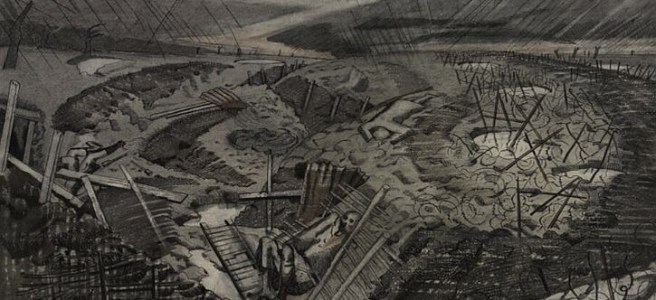
Header Image: After the Battle, 1918 – Paul Nash

With another connection to World War One, I’ve asked Mr. Cake (and he kindly agreed) to share a piece on the wonderful artist Paul Nash.

Paul Nash is one of the foremost of British artists of the 20th Century as well as a major landscape painter. He was an official war artist in both World Wars, a leading exponent of Modernism in England , a founding member of the avant-garde group Unit One, whose members included Henry Moore, Barbara Hepworth, Ben Nicholson and the art critic, poet and writer Herbert Read, with whom he organised the International Surrealist Exhibition at the New Burlington Galleries, London in 1936.

Nash’s paintings and lithographs that he produced as official war artist during WWI are some of the most potent and visceral images of the devastated landscapes wrought by the infernal mechanised weapons of war. Justly famous are The Ypres Salient At Night and We Are Making A New World both of which are part of the Imperial War Museums permanent collection.

The war had left Paul Nash emotionally and artistically drained. In 1933 he formed the short-lived but important avant-garde group Unit One. He formed links across the Channel with the Surrealists, later commenting that he hadn’t found Surrealism, Surrealism had found him. Around this time he was based in the seaside town of Swanage on the Dorset coast, which led him to formulate his theory of ‘Seaside Surrealism’. He also began an affair with another exceptional Surrealist, Eileen Agar ( see Surrealist Women: Eileen Agar). Notable works of this period as the found objects collage Swanage and the painting Landscape In A Dream from 1936-1938.
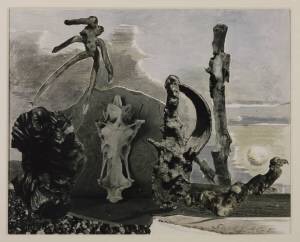
Swanage circa, 1936 – Paul Nash 

At the start of WWII, Nash was again commissioned as a official war artist, this time with the Royal Air Force and the Air Ministry, which led to one of his most haunting paintings, Totes Meer (Dead Sea), (see below) based on Caspar David Friedrich’s The Sea of Ice, which was inspired by a field of crashed German aircraft in Cowley, Oxfordshire.

Paul Nash died in 1946 from heart failure resulting from his long term asthma. He is currently the subject of a major retrospective at the Tate until March 2017. Recently there has been a critical re-evaluation of his work, especially the important paintings from WWI and WWII, and he is generally considered the most important British painter between J.M.W Turner and Francis Bacon.

Totes Meer (Dead Sea) 1940-1 Paul Nash 1889-1946 Presented by the War Artists Advisory Committee 1946 

The Origins of War

We all know the story. In Sarajevo, on June 28, 1914, Gavrilo Princip -a Bosnian-Yugoslav Nationalist- shot and killed Archduke Franz Ferdinand, heir to the throne of Austria-Hungary- the event that escalated the world into war. This was however, merely the match thrown onto the gasoline-soaked woodpile that was Europe in the years leading up to The Great War.

The geopolitical wrangling that went on in the decades leading up to outbreak of hostilities is complicated. Germany felt they were being economically oppressed and excluded politically by the other European powers, namely France and Britain. They were a relatively new nation, having coalesced from the unification of the separate states of Bavaria, Prussia and so forth. And because they weren’t a colonial power like Britain and France they didn’t have the depth of resources to draw on or the room for expansion as did those two. Here is a brief background on how things got to this point. Bear in mind that massive and numerous books have been written on the subject, so this really is just the basics.

Germany as we know it did not exist in the early 1800’s. Following the Napoleonic Wars, the independent German territories were bound together into The German Confederation. The confederation that would eventually become The German Empire in 1871, was made up of constituent territories, including four kingdoms, six grand duchies, five duchies, seven principalities, three cities and one imperial territory.

With the Industrial Revolution of the 19th century, the states of Germany had shifted from a rural agrarian economy to an industrial one, with strengths in coal, iron/steel and chemical production, and railroads. With this change came urbanization and the movement of its population from the countryside to the cities. During this time, Germany became an industrial, technological and scientific giant.

images
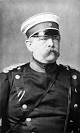
Otto Von Bismarck
With economic changes came political changes too. Economic wealth led to German nationalism which then resulted in a shift from a liberal democratic coalition among the states to imperialism and a united German Empire. During his tenure, Prussian Prime Minister, Otto Von Bismarck, engineered three successful wars, including the Franco-Prussian War of 1870, which resulted in France’s loss of the region of Alsace-Lorraine and the final unification of all the German states  under an Emperor (Kaiser Wilhelm I). Bismarck’s influence was instrumental in establishing the House of Hohenzollern (a Prussian dynasty) as the reigning monarchy over the newly formed empire.

Nevertheless, economic power failed to give the German Empire the political status to which it felt it entitled within the European community. Additionally, since the Empire had failed to establish alliances with the other European powers, it found itself with only Austria-Hungary as its ally. And while the rest of Europe had embraced the concept of democracy and self-determination, Germany’s Wilhelmine Westpolitik was a powerful conservative force opposing revolution, supporting old dynastic tradition, second only to Tsarist Russia.

de03b24f9973706b3534fea5ea296724
Alfred Von Schleiffen
The Germans felt that the British Empire had dominated the scene for too long and it was time for the rise of Mittel Europe -namely The German Empire to take its rightful place at the table alongside the other powers of Europe. It was with this idea that German growth and expansion were being strategically and maliciously restrained, that led the German military commander Count Alfred Von Schleiffen to formulate a plan for the invasion and defeat of France by way of Belgium. The Schleiffen Plan was completed in 1906, eight years before the outbreak of hostilities.

Meanwhile, the French, anxious about this new shift of military and economic power within Europe, and having been humiliated in 1870 by the German conquest of their territories, were developing their own plans to retake the regions of Alsace-Lorraine. So when the shot was fired in June 28, 1914, it was the match that set the woodpile of Europe ablaze.


The Dread Zeppelin

World War One saw both the introduction of, or the unprecedented use of a host of new deadly weapons. The submarine, for example, had been first used during the American Civil War. However, the First World War would see it become the great predator of the sea. Chemical weapons like chlorine and phosgene gas were deployed on a mass scale. The armored tank replaced the horse in the armies’ cavalries. And air warfare became a threat for the first time in history, bringing death and destruction to the doorsteps of the civilian population. No one was exempt from the ‘total war.’

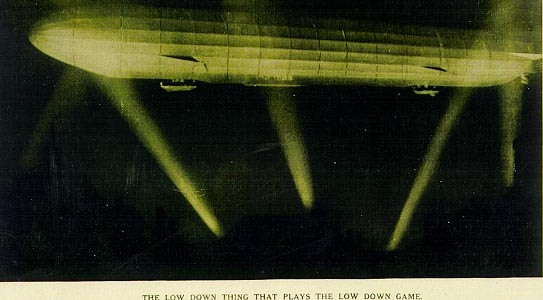
German zeppelins were capable of traveling at speeds of 85 miles per hour and carrying up to 2 tons of payload. From the early days of the war, these new weapons of mass destruction were deployed in bombing raids on Liege, Antwerp and Paris. In January of 1915, the massive hydrogen filled war machines brought their deadly cargo to the shores of Great Britain, striking the coastal towns of Great Yarmouth and King’s Lynn.

German Zeppelin corps commander, Peter Strasser was quoted as saying, “Nowadays, there is no such thing as a noncombatant. Modern warfare is total warfare.” The German aim in targeting civilian populations was to frighten the British into leaving the war. They upped their game in May, 1915.

As if it were straight out of an H.G. Wells’ science fiction novel, a massive airship darkened the starlit night over London on May 31, 1915. The 650-foot-long zeppelin, the largest ever constructed to date, glided toward the British capital, using the light reflecting off the Thames River as its guide. From the trap doors beneath the gondola of the craft, German troops dropped 90 incendiary bombs and 30 grenades onto the homes of the sleeping citizens below. The break of dawn brought with it the reports of seven deaths and the injury of thirty-five. But more than that, fear gripped the city.

Early on, the zeppelin was nearly unstoppable. It flew higher than artillery could fire, even higher than the airplanes of the day could fly. The planes couldn’t even get close enough to use their machine guns to bring them down. And not wanting to panic the citizenry with robust air raid warnings, the civil authorities’ only action in the face of imminent attack, was to send policemen with whistles out into the streets on bicycles with the cry of “take cover.”

The worst air attack came on September 8, 1915 when a zeppelin targeted London’s financial center. The three ton bomb –the largest deployed so far– caused heavy damage and killed 22 people, including 6 children. Public outcry was enormous, the zeppelins were now referred to as “baby killers” and the people demanded that their government do more to protect them from the menace in the air.

In response to the uproar, anti-aircraft defenses were recalled from the front lines in France, massive searchlights were installed, blackouts were instituted and the water from the lake in St. James’ park was drained so as not to direct the airships to the gates of Buckingham Palace. Additionally, British scientists were put to work developing ways to target the zeppelins’ vulnerable areas, namely the highly flammable hydrogen cells that made the ships lighter than air.

By mid-1916, the game had finally changed. British planes were able to reach higher altitudes and explosive bullets were employed to rip through the outer fabric of the death ships to ignite the hydrogen cells within. And though the Germans tried to press on with their air raids, sailing the zeppelins at higher altitudes, the crews began to suffer from the frigid temperatures and oxygen deprivation.

When the airships were brought down they were brought down in spectacular fashion. For example on September 2, 1916, the largest fleet of zeppelins ever to target London droned toward the city. One of the silver ships was caught in the searchlights and Royal Flying Corps pilot William Leefe Robinson was sent to deal with it. Robinson took his plane over 11,000 feet and drew close enough to fire his guns with the explosive bullets, ripping open the skin and igniting the hydrogen within. The massive fireball plummeted from the sky and could be seen from over 100 miles away.

With Britain’s now superior technology, the dread zeppelin was no longer the threat it once was. By the end of the war, German airships had staged more than 50 attacks on Britain, but at a heavy price with 77 of their 115 craft either shot down or disabled. And although raids on London killed nearly 700 and seriously injured almost 2,000, Germany’s goal of breaking the will of the British people was not achieved.