Suspending Disbelief

Writers sometimes ask a lot of their readers. No more so when we write action, fantasy, science fiction and horror. It is within those realms that we ask our readers to suspend disbelief. That is to ignore their critical faculties, to sacrifice reason, to set aside logic and to believe the surreal and the absurd for the sake of entertainment. Poet/philosopher Samuel Taylor Coleridge is credited with coining the term in 1817.

I’m always a fan of writing that makes sense, but sometimes the ‘makes sense’ part is subject to the fictional world in which it exists. In the far future, in another dimension, when the surreal world encroaches upon our own, the reader must let go of his preconceived notions and the things he knows to be true in order to enjoy the story he’s reading. Really, how much more fun is it to believe the impossible for the length of a novel than to constantly remind one’s self what is true?

Of course, there are are many shades of this particular grey and some ‘disbeliefs’ will more easily suspended than others. You might be able to get ‘aboard’ an alien starship because the existence of aliens has neither been proven nor disproven. Perhaps you don’t buy into the concept of alien life in our universe but you may be able to enjoy a story set in the distant future because we can only imagine the kinds of amazing technology humans will develop given enough time. Maybe you like a modern day conspiracy theory story with a shadowy government organization operating behind the scenes. In all of these examples there is that leap of imagination requiring the suspension of disbelief.

So if you find that suspending disbelief is not something you easily do, then realistic fiction will be your only cup of tea. I do hope you like tea in all its many flavors!

The Great War – Research Notes (18) Edmund Blunden: War Poet

Another of the British War poets I discovered in my research of The Great War for my novel in progress, is Edmund Blunden. The poem I’ve included at the conclusion was inspired by his experience at the Somme in 1916.

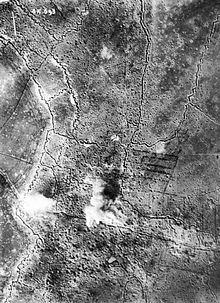
The first large offensive of the Battle of the Somme was the offensive at Thiepval Ridge. Mounted by the Reserve Army commanded by Lieutenant General Hubert Gough, the attack was intended to benefit from the attack of the Fourth Army at the Battle of Morval which was planned for twenty four hours later.

However, Thiepval Ridge was a well fortified entrenchment. The German defenders fought doggedly while the British advance bogged down after the first day. The coordination between infantry and artillery declined thanks to the chaos of the maze-like trench system, the dug-outs and shell craters. The British objectives were not actually achieved until October-November when the Reserve Army was reorganized and reinforced at the Battle of Ancre Heights.

Beyond the organizational turmoil, the deteriorating weather frustrated the plans of General Joffre to forge ahead with the planned attacks of the Anglo-French armies. Coincidentally, the Allies’ failures were further hampered by a revival in the German defense. It was time for experimentation in the war’s cruelest and deadliest weapons. The British implemented new techniques in gas warfare, machine gun bombardment and tank/infantry cooperation. The Germans struggled to withstand the ascendancy of men and material fielded by the combined British and French forces, even though they were being reinforced by troops, artillery and aircraft from Verdun. September became the costliest month for German casualties in the Battle of the Somme.

Thiepval Wood – September 1916, Edmund Blunden

The tired air groans as the heavies swing over, the river-hollows boom;
The shell-fountains leap from the swamps, and with wild-fire and fume
The shoulder of the chalk down convulses.
Then jabbering echoes stampede in the slatting wood,
Ember-black the gibbet trees like bones or thorns protrude
From the poisonous smoke — past all impulses.
To them these silvery dews can never again be dear,
Nor the blue javelin-flame of thunderous noons strike fear.

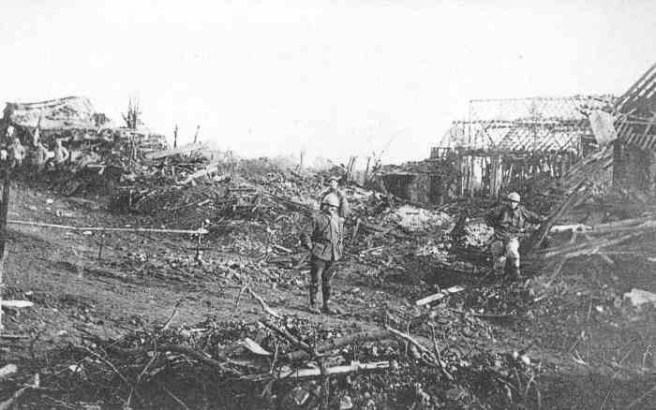
The ruins of Thiepval Village

Images courtesy Wikipedia and Vise Paris

Research Notes – The Great War (17) Robert Graves, War Poet

In the course of researching for my historical novel (in progress) I began reading about the War Poets: men whose experiences in the Great War gave rise to some of the most moving and heart wrenching poetry ever written. Unlike historical accounts with facts and statistics, the poetry brought to life (and death) the true suffering the men experienced during this dreadful conflict.

Robert Graves was a close friend of Siegfried Sassoon and like Sassoon used his experiences in the war as material for his poetry. He was badly wounded at The Battle of the Somme in 1917 and in addition, suffered the accompanying nightmare of shell shock. Nevertheless, unlike his friend Sassoon, he was never hospitalized for the condition. The story of his journey home, however, includes an odd series of coincidences both good and bad, that make for quite the interesting tale.

After the war, Robert Graves awaited demobilization while on leave in Ireland. For many men, the epidemic flu was hindering the process of returning them to their families. In February 1919, Graves finally received a telegram from the War Office confirming that his papers had come through. In order for the paperwork to be completed, however, Graves needed to return to the demobilization camp near his parents’ home in South London. Unfortunately for him, the release of troops from Ireland was about to be suspended due to the ‘Troubles’.

To make matters worse, he began to experience the intial symptoms of the deadly flu. Fearing for his health, should he be quarantined in an Irish hospital, Graves decided to make a run for it. He convinced an orderly sergeant to make out his travel papers and hopped on the next train from Limerick, even though he didn’t have the proper demobilization code marks. According to his memoir, Goodbye to All That, he said, “…I would at least have my flu out in an English and not an Irish hospital.”

On the night of February 13, 1919, he boarded the ferry to Fishguard with a high fever. He reports still having his mental faculties in good form, however. So upon discovering that a strike on the London Electric Railway was imminent, Graves immediately boarded a train from Wales to Paddington, in hopes of outrunning the inevitable disruptions. He made it safely and was able to catch the connecting trains and arrive at his home in Hove before travel was suspended.  Another happy accident was that he found himself sharing a taxi with a soldier who just happened to be the Cork District Demobilization Officer and was willing to provide him with the final code marks he needed to complete his paperwork.

The bad news: upon arriving at his home, he was so ill that he immediately took to his bed. And though Graves himself recovered, within two days of his return home, everyone in his household was dead except for his father-in-law and a servant.

Here is one of his poems:

The Last Post (June 1916)

The bugler sent a call of high romance–
‘Lights out! Lights out!’ To the deserted square:
On the thin brazen notes he threw a prayer,
‘God, if this is for me in time in France…
O spare the phantom bugle as I lie
Dead in gas and smoke and roar of guns,
Dead in a row with other broken ones,
Lying so stiff and still under sky,
Jolly young Fusiliers, too good to die.’
The music ceased, and the red sunset flare
Was blood about his head as he stood there.

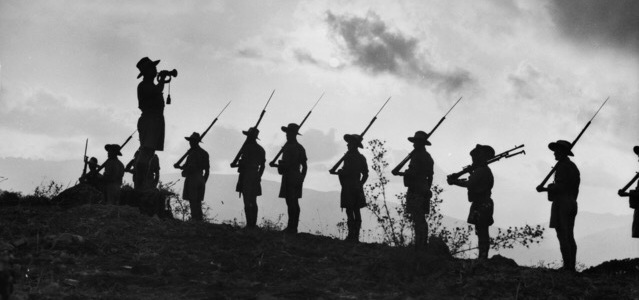
Image courtesy Australian War Memorial