Something a little different today…

I had the opportunity to practice some basic drawing skills last weekend. Going back to the ‘drawing’ board once in a while is a good idea; it keeps you from getting lazy!

Shading gives an object a three dimensional quality. Additionally, that object casts a shadow onto whatever background it rests upon. Being able to correctly add these to your drawing will make it realistic. The object I practiced this weekend was a sphere. I’ll show you the progression. There is specific terminology for the lines and shadows, but I skipped those for simplicity’s sake.

First, and obviously, you have to draw a circle. Using a jar lid as a template, I traced. Next you have to decide where the light source is coming from. In my drawing it is coming from the right. Further into the drawing I will make adjustments to the direction slightly, but this works for getting started. The ‘light’ lines will give you the basic dimension of the cast shadow, as well. The cast shadow of the sphere will be roughly perpendicular to the light lines.

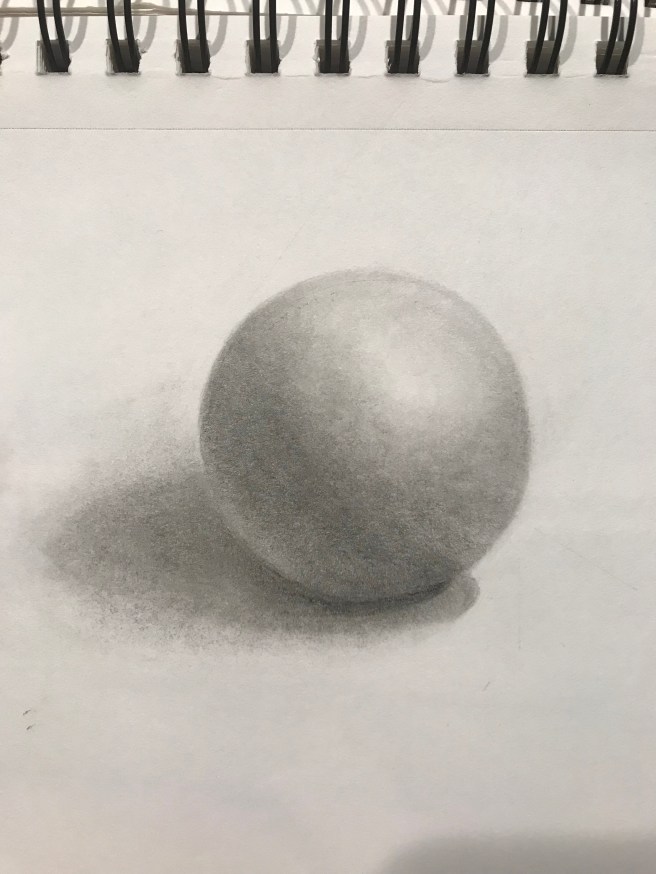
Next, I shaded the circle as if the light was coming slightly above and in front of the light. On a sphere, there will be no straight lines, all the shadows will be curved. And the shadow will fade gradually with the curvature. The second photo shows a 1 to 5 scale of tones from light to dark. Notice that the darkest part of the sphere doesn’t extend all the way to the surface it’s resting on. That’s because there will be a little reflected light from the surface. The cast shadow will also consist of a gradation of shades with the darkest being directly under the sphere.

Now it’s time for subtle adjustments. Notice in the first photo, the the darkest part of the shadow on the sphere is higher than in the second. This shadow should meet up with the shadow cast on the the surface. I corrected it by the second photo. Next, in above photo, there are still distinct lines from when I drew my original circle. Find them on the lower left and upper right of the sphere. Those kind of lines don’t exist in nature. Finally, the cast shadow is too far forward based on where I’ve placed the light source. This angle needs to be adjusted. Here is the final result:
I don’t pretend to be an expert; in fact I’m still learning a lot of the basics, still. However, I thought this might encourage others to pick up the pencil or pen and give it a try. Have a great Friday!

My Heart

Some days my feet are light
And I dance as if on air
Other days they’re heavy
As I trudge a path of despair

While in my lows, I wallow
Yet my highs can touch the stars
But whether in joy or sadness
My heart is wherever you are

A short poem ~ by Meg Sorick

Just a note; this is hyperbole, lest you all think I’m suffering from bipolar disorder.

Writing Ritually and Habitually

Some writers can write anywhere, anytime, under any conditions. Some of us need routine. And some of us have obsessive compulsive rituals we need to follow for any writing to happen. I am pretty adaptable in my habits but I do have preferences. This is my favorite way to write:

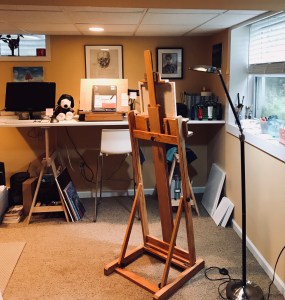
Place: I recently converted part of my finished basement into a writing space and art studio. Prior to that, I was sharing a desk with my husband in an alcove of our bedroom and using the kitchen counter for art projects. I’m sure you can imagine the mess I was making. In the basement studio —I call it my subterranean lair, because in my head I am a superhero— I have sliding glass doors and a large double window for natural light and lots of plants just outside for a view of nature as well. I have a long countertop area to use for drawing and an area for my computer and monitor at the other end. My easel stands in front of the window for my canvases. This setup keeps my on my feet for not just for art but for writing, too. Standing is my preferred posture; it’s better than sitting on your kiester all day. Trust me, I‘m a doctor— at least until August 31st! Besides that, it makes it easier to move around. If I’m working out a scene in my head, I might pace or dance around if I have music playing. And that is definitely a healthy habit to have!

Time: I seem to have all my best ideas in the wee hours of the night, and alas, so many of them are gone by morning. However, when something truly inspired wakes me up, I have a notebook and pen nearby so I can tiptoe to the bathroom and scribble it down. As for my lengthy writing sessions, I prefer to start first thing in the morning, write for at least an hour or two and break off for my exercise; I usually don’t write in the middle of the day. I also may write in the evenings, just before bed, but often that leaves me unable to turn my brain off for sleep. Not cool; I love sleep.

Music: I like to write with music on in the background, but it isn’t absolutely essential. Complete quiet is fine, too. When I do have music on, it is usually classical, jazz, or soft electronic music. The only time that changes is if I’m writing something ‘energetic’ like an argument, a comedic scene or a big revelation. In that case, I might put on dance music or loud rock. Under normal circumstances, though, I get too distracted with the lyrics. For drawing and painting, I choose my music based on the mood of the piece I want to create. Sometimes, it’s not even music but nature sounds that make the backdrop to my artwork.

Beverages: Early morning writing requires coffee, at least two cups. And by cups, I mean giant mugs. If I find myself writing in the afternoon, then I have tea. And after 5:00, well it’s happy hour, right? Seriously, though I don’t over-imbibe while I write. Occasionally, a whisky or a pint is a little lubrication for the creative mind, but too much of that and you end up with a mess on your hands and a whole lot of rewriting to do! (See this episode of Drinking Adventurously for more on that subject).

Goals: In paying attention to the habits of other successful writers like Stephen King, Lisa Scottoline, John Grisham, and Nora Roberts, the single habit they all share is setting writing goals. Perhaps it is as vague as ‘a page a day’ —if you are writing a page that is filled with dialogue, that might not be very many words, whereas a scene-setting narration with lots of description might have a high word count. Other goals may be specific to word count, chapter completion, character development or plot resolution. My goals are usually tied to plot resolutions. In other words, I write until I finish up a scene at an appropriate spot. It isn’t always the end of a chapter, but that is most often the way it ends up.

If there is one thing I’ve learned in writing these past four years, there is not a right way or a wrong way to write, as long as you keep writing! Tell me, fellow writers, what are your rituals?