I must have misplaced my modifier.

Good grammar and spelling can make or break an otherwise wonderful piece of writing. One common mistake is to misplace modifiers. What is a misplaced modifier? Simply put, it’s a word or phrase put in the wrong place in a sentence. It will make a sentence confusing and illogical. Take for example, this converstion:

Me: “This morning, I passed a horse on the way to work.”
You: “Where does the horse work?”
Me: “No, the horse wasn’t going to work, I was. A policeman was riding the horse directing cars.”
You: “So the horse was directing cars?”
Me: “No! The policeman was directing the cars on the horse.”
You: “How were the cars on the horse?”

Ridiculous, right? The modifiers should be placed as close to whatever they describe or give information about. Like this: “This morning, on my way to work, I passed a horse.” And so forth. Notice, too, how the modifying phrase is set apart by commas.

A good way to avoid this mistake is to read your sentences aloud before pressing that post button. It becomes apparent when our modifiers are misplaced and gives us the opportunity to restructure the sentence properly. Happy writing, and productive editing, my friends.

In the Zone

In reading about the Spanish Influenza, I came across a bit of information that is perfectly suited for the expertise of Mr. Cake. I pressed him into service for a guest post and he kindly agreed.  

Avant-garde catalyst, the quintessential modernist and fashionable man about town, Guillaume Apollinaire saw himself as a spiritual heir of Charles Baudelaire, an urban poet who doubled up as an art critic. He coined the term Cubism and was the most impassioned and ardent of its early defenders. He also coined the term Orphism (a tendency in abstract art) and more famously, Surrealism, to describe Erik Satie music for Jean Cocteau’s ballet Parade.

His list of contacts within Parisian artistic and literary scenes reads as a veritable who’s who of the pre-war avant-garde and include Picasso (a particularly close friend), Andre Breton, Marc Chagall, Gertrude Stein, Marcel Duchamp, Blaise Cendrars, Jean Cocteau, Henri Rousseau, Andre Derain and Giorgio de Chirico, who painted a Premonitory Portrait of Apollinaire in 1914 that eerily predicts the wounds that he was to suffer during WW1.

His 1913 collection Alcools is a landmark in literary modernism and features the important poem Zone that while grounded in Symbolism, points towards the future in its emphasis on the energy and vitality of the modern city and engagement with (then) new, evolving technologies.

Apollinaire also wrote several erotic novels including Les Onze Mille Verges, (The Eleven Thousands Rods), and he also led to the critical re-evaluation of Marquis De Sade of whom he remarked was ‘the freest spirit to ever live’.

Apollinaire volunteered during the first WWI and was stationed, appropriately for someone who was known for his fondness of a drink, in the Champagne Region. He suffered a head-wound in 1916 that required Apollinaire to undergo trepanning; he never really recovered although he published in 1917 another landmark collection of poetry Calligrammes that uses typography to startling effect, poems are shaped like a mirror, heart, a watch etc.

In 1918, still weakened by his war wound Apollinaire succumbed, like 19 million others to the Spanish Flu. He was 38 years old.

After his death Andre Breton, who admired Apollinaire and was very much in the tradition of poet/critic and cultural instigator, would take his coined phrase Surrealism and make it into one of the major intellectual and artistic movements of the 20th century.

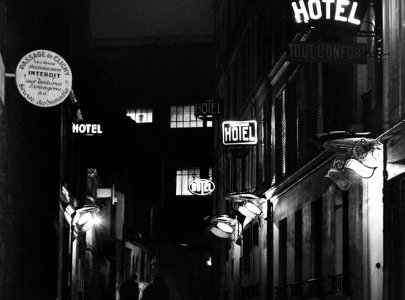
I would have liked to include his seminal poem Zone, however it is a very lengthy poem, so I have chosen instead one of his poems from his 1913 collection Alcools, Hotels.

Hotels

The boss is doubtful
Whether you’ll pay
Like a top
I spin on the way

The traffic noise
My neighbour gross
Who puffs an acrid
English smoke

O La Vallière
Who limps and smiles
In my prayers
The bedside table

And all the company
in this hotel
know the languages
of Babel

Let’s shut our doors
With a double lock
And each adore
his lonely love

Translation A.S Kline

Image: Brassai-Bouvelard De Clichy 1932
Places, everyone …

“If you send your characters on a voyage, be sure you are acquainted with the countries where their travels lead them, and spin your tales with such magic that I can identify with them. Remember that I voyage at their side wherever you send them to, and that I may know more than you and will not excuse your errors in reporting manners and costumes nor forgive a geographic blunder. …you must make your descriptions of your chosen localities authentic, or else you should stay at home. This is the only area of what you write where invention cannot be tolerated, unless the lands to which you transport me are imaginary.” – Essay on Novels, The Marquis de Sade

Another bit of good advice, no?

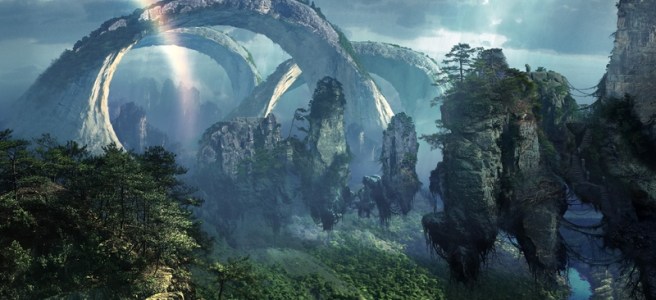
Setting the location for your story can be tricky business. The safest approach, of course, is to set the location in or around the area in which you live. Or if it is a ficticious locale, base it on an area with which you are intimately familiar. If you are a science-fiction or fantasy writer, the ‘world’ is your oyster. You have the power of a god to create the world of your dreams. A caution, however –be consistent. Keep extensive notes, make charts and maps. Write a ‘bible’ for your world and its inhabitants. They need a history, an origin story, and even if they are an ‘atheistic’ society, they need a set of beliefs.

Back to the ‘real’ world…  Even here on Earth, extensive note-taking and chart-making are good ideas. Unless your characters are wandering through the Twilight Zone, the post office ALWAYS needs to be across from the library, not sometimes across from the pharmacy. Someone will notice. (Me, probably….) Anyway, don’t get lazy with this stuff or you’ll have a mess on your hands.

And like the Marquis so eloquently stated, “I may know more than you and will not excuse your errors… nor forgive a geopgraphic blunder.” How humiliating would it be to have a reader call you out for a glaring error publicly, either in the comments of your blog post or, even worse, within a review of your work on Amazon?

If you do send the story to a secondary locale, make sure you are also familiar with this one. And if not, for heaven’s sake do exhaustive research. The minutiae of the secondary location might not be a big deal if it isn’t relevant to the story. But the big things need to be accurate. Is there public transportation?  Are there high rise buildings or quaint, clapboard houses? Forests or deserts, mountains or flatlands? How long does it really take to get from point A to point B? Someone will notice… Ahem.

Other things that can hang your story out to dry:

  • Local languages and colloquialisms
  • Weather, climate and seasonal changes
  • Time (Things happening too quickly, for example boy meets girl they fall in love… in the span of three days. Another faux pas is messing up the flow of time, for example a character refers to something that hasn’t happened yet.)
  • Cultural and religious variations among regions (even within a single nation)
  • Politics and government
  • Pop culture (references that can ‘date’ your story, if you want it to be ‘timeless’)
  • Laws and customs (which can vary widely, even within the same country)

I constantly seek new ways to improve my skills as a writer. And thusly, I am enjoying plucking these gems of literary wisdom from the notorious de Sade. I hope, as always, you find this reminder as helpful as I did.