
Drinking Adventurously Local Edition

Week 30 in the Year Of Drinking Adventurously. Gueuze.

We’re still “in Belgium” this week for another style of brewed goodness. Gueuze is probably not a style of beer that you’ve heard of. But perhaps you’re familiar with the term lambic? Lambic beer arises from adding fruit to the wort (the boiled ingredients including grains and/or malted extracts and other additions like spices) and letting the flavors permeate the brew. Ingredients like cherries, strawberries, peaches, raspberries add a distinct fruitiness to the finished product. For non-beer drinkers, lambic may be a palatable option. Lambics remind me more of cider than traditional beer. Gueuze is a blend of Lambics. Usually, blending one, two and three year old brews together. The resulting combination facilitates a secondary fermentation and brings on natural carbonation.

IMG_4004
The taproom at Freewill

For this week’s adventure, I took a short ride to the next town over — Perkasie, Pennsylvania. Literally less than five miles from my house. Freewill Brewing Company has been around for a mere four years, but in that time have carved a niche in not just the local Bucks County and Philadelphia region but have also expanded into New Jersey, Delaware and the Boston area. One of their specialties? Sour beers. Perfect for researching this week and last week’s posts. This past Saturday, I had the opportunity to take the brewery tour and to talk to one of the Brewers, Hannah about the sour beers Freewill specializes in.

The “clean beer” is brewed and fermented on the main floor of the brewery. We aren’t really concerned with these beers this week.  Through a winding corridor and down a flight of stairs, we enter the “sour cellar” where the wild yeasts thrive and the dank, funky atmosphere provides the perfect conditions for making sour beer.

IMG_4007
Plastic fermenting totes and oak wine barrels

After boiling, the wort goes into huge plastic totes and the pieces of fruit are added.  There it sits burping away until such time it gets transferred to an aged oak barrel. For the purpose of sour beer aging, Freewill uses old wine barrels and in some cases, brace yourself, old grappa barrels! There it remains for a year or two.

IMG_4008
Grappa barrels from Italy


The sour beer varieties are then bottled and sold for consumption. One of the interesting things about the wild yeast: it self propagates and it evolves. The original strain was purchased several years back from another small brewery and its progeny has been fermenting Freewills’s sours ever since.

Since the varieties on tap in the taproom constantly change, the only sour I sampled this week was When Doves Cry: a Kettle Sour IPA with a 7.5% ABV. A collaboration with Evil Genius for Philly Beer Week, it’s a kettle sour with elderberries, notes of grapefruit and strawberries. Tart and refreshing.

The other beers in my flight were a saison, an American IPA and a spicy habanero Imperial Ale.  I brought home some bottles though. The Grape Sour and… made with Pennsylvania peaches “Peachy McPeachface” sour peach ale.

More beers from Belgium next week and if all goes well, another local adventure!

See how it “gueuze” with Lula!
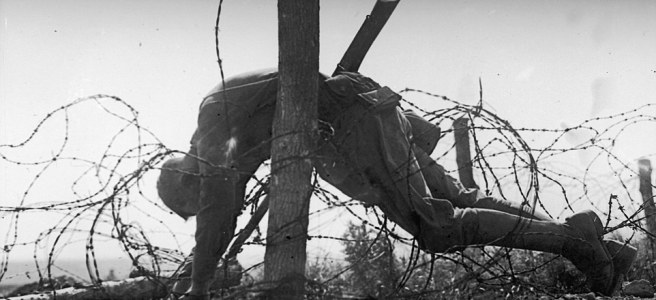
The Silent One (by Ivor Gurney)

Who died on the wires, and hung there, one of two–
Who for his hours of life had chattered through
Infinite lovely chatter of Bucks accent:
Yet faced unbroken wires: stepped over, and went
A noble fool, faithful to his stripes– and ended
But I weak, hungry, and willing only for the chance
Of line– to fight in the line, lay down under unbroken
Wires, and saw the flashes and kept unshaken,
Till the politest voice– a finicking accent, said:
‘Do you think you might crawl through, there: there’s a hole’
Darkness, shot at: I smiled, as politely replied —
‘I’m afraid not, Sir.’ There was no hole, now ay to be seen,
Nothing but chance of death, after tearing of clothes
Kept flat, and watched the darkness, hearing bullets whizzing–
And thought of music– and swore deep heart’s deep oaths
(Polite to God) and retreated and came on again,
Again retreated– and a second time faced the screen.

Image courtesy The Daily Mail. 

About Ivor Gurney…

Born in 1890, Ivor Gurney was the son of a tailor and a seamstress. He showed musical ability and sang as a chorister at Gloucester Cathedral, from 1900 to 1906. Gurney began composing music at the age of 14, and won a scholarship to the Royal College of Music in 1911. Gurney’s dynamic personality was tainted by mood swings which appeared during his teenage years. They were significant enough to impact his work at college, eventually resulting in breakdown in 1913. He withdrew to rest, after which he seemed to recover and was able to return to college.

Nevertheless, college was once again interrupted by World War I. Gurney enlisted as a private soldier in the Gloucestershire Regiment in February 1915. At the Front, he began writing poetry seriously, sending his efforts to his friend, the musicologist-critic Marion Scott, who worked with Gurney as his editor and business manager. He was in the midst of writing the poems for what would become his first book Severn and Somme when he was wounded in the shoulder in April 1917. After recovering, he was returned to battle, still working on his book and composing music including the songs In Flanders and By A Bierside.  Meanwhile, Gurney was gassed in September 1917 and sent to the Edinburgh War Hospital where he met and fell in love with a VAD nurse, Annie Nelson Drummond, but the relationship was doomed to fail. There is speculation about the possible effects of the gas on his mental health, even though Gurney had demonstrated the signs and symptoms of a bipolar disorder since his teens.  After his release from hospital he was posted to Seaton Delaval, a mining village in Northumberland, where he wrote poems including ‘Lying awake in the ward’. Severn and Somme, was published in November 1917.

Gurney died of tuberculosis while still a patient at the City of London Mental Hospital shortly before dawn on 26 December 1937, aged 47. He was buried in Twigworth, near Gloucester.  125px-Ivor_gurney_grave

On November 11, 1985, Gurney was among 16 Great War Poets commemorated on a slate stone unveiled in Westminster Abbey’s Poet’s Corner. The inscription on the stone was written by a fellow Great War poet, Wilfred Owen. It reads: “My subject is War, and the pity of War. The Poetry is in the pity.” A memorial to Gurney was erected in 2009 near Ypres, close to the spot where he was the victim of a mustard gas attack in 1917, and a blue plaque on Eastgate Street in Gloucester, commemorates his life.

(Source material Wikipedia)