Research Notes – The Great War (17) Robert Graves, War Poet

In the course of researching for my historical novel (in progress) I began reading about the War Poets: men whose experiences in the Great War gave rise to some of the most moving and heart wrenching poetry ever written. Unlike historical accounts with facts and statistics, the poetry brought to life (and death) the true suffering the men experienced during this dreadful conflict.

Robert Graves was a close friend of Siegfried Sassoon and like Sassoon used his experiences in the war as material for his poetry. He was badly wounded at The Battle of the Somme in 1917 and in addition, suffered the accompanying nightmare of shell shock. Nevertheless, unlike his friend Sassoon, he was never hospitalized for the condition. The story of his journey home, however, includes an odd series of coincidences both good and bad, that make for quite the interesting tale.

After the war, Robert Graves awaited demobilization while on leave in Ireland. For many men, the epidemic flu was hindering the process of returning them to their families. In February 1919, Graves finally received a telegram from the War Office confirming that his papers had come through. In order for the paperwork to be completed, however, Graves needed to return to the demobilization camp near his parents’ home in South London. Unfortunately for him, the release of troops from Ireland was about to be suspended due to the ‘Troubles’.

To make matters worse, he began to experience the intial symptoms of the deadly flu. Fearing for his health, should he be quarantined in an Irish hospital, Graves decided to make a run for it. He convinced an orderly sergeant to make out his travel papers and hopped on the next train from Limerick, even though he didn’t have the proper demobilization code marks. According to his memoir, Goodbye to All That, he said, “…I would at least have my flu out in an English and not an Irish hospital.”

On the night of February 13, 1919, he boarded the ferry to Fishguard with a high fever. He reports still having his mental faculties in good form, however. So upon discovering that a strike on the London Electric Railway was imminent, Graves immediately boarded a train from Wales to Paddington, in hopes of outrunning the inevitable disruptions. He made it safely and was able to catch the connecting trains and arrive at his home in Hove before travel was suspended.  Another happy accident was that he found himself sharing a taxi with a soldier who just happened to be the Cork District Demobilization Officer and was willing to provide him with the final code marks he needed to complete his paperwork.

The bad news: upon arriving at his home, he was so ill that he immediately took to his bed. And though Graves himself recovered, within two days of his return home, everyone in his household was dead except for his father-in-law and a servant.

Here is one of his poems:

The Last Post (June 1916)

The bugler sent a call of high romance–
‘Lights out! Lights out!’ To the deserted square:
On the thin brazen notes he threw a prayer,
‘God, if this is for me in time in France…
O spare the phantom bugle as I lie
Dead in gas and smoke and roar of guns,
Dead in a row with other broken ones,
Lying so stiff and still under sky,
Jolly young Fusiliers, too good to die.’
The music ceased, and the red sunset flare
Was blood about his head as he stood there.

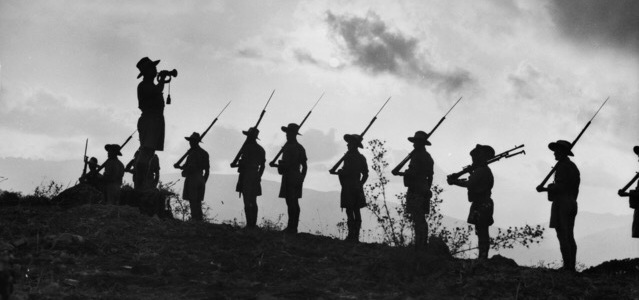
Image courtesy Australian War Memorial 
The Great War – Research Notes (16) The Art Of War

When war broke out in August 1914, no one on either side of the conflict believed that it would rage on for over four bloody, devastating years. Many in fact, welcomed the war, believing it to be an opportunity for adventure —glorious and brief. The famous declaration that the whole thing would be finished ‘before the leaves fell from the trees’ or at the latest ‘by Christmas’ contributed to the romantic notion of going off to war. These fantasies were soon shattered by the gruesome reality of modern warfare.

The responses to the war evolved as time passed; from initial enthusiasm, nationalistic fervor and patriotism to shock, horror, anguish and remorse. These various and sometimes contradictory emotions are reflected in the art of the time. Photography and film news reels brought the carnage to life, so that even those at home got a taste of the true nature of war. Many artists and writers saw the war from the front lines and composed poetry, authored literature and created works of visual art reflective of those dreadful experiences. The following are samples of some of the works of art produced during and following The Great War:

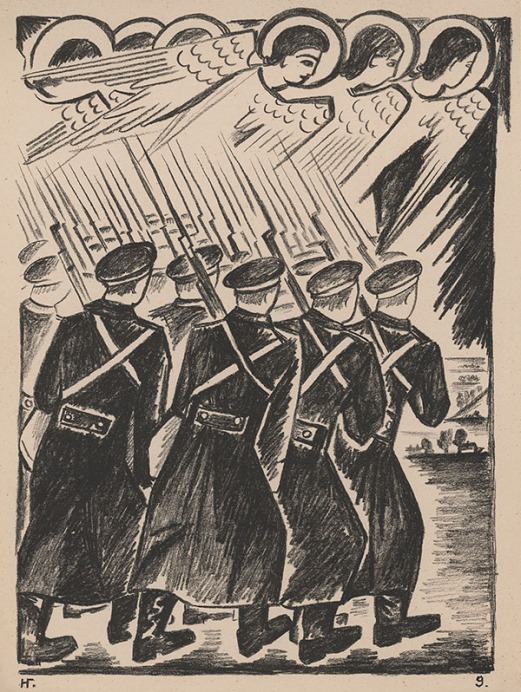
I.  At the outset, many believed that the war would bring an end to the old social and political systems and usher in a new order of equality and progress. This optimism can be seen in the following lithograph from a collection called, Mystical Images of War. The artist, Natalia Goncharova, a Russian living in Paris at the outbreak of war, depicts the angelic host watching over the soldiers as they march away.

The Christian Host ~ Natalia Goncharova, 1914

goncharova.jpg

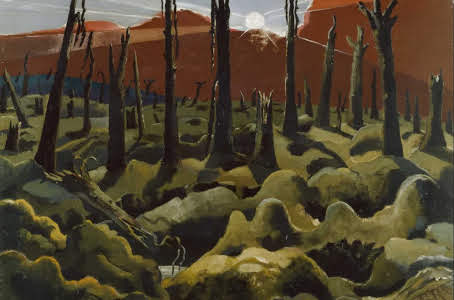
II.  Paul Nash is one of my favorite artists and he’s been featured here previously. The painting Ypres Salient At Night heads my poem: Tales Of War. Despite the optimistic title, Paul Nash’s painting depicts a scarred landscape with shell-holes, mounds of earth, and leafless trees –the resulting devastation of World War One.

We Are Making a New World ~ Paul Nash; 1918

Unknown

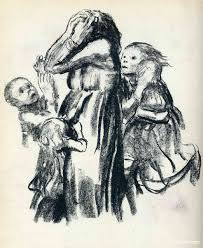
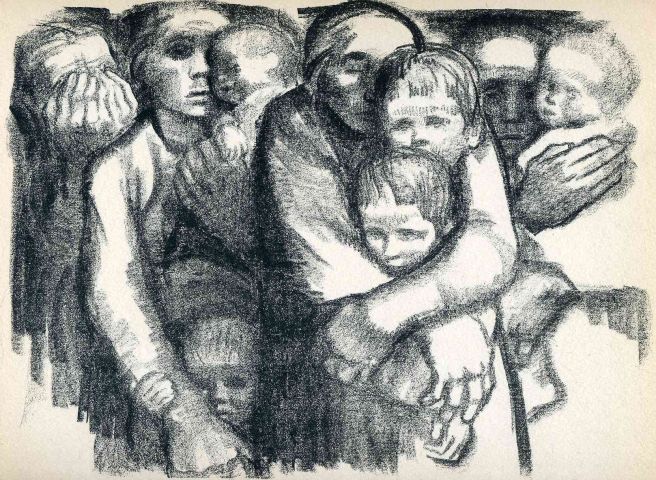
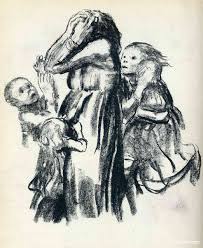
III.  Kathe Kollwitz used her art to portray the grief of loss from war. The following two pieces show the heartbreaking agony and hardship experienced by those left behind.

Killed In Action (Gefallen) ~ Kathe Kollwitz, 1920

Unknown-1

Mothers in different stages of life, held together by one common bond: the need to protect their children.

Mothers (Mütter) ~ Kathe Kollwitz, 1919

81cfd894f50c6a43b91ab3e4ffa5efc6.jpg

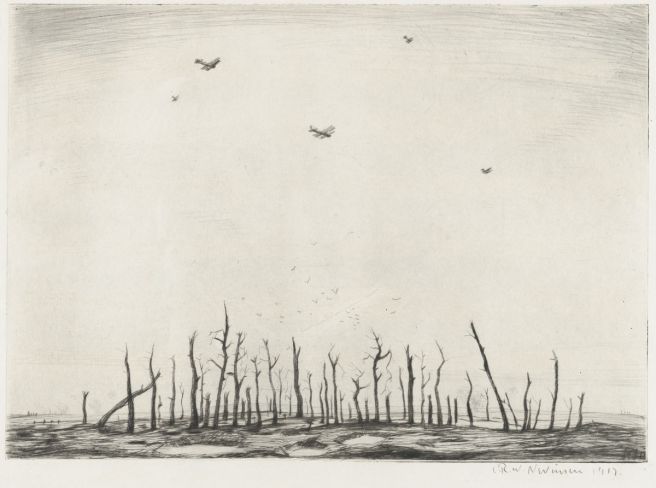
IV.  Christopher Richard Wynn Nevinson revisits the desolation of No Man’s Land with insect-like planes buzzing overhead in That Cursed Wood, a title taken from a line in Siegfried Sassoon’s poem, At Carnoy: “Tomorrow we must go / To take some cursed wood… Oh world God made!”

That Cursed Wood ~ Christopher Richard Wynn Nevinson, 1917

main-image.jpeg

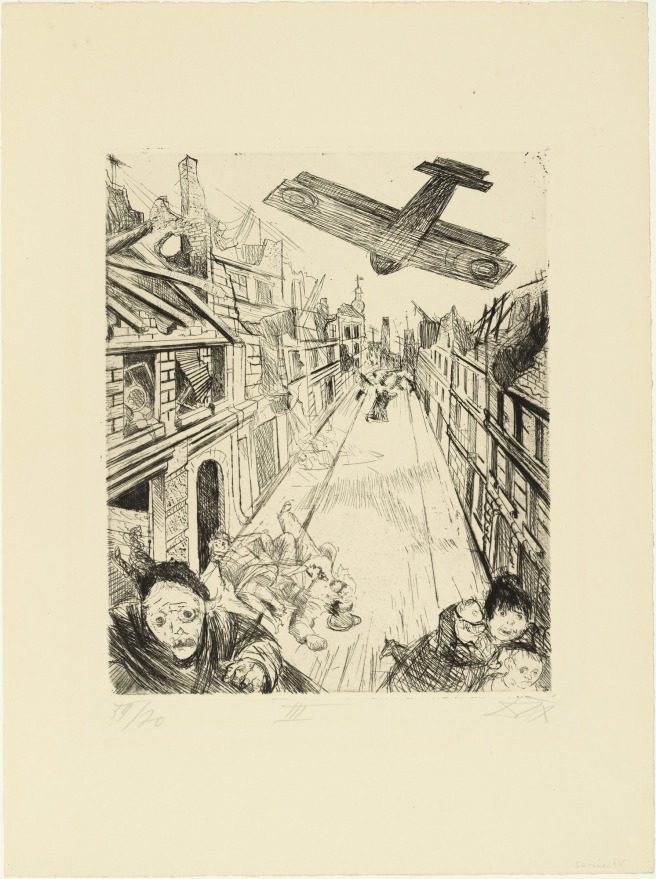
V.  I’ve featured Otto Dix twice before in my Great War posts. Shock Troops Advance Under Gas was the image for a post on chemical weapons and I used The Wounded Man to head my post about the disfiguring injuries to soldiers. You can click on the links to view those pieces. Otto Dix served for four years as a machine gun operator in the German army on the front lines in Belgium and France. He was grievously injured and suffered terrible nightmares about his experience. After the Armistice, during the height of these nightmares, he produced a series of drawings and etchings called The War (Der Krieg). Here is one more from that collection. In sharp contrast to the nationalist propaganda featuring war heroes like Baron Manfred von Richthofen (The Red Baron), Lens Being Bombed shows the terror and desperation of the citizens of the town in Northern France as they run for their lives.

Lens Being Bombed (Lens wird mit Bomben Belegt) ~Otto Dix, 1923-1924

cri_000000116429.jpg

There are many, many more significant artists and artwork to consider, so this will be one of several posts on the subject.

Research Notes – The Great War (15) The War Poets

In the course of researching my historical novel: Here Lies a Soldier, I’ve read books on the battles, the origins of the conflict, the Spanish Flu epidemic which came close on its heels, and of the life and struggle of the average citizen striving to weather that horrible storm. Among some of the most compelling subjects I’ve researched are the works of art, the literature and especially the poetry composed at the time.

During the First World War, unlike previous wars, a significant number of important British poets served as soldiers. As one might expect, they composed poetry that reflected their experiences in battle, the conditions in the trenches and the spirit of the men they fought beside. Some of them died in battle: Edward Thomas, Isaac Rosenberg, Charles Sorley and Wilfred Owen. The ones that survived, like Siegfried Sassoon, Ivor Gurney and Robert Graves, were deeply affected by the horrors of war and their work demonstrates their traumatization.

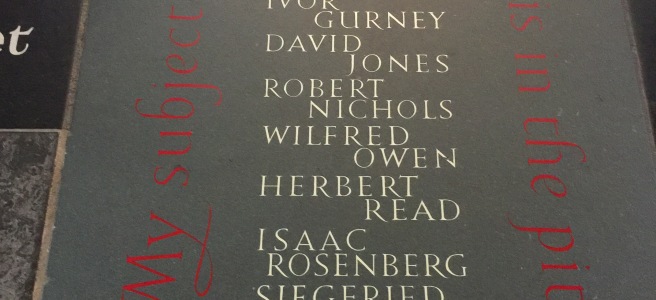
In Westminster Abbey, Poet’s Corner is a section of the South Transept. Among the graves and other memorials of Britain’s famous poets, lies a stone slab with the names of the War Poets inscribed on it. It’s also inscribed with words from Wilfred Owen’s “Preface”

“My subject is war, and the pity of war. The Poetry is in the pity.”

Anthologies of these poems were very popular during the war. In my collection of War Poems: Men Who March Away, the editor has grouped the collection by date, giving the reader a glimpse of how attitudes toward the war changed over time. Here is one of Wilfred Owen’s poems – Exposure. The soldiers faced not only the enemy in battle but also the terrible conditions in the trenches – the mud, the filthy water, the lice, the rats and the cold. Sometimes the waiting was as dreadful as the action.

Exposure – Wilfred Owen

Our brains ache, in the merciless iced east winds that knive us . . . 

Wearied we keep awake because the night is silent . . .

Low drooping flares confuse our memory of the salient . . .

Worried by silence, sentries whisper, curious, nervous,

       But nothing happens. 

Watching, we hear the mad gusts tugging on the wire,

Like twitching agonies of men among its brambles.

Northward, incessantly, the flickering gunnery rumbles,

Far off, like a dull rumour of some other war.

       What are we doing here?

The poignant misery of dawn begins to grow . . .

We only know war lasts, rain soaks, and clouds sag stormy.

Dawn massing in the east her melancholy army

Attacks once more in ranks on shivering ranks of grey,

       But nothing happens.

Sudden successive flights of bullets streak the silence.

Less deadly than the air that shudders black with snow,

With sidelong flowing flakes that flock, pause, and renew,

We watch them wandering up and down the wind’s nonchalance,

       But nothing happens.

Pale flakes with fingering stealth come feeling for our faces—

We cringe in holes, back on forgotten dreams, and stare, snow-dazed,

Deep into grassier ditches. So we drowse, sun-dozed,

Littered with blossoms trickling where the blackbird fusses.

       —Is it that we are dying?

Slowly our ghosts drag home: glimpsing the sunk fires, glozed

With crusted dark-red jewels; crickets jingle there;

For hours the innocent mice rejoice: the house is theirs;

Shutters and doors, all closed: on us the doors are closed,—

       We turn back to our dying.

Since we believe not otherwise can kind fires burn;

Now ever suns smile true on child, or field, or fruit.

For God’s invincible spring our love is made afraid;

Therefore, not loath, we lie out here; therefore were born,

       For love of God seems dying.

Tonight, this frost will fasten on this mud and us,

Shrivelling many hands, and puckering foreheads crisp.

The burying-party, picks and shovels in shaking grasp,

Pause over half-known faces. All their eyes are ice,

       But nothing happens.