Breaking Out the Blurb

Adventures in novel writing…

I feel like I’ve been working on Breaking Bread forever! But at last I’m finally seeing light at the end of the tunnel. As long as it’s not an oncoming train… and frankly the way the past year has been? That could very well be the case.FullSizeRender

I’ve reached that stage in novel development that I like the least — writing the synopsis, or blurb that goes on the back cover of the book and in the description on the Amazon page. How do you distill 85,000+ words down to a few sentences or a short paragraph? And write those sentences in such a way as to suck your potential readers into buying your novel? Ugh. It’s agonising!

Why is it so hard? Fellow writers, do you struggle with this part, too?

The blurb needs to convey the mystery, the suspense, the drama of the book without giving away the details or the ending. It also has to be concise and attention grabbing. I either end up with three sentences or an entire page. Finding the happy middle ground is elusive. So as I work on the blurb for my fifth novel, Breaking Bread, (and yes, I’m going with that title – more about that in another post), I rant, I rail, I stomp and I curse. That is ridiculous, right? Temperamental artist stereotype, right here! (She says throwing herself onto her Victorian fainting chair.) After I’ve had enough wallowing and whining, I get angry. What?!? Angry, you say? How does that help?do-not-keep-calm-anger-is-an-energy

This is not the path I would recommend to you all, but for me, getting angry energizes me. It sets me on fire and it feels kind of good. Maybe that makes me a dangerous psychopath, or possibly The Incredible Hulk’s previously unknown twin sister, I’m not really sure. Whatever the case, anger makes me feel alive. Once I get the frustration out of my system, I can move on, rejuvenated.

I nailed that blurb today. And if I didn’t nail it, I want you to tell me. Here it is below. All suggestions are welcome.

Breaking Bread, Book Five in the Bucks County Novels

Maya Kaminski has achieved her dream of owning a French bakery cafe, even though her family opposed her every step of the way. It hasn’t been easy, but her hard work and dedication have paid off —the business is thriving and she’s slowly getting ahead. Just as things seem to be going her way, her childhood friend, Brad Logan, moves back into town and with his recent inheritance, buys Maya’s building, intending to help her out. However, Maya is so used to relying on herself that it’s a struggle to accept help from anyone, let alone a man with whom she finds herself falling in love. When the cafe comes under attack, first by what appears to be petty mischief but quickly escalates to dangerous sabotage, Maya will need all the help she can get to save her business and her life.

(‘Keep calm’ image credit: farenheit211)

The Great War – Research Notes (2) The Schlieffen Plan

A trip to Belgium in 2013 was the inspiration to write a short story called Here Lies a Soldier. After I finished, I posted it and thought that was the end. The characters, however, had something else in mind altogether. Thus, I find myself immersed in the history of The Great War so as to write the most authentic story of that time that I can.

The outbreak of war in 1914 had been planned in advance for nearly twenty years. In those preceding decades, the maneuvering for power on the Continent among the players who finally declared against each other in the early days of that fateful August, had resulted in their political and military leaders preparing plans for all the potential scenarios that might arise in the case of a general European war.

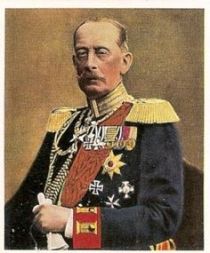
Of all the plans that had been drafted, the most important of them was that of the Germans because ultimately, its execution turned a regional war into a world war. It was called The Schlieffen Plan after it’s author, Count Alfred von Schlieffen, who served as the Chief of the German General Staff from 1891 to 1906. de03b24f9973706b3534fea5ea296724The bulk of the plan had already been formulated by 1895. Minor modifications and what can only be called tampering, were the only changes that were made to the plan after Shclieffen’s retirement.
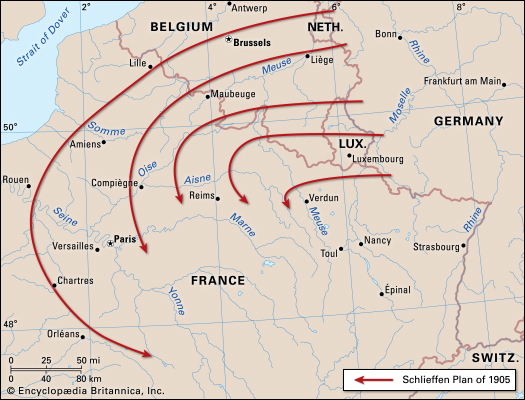

The plan went like this:

Shielffen concluded, based on the alliances formed during his tenure, that Germany would have to fight a two front war. France had allied with Russia, therefore any war involving either of those parties would inevitably drag the other into the fray. In those days the objective was to be the fastest to mobilize. The first army to get into position would ultimately be the victor, or so it was thought. Schlieffen calculated correctly that the German army would be the fastest to mobilize, with the French second fastest and the Russian army the slowest.

If Germany could rush into position, Shlieffen believed, the two front war could be avoided. With a massive push against France in the opening weeks of a confrontation, the speedy German forces could overwhelm the French before the Russians had their troops mobilized. After quickly defeating the French, they could now send the full force of the German war machine against the sluggish Russians.

For this plan to work, several assumptions were made. One, that an engaged French army would launch an attack into the region of Allsace-Lorraine– the former French regions lost to the Germans in the Franco-Prussian War of the 1870’s. This would leave the Western borders of France weak and vulnerable. The main wing of the German army would march west, drop down through Belgium (unopposed, or so they thought) and have the French forces surrounded from The English Channel on the west to the defensive forces engaging the French offensive in Alsace-Lorraine on the east. The whole thing would take no more than six weeks. Paris would be captured and the Germans could turn their attention to the Russian army on the extreme eastern front.

Shlieffen said, “Let the right-flank grenadier brush the Channel with his sleeve.”

178709-004-C3306AFE.jpg


However, for Germany to launch the massive and speedy offensive into Western France, neutral Belgium had to be invaded. The original Shlieffen plan also called for an intrusion into a small section of the Netherlands. Schlieffen had calculated (wrongly) that, despite a treaty guaranteeing Belgium’s neutrality and Britain’s promise to uphold such, the British would stand idly by while ‘little Belgium’ was violated by the massive two million man German offensive. That alone would not prove to be the only downfall of The Schlieffen Plan.

When Schlieffen retired in 1906, he was replaced by Helmuth von Moltke, nephew of the great Field Marshall Helmuth von Moltke, director of the Wars of German Unification and military counterpart of Otto von Bismarck, the political might behind the Kaiser of united Germany. The namesake did not live up to his uncle’s reputation, however. He himself acknowledged this. Reportedly confessing to a friend he said, “I lack the capacity for risking all on a single throw.” And that kind of nerve was exactly what the Shlieffen Plan demanded in order to be successful.

Shlieffen had insisted that the strength of the right wing was critical to the success of the plan. Moltke weakened that very wing by reallocating troops (unnecessarily) to strengthen the defensive position in Alsace-Lorraine. He also opted not to violate Holland’s territory as well as Belgium’s, which meant the massive German wing (three armies) was squeezed though a narrow thirty-five mile gap between the Belgian/Holland border and the Ardennes forest. This also meant they had to fight their way past Belgium’s strongest defensive position – the fort at Liege.

Long story short – the Belgian army did not roll over and let the Germans pass. They put up a hell of a fight, slowing them down and totally disrupting the aggressor’s timetables. Additionally, the British did not stand idly by and let Belgium, whom they had sworn to defend, be invaded by the German army. They quickly declared war on Germany and sent the British Expeditionary Force into the fray.

The Germans had thought the Schieffen Plan guaranteed them victory within three or four months. And what it really guaranteed was that if victory was not achieved in that time, it would not be achieved at all. The two front war they hoped to avoid was now the reality. A reality that quickly became a nightmare.

114

Images via: Spartacus-educational, Wikipedia, and Britannica

“Women who wear black, lead colorful lives.” – Neiman Marcus

Catherine Deneuve – Walter Carone, photographer

I set up my blog back in August of 2014, soon after I began experimenting with writing. It took me a year to actually take it seriously. This was shortly after enrolling in WordPress’ blogging university courses. One of the tricks they teach you is to give your blog a unique and eye catching name. At that time I chose: Meg Sorick Writes Better Than She Dresses, and used the tag line: “She tried to look picturesque but only succeeded in being untidy.” – a quote from Oscar Wilde’s A Picture Of Dorian Grey. Looking back, I’m trying and failing to remember why I assumed such a self deprecating position. I’m neither untidy nor a bad dresser. I do, however have a simple approach. My wardrobe is nearly automated.

Within the drawers of my bureau you will find black short sleeved shirts, black long sleeved shirts, black cardigan sweaters and black undergarments. In my closet, hang black dresses, blouses, skirts, jackets and slacks. There is a shelf for denim and another for my black handbags. I have black boots, tall and short, black stilettos, black ballet flats and black Crocs that I wear while I’m working at my ‘real’ job. All I have to do in the morning when I’m getting dressed is choose the next clean, black item in the queue and I’m ready to go. You will not believe how freeing this feels! And no it’s not boring, there is still a variety in the styles that I wear. I just never have to worry about coordinating anything I’m putting on my body. I always know it will match AND that it will look good. Ever see yourself in an old photo and cringe at what you were wearing? My system eliminates that from happening.

Apparently, there are a lot of people who feel like time is wasted worrying about clothing when you could be thinking about more important things. Examples include Albert Einstein, Steve Jobs, President Barack Obama, Mark Zuckerberg and Christopher Nolan. I hear you saying, “But those are all men…” How about this? Fashion editors Carrie Donovan and Grace Coddington, writer Fran Liebowitz and R&B star Janell Monae all wear black or black and white every day. Actress Drew Barrymore has recently written about minimizing her wardrobe.

In addition to running a chiropractic practice -albeit part time- I’m also writing, editing and researching nearly full time AND if you’re paying attention, you know I’ve also got my creative irons in a couple other fires. I don’t have time to think about my next outfit! There is work to be done and fun to be had! So I’m belting up my black bathrobe to have my first cup of black coffee before showering and dressing in the next black thing. Hmm, maybe I’ll wear a skirt today…