
A picture is worth a thousand words…

Finding the inspiration to write.

New writers, experienced writers, amateur or professional —meaning you actually get paid for this stuff, at some point, will struggle to find something to write about. Even non-fiction writers may wrestle with finding new ways to express themselves so that their writing doesn’t become stale or monotonous. And yet, we do write on. Writers have unique ways of working through the times we get stuck and can’t move forward.

I am a very visual person. Even while I write, I am imagining the scene as if it is a film rolling in my head. I cast actors in the roles of all my characters, even minor ones. I’ve drawn the layouts of houses and other buildings, charted maps of my fictional locations and collected photos and images for all of it on Pinterest boards for each project. I’ve kept my ongoing project boards private, but you are welcome to check out the public ones here.

So because I like having a visual stimulus, I often use art as an inspiration to write.

Finding beautiful things to gaze upon does not require a trip to an art museum. Although, that’s not a bad way to idle away an afternoon. Speaking of Pinterest, they have an entire category dedicated to art. There you will find not only images of major works of art but also those of unknown and amateur artists, which are no less compelling.

How about street art? Do you live in or near a city or town that supports and/or encourages street art? Philadelphia has a fantastic Murals Art project.

context-philadelphia-street-art-1

Check out their website for more photos here.

Seriously, don’t you feel a story just begging to be written about some of those pieces of art? Go write one! There are street art photo tours online from different cities around the world. I encourage you to check them out.

Have you heard about the book Beauty In Decay: The Art of Urban Exploration? You can find it on Amazon. It is a stunning photographic collection of abandoned buildings accompanied by poetic text. Tell me that isn’t fuel for the fire of storytelling. What happened here? Who lived there? Why did everyone leave? Some images can be viewed online if you don’t want to shell out the $35 for the book.

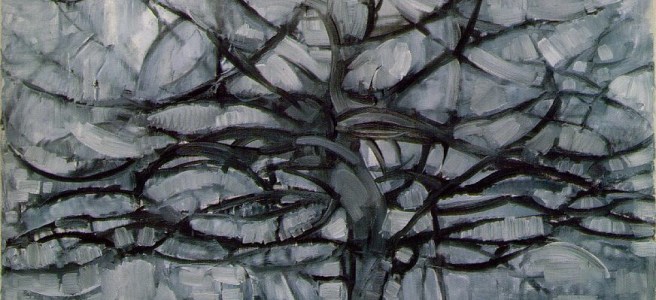
Lastly, let me share a few of my favorite images, ones that have conjured ideas for writing. The header image is “The Grey Tree” by Piet Mondrian. I stared at that image on and off while writing a winter scene. It’s so stark and cold. And I love that you can see the brush strokes. It speaks of darkness, of cold, of death….

Or how about a masterpiece? Van Gogh’s Sunflowers? Monet’s Garden at Giverny? Picasso’s Guernica?


And I’m just dying to write something based on the sculptures by Matteo Pugliese. I won’t hijack an image here but I urge you to check out his work at MatteoPugliese.com. His bronze figures emerge from the walls like human forms escaping imprisonment from life in the second dimension. I’m telling you…

While you’re at it, explore the art and photography blogs here on WordPress. Some of the images are amazing. I follow a couple of bloggers who regularly post some fabulous images for the daily and weekly photo challenges they participate in. Stop and stare at them for a while. Based on what you see, imagine what happens next. Or ask yourself, what just happened here? After all the root word for imagine is image! I hope these suggestions help you find some inspiration. Happy writing my friends!

Fairy Trees and Folk Tales

From 2014, this is the first piece of any length I wrote on my blog.  It’s the story of fairy trees in Ireland.  Little “sister” here it is!

I’m in Ireland this week. My husband is here for work and I tagged along. Now this is actually my third time here in the area of Galway so I’ve come to feel pretty comfortable here. I can even give people directions if it’s to one of the major sights. I’ve heard many a fairy tale in three trips and I heard a story yesterday that I just had to share.

The Irish believe in fairies and fairy trees. A fairy tree is a hawthorn tree, of which there are two varieties: white or flowering hawthorns, and black, which do not flower. To determine if a hawthorn tree is a fairy tree, you must break off a branch and strip away the bark. If there is a pink stripe along the grain of wood, then it is a fairy tree. If it is, beware! Do no harm to the tree! However, legend has it that if you are ill, you can ask the fairy tree to heal your sickness and tie a bit of your clothing to the tree. By the time the cloth has disintegrated on the tree, your illness will have disappeared. (I imagine this would be waste of time for something minor like a cold!)

The story goes like this. The Irish highway department was recently building a new motorway from Dublin to Galway and as they were digging the road bed, they came across a hawthorn tree. Every time the bulldozing machine got near to the tree, the motor would conk out. They brought in the mechanic and he could find nothing wrong. Nevertheless they did some maintenance to the machine, filled it with petrol and oil, changed the battery, and so forth. Once again they started to dig in the area of the tree and once again it conked out. This happened over and over until finally they brought in a whole new machine from a different part of the road project. What do you think happened? Yep, the machine conked out!

The next step was to cut the tree down, so they brought in a man with a chainsaw to cut the tree down but as soon as he put the saw to the tree, the chain broke. The same thing happened with a second saw. Finally, they tried using hand saws to cut down the tree but when the men got close to the tree with their saws, they were thrown back from the tree! So if you’re traveling from Galway back to Dublin, you’ll find a slight right bend in the road. And if you look to the left of the road, you’ll see the fairy tree. That’s right, they moved the whole motorway around the fairy tree! Only in Ireland!

More than words

Yesterday, my friend Whitney who blogs about the huge renovation she and her husband are doing to their house, posted some before and after photos.  She’s been blogging since August and I commented on how much had changed in that time.  She responded by asking me if I knew how many words I’d written in that same period of time.   Whitney and I met right at the beginning of both of our journeys. Honestly, I’ve never thought about it but she made me curious and reflective.

I started this blog very tentatively back in 2014.  I posted a non-fiction piece about a trip to Ireland.  I repeated a story a tour guide had told me about fairy trees.  There’s just something about that place.  It inspires the poet and the dreamer for sure.

IMG_2109
Cliffs of Moher


Next, I wrote and posted three fairy tales set in the far, hazy past.  Then nothing for a while — months, in fact.  But then at the end of June 2015, I published my first novel.  It was time to get serious.  This blog was to be my author platform, my doorway into a community of other creators and poets and dreamers.

Since August 2015, I have written Second Chances (working title), the fourth book in my novel series at 91,853 words and started the fifth, which has a few chapters complete totaling 6,058 words.   I’ve also written a ten part series called Diary of a New Writer which totals 8,118 words.  My ongoing fictional piece Here Lies a Soldier has run up to 7,368 words so far.   My short stories based on songs add up to another 13,451 words.  The Year of Drinking Adventurously has yielded another 4,150 words.  And all the other blog posts, poems, limericks and so forth add up to 27,314 words.  For a grand total of 158,312 words in 7 months time.

Does that seem like a lot?  It isn’t really.  On average it works out to 754 words a day.  For those of you who have participated in NaNoWriMo, you’d need more than twice that many words per day to complete the challenge.  Obviously, I’m not trying to keep to a schedule as rigorous as that, but I am trying to be a consistent and productive writer.  I return once again to the important role that discipline plays in successful writing.  Without going back into exhaustive detail about it, I’ll just say that having a schedule –one that is practical and fits into your life comfortably, is key.  When you figure out that schedule, stick to it.

I love to write, it brings me a lot of joy. But it’s more than words.  I would go so far as to say that it’s been therapeutic.  There are things I can write about in fiction that I’d be reluctant to talk about otherwise.  And this community I’ve found?  Absolutely priceless.  I love you guys!

How about it, writers and bloggers?  Have you ever counted up your words?  And what do you love most about blogging?