
Books, how I love thee.

Writers, if you are not a lover of books, you need to have your heads examined. Seriously, you cannot, CANNOT be a good writer if you do not read. I have always loved books. As an only child, I grew up reading – making fictional friends to take the place of siblings. The first books I clearly remember reading were Richard Scarry’s picture books. Then it was Ramona Quimby and her big sister Beezus. Nancy Drew, Little House on the Prairie, Little Women….

I was a book nerd in high school, too. When other kids goofed off in free periods, I’d go bother the librarian. My high school librarian Mrs. Long, was a big, intimidating lady, but oh, she had great taste in books. She introduced me to Tolkien, Frank Herbert, Jules Verne, Douglas Adams…

And honestly, how can one pick a favorite? I’ve read the complete Sherlock Holmes collection and not just because of the TV series, either. (Although, I could listen to Benedict Cumberbatch reading a deli menu. That voice…) Other favorites include: Robinson Crusoe, The Count of Monte Cristo, Twenty Thousand Leagues Under the Sea. More contemporary favorites are Tom Clancy’s: The Hunt For Red October, John Grisham’s: A Time To Kill, Khaled Hosseini’s: The Kite Runner and Sara Gruen’s: Water For Elephants.

Anthony Trollope asked, “What on earth could be more luxurious than a sofa, a book and a cup of coffee?” I couldn’t agree more. Perhaps I would add to that: a rainy or snowy day and a cozy blanket to wrap around your shoulders. To be forced by the weather to stay inside and curl up with a book? Heaven! And to have one with some heft, too, be it paper or electrons. As far as I’m concerned, a good story can go on forever. Lord of the Rings? Bring it on. Red Mars? But wait, there’s a trilogy.

I read many different genres and enjoy them all: mystery, thriller, romance, science fiction, espionage, historical fiction, biography… It’s been said that you can know a person by the type of books he (or she) reads. What does that say about me? Am I unknowable? Hmm. Perhaps just multi-faceted. Let’s go with that; it sounds so deep and sophisticated! *Snort*

Lately, I’ve been reading lots of history and non-fiction for research purposes. Beyond that, I just completed Graham Greene’s The End Of the Affair.  I am halfway through a biography of WB Yeats. I’m also working my way through the short stories of the Marquis de Sade. So what are you currently reading? Tell me what books you love. And what’s on your to-read list? If you like, join me on Goodreads. Winter is coming, let’s all curl up with a good book.
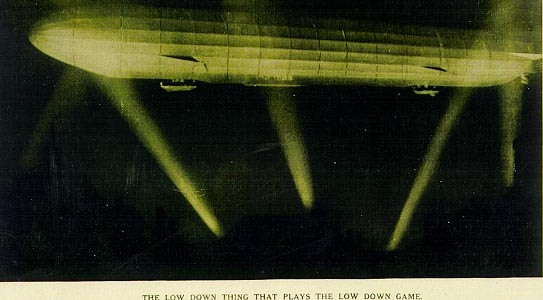
The Dread Zeppelin

World War One saw both the introduction of, or the unprecedented use of a host of new deadly weapons. The submarine, for example, had been first used during the American Civil War. However, the First World War would see it become the great predator of the sea. Chemical weapons like chlorine and phosgene gas were deployed on a mass scale. The armored tank replaced the horse in the armies’ cavalries. And air warfare became a threat for the first time in history, bringing death and destruction to the doorsteps of the civilian population. No one was exempt from the ‘total war.’

German zeppelins were capable of traveling at speeds of 85 miles per hour and carrying up to 2 tons of payload. From the early days of the war, these new weapons of mass destruction were deployed in bombing raids on Liege, Antwerp and Paris. In January of 1915, the massive hydrogen filled war machines brought their deadly cargo to the shores of Great Britain, striking the coastal towns of Great Yarmouth and King’s Lynn.

German Zeppelin corps commander, Peter Strasser was quoted as saying, “Nowadays, there is no such thing as a noncombatant. Modern warfare is total warfare.” The German aim in targeting civilian populations was to frighten the British into leaving the war. They upped their game in May, 1915.

As if it were straight out of an H.G. Wells’ science fiction novel, a massive airship darkened the starlit night over London on May 31, 1915. The 650-foot-long zeppelin, the largest ever constructed to date, glided toward the British capital, using the light reflecting off the Thames River as its guide. From the trap doors beneath the gondola of the craft, German troops dropped 90 incendiary bombs and 30 grenades onto the homes of the sleeping citizens below. The break of dawn brought with it the reports of seven deaths and the injury of thirty-five. But more than that, fear gripped the city.

Early on, the zeppelin was nearly unstoppable. It flew higher than artillery could fire, even higher than the airplanes of the day could fly. The planes couldn’t even get close enough to use their machine guns to bring them down. And not wanting to panic the citizenry with robust air raid warnings, the civil authorities’ only action in the face of imminent attack, was to send policemen with whistles out into the streets on bicycles with the cry of “take cover.”

The worst air attack came on September 8, 1915 when a zeppelin targeted London’s financial center. The three ton bomb –the largest deployed so far– caused heavy damage and killed 22 people, including 6 children. Public outcry was enormous, the zeppelins were now referred to as “baby killers” and the people demanded that their government do more to protect them from the menace in the air.

In response to the uproar, anti-aircraft defenses were recalled from the front lines in France, massive searchlights were installed, blackouts were instituted and the water from the lake in St. James’ park was drained so as not to direct the airships to the gates of Buckingham Palace. Additionally, British scientists were put to work developing ways to target the zeppelins’ vulnerable areas, namely the highly flammable hydrogen cells that made the ships lighter than air.

By mid-1916, the game had finally changed. British planes were able to reach higher altitudes and explosive bullets were employed to rip through the outer fabric of the death ships to ignite the hydrogen cells within. And though the Germans tried to press on with their air raids, sailing the zeppelins at higher altitudes, the crews began to suffer from the frigid temperatures and oxygen deprivation.

When the airships were brought down they were brought down in spectacular fashion. For example on September 2, 1916, the largest fleet of zeppelins ever to target London droned toward the city. One of the silver ships was caught in the searchlights and Royal Flying Corps pilot William Leefe Robinson was sent to deal with it. Robinson took his plane over 11,000 feet and drew close enough to fire his guns with the explosive bullets, ripping open the skin and igniting the hydrogen within. The massive fireball plummeted from the sky and could be seen from over 100 miles away.

With Britain’s now superior technology, the dread zeppelin was no longer the threat it once was. By the end of the war, German airships had staged more than 50 attacks on Britain, but at a heavy price with 77 of their 115 craft either shot down or disabled. And although raids on London killed nearly 700 and seriously injured almost 2,000, Germany’s goal of breaking the will of the British people was not achieved.

Coincidence? I think not!

“But while I advise you to embellish, I forbid you to depart from what is plausible. The reader has every right to feel aggrieved when he realizes that too much is being asked of him. He feels that the author is trying to deceive him, his pride suffers and he simply stops believing the moment he suspects he is being misled.” An Essay On Novels – The Marquis de Sade

Isn’t that great advice? Whether you write by the seat of your pants (pantser) or you meticulously plot out your story (plotter), you eventually will come to a point where you write yourself into a corner or your plot hits a wall. You have a couple options: scrap it and start over from the point you got yourself into that mess, or write yourself out of it. If you choose the latter, the challenge is writing a solution without taking the shortcut of using coincidences to bail yourself out. I read this advice from Emma Coates –one of Pixar’s story artists– years ago, and I never forgot it: “coincidences to get your characters into trouble are great; coincidences to get them out of it is cheating.” Not only that, like the Marquis said, it asks too much of the reader. image

Nevertheless, good storytelling depends on the element of surprise. No one wants to have the ending figured out in chapter three. The writer’s approach may be to:  1) slowly reveal clues that gradually build to a logical conclusion, or 2) misdirect us with spurious information, or 3) obfuscate the story so that at the climax, the truth is dropped like a bomb on the reader. The trick is to reveal the truth -as shocking as it may be- in a way that the reader think to himself, “of course!” because finally it all makes sense. The worst thing in the world is to leave the reader scratching his head at the end, wondering how the hell he got from there to here in 100,000 words, and regretting buying it on Amazon.

Header image via the poisoned pencil, David Tenant image via Pinterest.