Research Notes – The Great War (17) Robert Graves, War Poet

In the course of researching for my historical novel (in progress) I began reading about the War Poets: men whose experiences in the Great War gave rise to some of the most moving and heart wrenching poetry ever written. Unlike historical accounts with facts and statistics, the poetry brought to life (and death) the true suffering the men experienced during this dreadful conflict.

Robert Graves was a close friend of Siegfried Sassoon and like Sassoon used his experiences in the war as material for his poetry. He was badly wounded at The Battle of the Somme in 1917 and in addition, suffered the accompanying nightmare of shell shock. Nevertheless, unlike his friend Sassoon, he was never hospitalized for the condition. The story of his journey home, however, includes an odd series of coincidences both good and bad, that make for quite the interesting tale.

After the war, Robert Graves awaited demobilization while on leave in Ireland. For many men, the epidemic flu was hindering the process of returning them to their families. In February 1919, Graves finally received a telegram from the War Office confirming that his papers had come through. In order for the paperwork to be completed, however, Graves needed to return to the demobilization camp near his parents’ home in South London. Unfortunately for him, the release of troops from Ireland was about to be suspended due to the ‘Troubles’.

To make matters worse, he began to experience the intial symptoms of the deadly flu. Fearing for his health, should he be quarantined in an Irish hospital, Graves decided to make a run for it. He convinced an orderly sergeant to make out his travel papers and hopped on the next train from Limerick, even though he didn’t have the proper demobilization code marks. According to his memoir, Goodbye to All That, he said, “…I would at least have my flu out in an English and not an Irish hospital.”

On the night of February 13, 1919, he boarded the ferry to Fishguard with a high fever. He reports still having his mental faculties in good form, however. So upon discovering that a strike on the London Electric Railway was imminent, Graves immediately boarded a train from Wales to Paddington, in hopes of outrunning the inevitable disruptions. He made it safely and was able to catch the connecting trains and arrive at his home in Hove before travel was suspended.  Another happy accident was that he found himself sharing a taxi with a soldier who just happened to be the Cork District Demobilization Officer and was willing to provide him with the final code marks he needed to complete his paperwork.

The bad news: upon arriving at his home, he was so ill that he immediately took to his bed. And though Graves himself recovered, within two days of his return home, everyone in his household was dead except for his father-in-law and a servant.

Here is one of his poems:

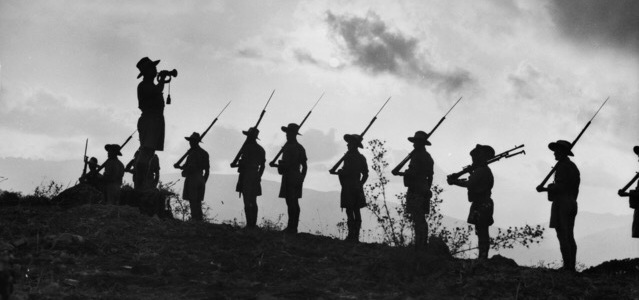
The Last Post (June 1916)

The bugler sent a call of high romance–
‘Lights out! Lights out!’ To the deserted square:
On the thin brazen notes he threw a prayer,
‘God, if this is for me in time in France…
O spare the phantom bugle as I lie
Dead in gas and smoke and roar of guns,
Dead in a row with other broken ones,
Lying so stiff and still under sky,
Jolly young Fusiliers, too good to die.’
The music ceased, and the red sunset flare
Was blood about his head as he stood there.

Image courtesy Australian War Memorial 

Inhuman (4)

Find the rest of the story here: parts one, two and three.

(4)

Amanda laughed, realizing she sounded a little hysterical. This was ridiculous, something straight out of science fiction. She took a deep breath and hoped she sounded reasonable. “But he had parents, family, a childhood… I’ve seen photos…”

“But you never met anyone from his past, did you?”

“No, he’s an only child and his parents died just a few years ago. Before Brian and I met.”

“And what about your wedding? Any old friends on Brian’s side? Extended family?”

“N-no… he’s not close to his family and he grew up clear across the country, so… no none of his old friends were at the wedding.”

Lydia nodded. “There are no old friends or extended family. SAIW-02 was created in a laboratory a little over five years ago.”

“I don’t believe you.”

“Amanda, we realize how inconceivable this sounds. Maybe you’d like to see for yourself,” suggested Alexander, rising from his seat. “Let us take you to Brian.”

He held out a hand to help Amanda up from the sofa and tucked it in the crook of his arm as he led her from the room. Lydia and Nathan followed a few paces behind. They followed the long hall to the elevators at the far end. When the four of them had entered and the doors closed behind them, Nathan used another retina scanner to direct it to a floor only accessible via this security. As the elevator descended, Amanda tried to recall anything, any tiny detail that she might have overlooked. Was the lack of family and friends enough to cast suspicion on his background? He had a college degree, friends from university, work friends. He excelled at his job —maybe that was no surprise— but he had made friends, he’d fallen in love with her, he had told her he wanted to have children eventually. Were those the actions of a machine? And his memories… He believed he had parents and a childhood, old friends and a family home. The truth hit Amanda like a ton of bricks. Brian didn’t know.

“Why? Why would he not know? Why would he think he was human if he’s not?” Amanda asked. “If he knew he was an ‘android super soldier’ (she air quoted) why would he have ever agreed to go to the doctor? He would have known what they would find. If what you’re telling me is true, how does Brian not know?”

“One thing at a time, Amanda,” Lydia said calmly. “I promise, we’ll tell you everything we can.”

Everything we can. Not everything, then… Amanda thought.

The elevator stopped at Subfloor Three and after a pause, the doors slid open onto another hallway identical to the one they’d left above but for one exception. There were no doors interrupting the walls on either side, just an unbroken corridor that terminated in a similar set of secure doors at the end. Alexander, still holding Amanda’s arm against him, led the way. The ubiquitous retina scanner admitted them into a glass foyer.

At first, Amanda was overwhelmed by the space. The vast laboratory seemed to take up the entire floor. All the surfaces were gleaming white and the handful of workers within were dressed as surgeons would be —white gowned, capped, masked and gloved. Alexander plucked a white jump suit from a hook on the wall and handed it to her. “It’s a clean room. We keep the dust and debris to an absolute minimum. Preserves the sensitive instruments.”

No one spoke as they suited up. When Amanda had slipped into the suit, Lydia passed her a pair of elastic booties to fit over her shoes and a cap and mask for her hair and face. Finally they each donned a pair of surgical gloves from a dispenser on the wall. After everyone was appropriately attired, Alexander opened the inner door. The dominant sound was a low hum —machine noise— with no distinct source.

Alexander led them to an area behind another wall of glass. Behind it were four bays with computer interface hardware mounted to delicate scaffolding where —in two of them— a human form was resting. Amanda’s eyes were drawn to Bay 2 where her husband lay semi-supine with a thick cable threading into his nostrils. Without Alexander’s arm supporting her she might have collapsed. “He’s been deactivated, Amanda. We’re purging the current programming and restoring him to default mode.”

She shook her head to clear it. “I still… I don’t… how…?”

“These androids were in beta testing.” Alexander gestured to the bays. For the first time Amanda noticed the second android in the bay next to Brian. Another male, this one with African American features. “They hadn’t even been introduced to the armed forces.”

Nathan cleared his throat. “They were programmed with basic human functions, only interacting within the confines of the laboratory and with the workers employed here. But their programming is intuitive, they are capable of learning and adapting.”

“Rather quickly, it seems,” Lydia interjected. “They developed some unintended and unexpected characteristics.”

“Quite right. They developed ‘feelings’,” Alexander said with obvious distaste. “Emotions, concern and sympathy, conscience, accountability, and em… guilt. Not particularly the sort of thing one wants in a weapon…”

Amanda flinched and Lydia shot Alexander a warning look. He mumbled an insincere apology as Nathan continued. “Remember, this is an experiment, Amanda. The actual deployment of the SAIW units may be years away.”

She pulled her arm from Alexander’s grasp and wandered over to the glass wall to stare at the being she had believed was her husband. “You haven’t answered my question. Why did Brian believe he was human? And how on earth did he find himself living a normal human life? With me?”

Nathan stepped forward to stand beside her. He watched as a single tear trailed down her cheek. “I’m sorry Amanda. This never should have happened.” He sighed heavily. “But some of the issues we wrestle with go beyond mere science. They’re better addressed in the realms of ethics and philosophy. What is life? What does it mean to be alive? If it is alive, does it have rights?” He glanced at her. “Those are the fundamental questions. The answer to which our lead scientist decided for himself.”

“What do you mean?” she asked.

He gestured to the area behind the glass wall. “Brian’s creator decided to set him —and the rest of them— free.”

To be continued…

The Great War – Research Notes (16) The Art Of War

When war broke out in August 1914, no one on either side of the conflict believed that it would rage on for over four bloody, devastating years. Many in fact, welcomed the war, believing it to be an opportunity for adventure —glorious and brief. The famous declaration that the whole thing would be finished ‘before the leaves fell from the trees’ or at the latest ‘by Christmas’ contributed to the romantic notion of going off to war. These fantasies were soon shattered by the gruesome reality of modern warfare.

The responses to the war evolved as time passed; from initial enthusiasm, nationalistic fervor and patriotism to shock, horror, anguish and remorse. These various and sometimes contradictory emotions are reflected in the art of the time. Photography and film news reels brought the carnage to life, so that even those at home got a taste of the true nature of war. Many artists and writers saw the war from the front lines and composed poetry, authored literature and created works of visual art reflective of those dreadful experiences. The following are samples of some of the works of art produced during and following The Great War:

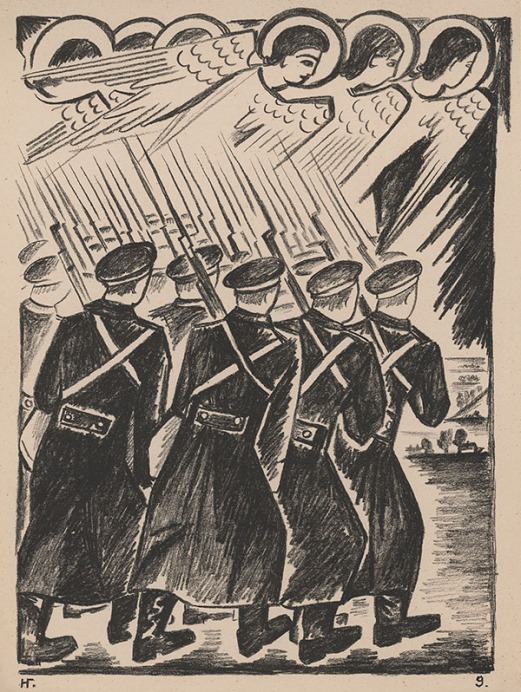
I.  At the outset, many believed that the war would bring an end to the old social and political systems and usher in a new order of equality and progress. This optimism can be seen in the following lithograph from a collection called, Mystical Images of War. The artist, Natalia Goncharova, a Russian living in Paris at the outbreak of war, depicts the angelic host watching over the soldiers as they march away.

The Christian Host ~ Natalia Goncharova, 1914

goncharova.jpg

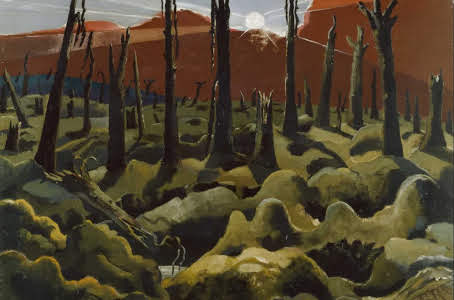
II.  Paul Nash is one of my favorite artists and he’s been featured here previously. The painting Ypres Salient At Night heads my poem: Tales Of War. Despite the optimistic title, Paul Nash’s painting depicts a scarred landscape with shell-holes, mounds of earth, and leafless trees –the resulting devastation of World War One.

We Are Making a New World ~ Paul Nash; 1918

Unknown

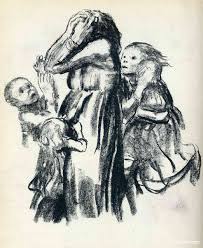
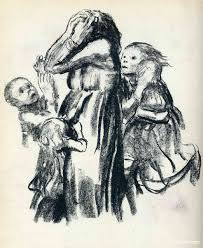
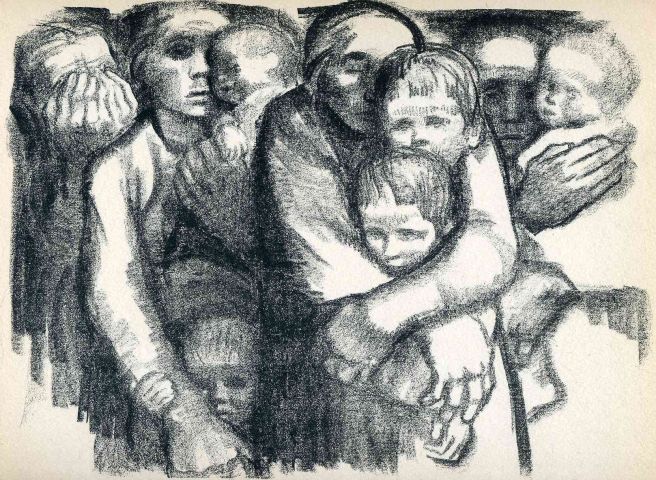
III.  Kathe Kollwitz used her art to portray the grief of loss from war. The following two pieces show the heartbreaking agony and hardship experienced by those left behind.

Killed In Action (Gefallen) ~ Kathe Kollwitz, 1920

Unknown-1

Mothers in different stages of life, held together by one common bond: the need to protect their children.

Mothers (Mütter) ~ Kathe Kollwitz, 1919

81cfd894f50c6a43b91ab3e4ffa5efc6.jpg

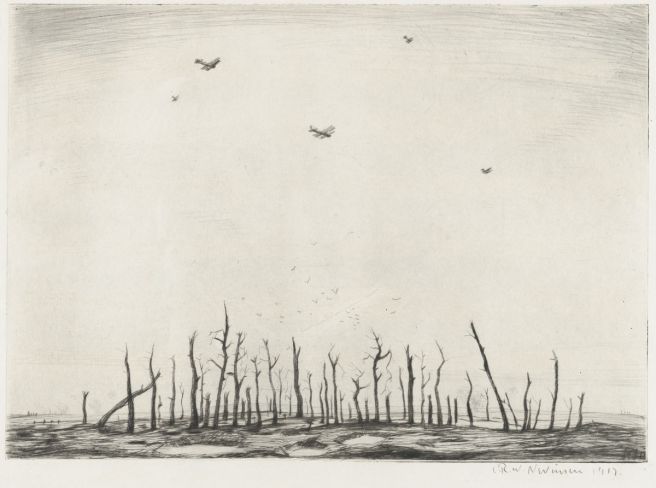
IV.  Christopher Richard Wynn Nevinson revisits the desolation of No Man’s Land with insect-like planes buzzing overhead in That Cursed Wood, a title taken from a line in Siegfried Sassoon’s poem, At Carnoy: “Tomorrow we must go / To take some cursed wood… Oh world God made!”

That Cursed Wood ~ Christopher Richard Wynn Nevinson, 1917

main-image.jpeg

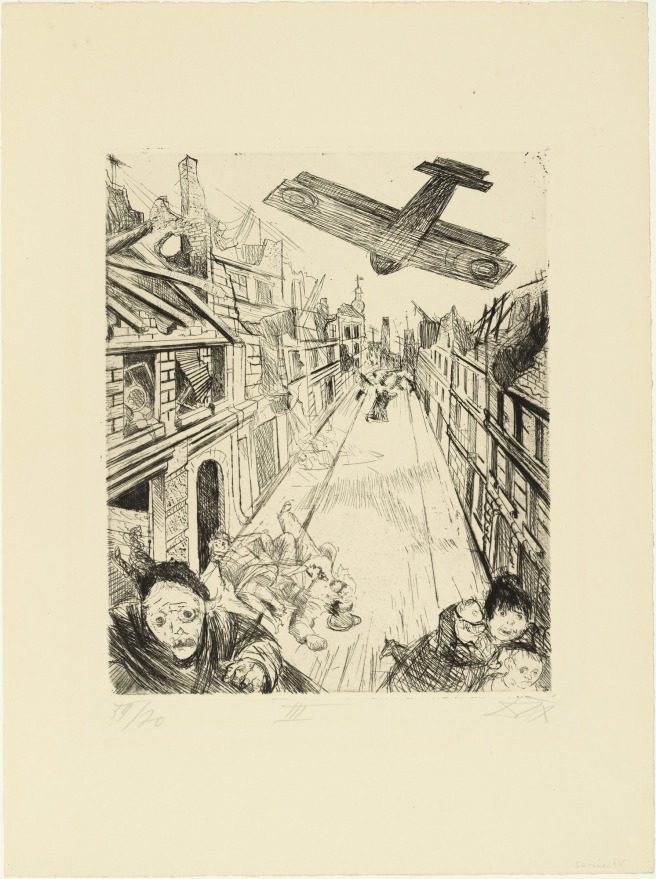
V.  I’ve featured Otto Dix twice before in my Great War posts. Shock Troops Advance Under Gas was the image for a post on chemical weapons and I used The Wounded Man to head my post about the disfiguring injuries to soldiers. You can click on the links to view those pieces. Otto Dix served for four years as a machine gun operator in the German army on the front lines in Belgium and France. He was grievously injured and suffered terrible nightmares about his experience. After the Armistice, during the height of these nightmares, he produced a series of drawings and etchings called The War (Der Krieg). Here is one more from that collection. In sharp contrast to the nationalist propaganda featuring war heroes like Baron Manfred von Richthofen (The Red Baron), Lens Being Bombed shows the terror and desperation of the citizens of the town in Northern France as they run for their lives.

Lens Being Bombed (Lens wird mit Bomben Belegt) ~Otto Dix, 1923-1924

cri_000000116429.jpg

There are many, many more significant artists and artwork to consider, so this will be one of several posts on the subject.